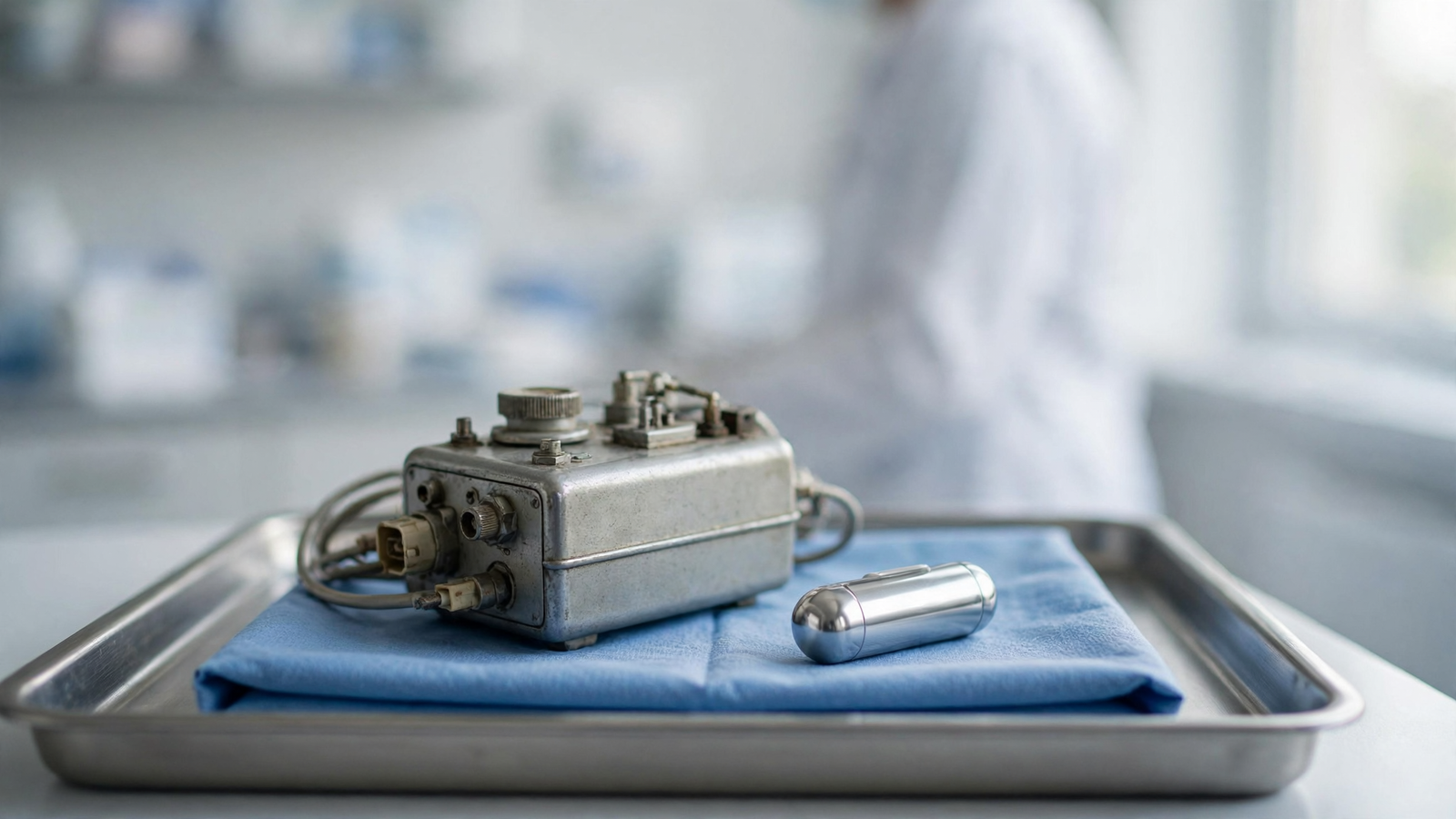
Inside the human heart is a small electrical system with an enormous responsibility. It generates and distributes the signals that tell the heart muscle when to contract. When those signals become too slow or unreliable, the result can be fatigue, dizziness, fainting, or a dangerous loss of blood flow.
The pacemaker was created to answer that very specific problem: not by replacing the heart, but by helping it keep time.
Today, pacemakers are among the most familiar implantable medical devices. They can detect a heartbeat that is too slow, deliver a precisely timed electrical impulse, and then remain quiet when the heart is working normally. Some newer models are small enough to sit entirely inside the heart, without the wires traditionally associated with the device.
That progress grew from an unlikely combination of cardiac medicine, radio engineering, wartime electronics, and one inventor’s mistake.
The heart’s hidden clock
A healthy heartbeat begins with an electrical signal produced by a group of specialized cells in the heart’s upper right chamber. The signal spreads across the atria and then passes through a control point before reaching the ventricles, the chambers that pump blood to the lungs and the rest of the body.
This built-in timing system is often called the heart’s natural pacemaker. If it malfunctions, the heart may beat too slowly. The condition can occur because of age-related changes, heart disease, certain medications, congenital problems, or damage to the heart’s electrical pathways.
Before implantable pacemakers became practical, doctors had limited ways to manage severe slow heart rhythms. External machines could send electrical pulses through wires or skin, but they were bulky and could be uncomfortable. They also tied a patient to equipment rather than allowing ordinary movement. For related reading, see ENIAC: How a Room-Sized Machine Started the Computer Age.
The engineering challenge was daunting. A useful implantable device needed to be small, dependable, electrically safe, and capable of operating inside the body for long periods. Its power source had to last. Its timing had to be accurate. And the current delivered to the heart had to be carefully controlled.
An accidental rhythm
American engineer Wilson Greatbatch became central to solving that problem. In the 1950s, he was working on equipment intended to record the electrical activity of the heart. According to the National Inventors Hall of Fame, he mistakenly installed the wrong electronic component while building a circuit.
Instead of producing a continuous recording signal, the circuit emitted regular electrical pulses. Greatbatch recognized that the rhythm resembled the timing of a heartbeat. The mistake suggested a new possibility: a small device might be able to stand in for a failing natural pacemaker by delivering timed impulses to the heart.
The idea still required medical collaboration. Greatbatch worked with physicians William Chardack and Andrew Gage in Buffalo, New York. Their work led to an implantable pacemaker design that could stimulate the heart from inside the body.
Early versions were not yet the compact devices familiar today. They were relatively large, and their batteries did not last indefinitely. But they demonstrated that electronics could be placed inside the body and used to support a vital biological rhythm.
In 1958, Swedish physician Åke Senning implanted an early fully internal pacemaker designed by engineer Rune Elmqvist. The patient, Arne Larsson, went on to receive many replacement devices over the course of his life. The episode showed both the promise of the technology and an important reality of early pacemakers: the device could save a life, but its power supply and hardware would need continual improvement.
From experiment to medical device
The first pacemakers were products of a rapidly changing electronics industry. Transistors made circuits smaller and more efficient than earlier vacuum-tube systems. Improvements in batteries, sealing materials, surgical techniques, and biocompatible metals made implantation more practical.
Medical-device companies began developing commercial systems, while physicians learned how to place the generator and guide the electrical leads. In the traditional design, the pulse generator sits beneath the skin, often in the upper chest. One or more thin leads travel through a vein to the heart, where they sense cardiac activity and deliver stimulation when needed.
The device does not usually force the heart to beat at every moment. Instead, it monitors the heart and responds when the rhythm falls below a programmed threshold or when the timing between chambers becomes abnormal. That “on demand” approach conserves energy and allows the patient’s own heart activity to continue whenever possible. For related reading, see Apollo 8: How Three Astronauts Changed Humanity’s View of Earth.
Over time, pacemakers became programmable. Clinicians could adjust settings without replacing the entire device, using an external programmer placed near the patient’s chest. Different models could coordinate the timing of the upper and lower chambers, support people with particular conduction problems, or adapt the pacing rate to activity.
The result was a shift in what an implantable device meant. It was no longer simply a machine that supplied a substitute pulse. It became a responsive medical system that sensed, calculated, and acted within the body.
A technology built around restraint
The most elegant feature of a pacemaker may be what it does not do. It does not replace the heart’s muscle. It does not pump blood by itself. It does not need to intervene when the natural rhythm is functioning normally.
That restraint is essential. A pacemaker’s job is to supply a signal at the right moment and at the lowest effective energy. The electronics must distinguish between a heartbeat that has occurred and one that has not. The leads must remain in position. The casing must protect the circuitry from body fluids, while the device’s electrical output remains safe for surrounding tissue.
Modern systems also have to fit into a patient’s broader life. The U.S. Food and Drug Administration notes that pacemakers are regulated medical devices and that patients must consider issues such as electromagnetic interference, medical procedures, device checks, and battery replacement. Many contemporary devices are designed to be compatible with certain magnetic-resonance imaging conditions, although compatibility depends on the specific system and clinical requirements.
Remote monitoring has added another layer of care. Depending on the device and the patient’s care plan, information about battery status, lead performance, and recorded heart rhythms may be transmitted to a clinic. That can help clinicians identify changes between in-person appointments.
The leadless generation
The traditional pacemaker remains useful, but its leads can create challenges. They pass through blood vessels and must remain securely connected to the generator. For some patients, a different approach is possible. For related reading, see Penicillin: How a Moldy Dish Changed the Course of Medicine.
Leadless pacemakers place the pulse generator directly inside the heart, typically in the right ventricle. These small devices are delivered through a catheter rather than through an incision used to create a pocket beneath the skin. Because they have no traditional chest generator or connecting lead, they may reduce some complications associated with those components.
Leadless systems are not suitable for everyone. Their use depends on a patient’s rhythm, anatomy, medical history, and the capabilities of the specific device. Some patients need pacing in more than one chamber or require functions that a particular leadless model cannot provide.
That limitation illustrates a broader truth about medical technology: progress rarely produces one universal replacement. Instead, it expands the set of tools doctors can match to individual needs.
A quiet partnership with the body
The pacemaker’s story is often told as an invention story, beginning with a circuit that produced the wrong signal. But its lasting importance comes from the partnership that followed. Engineers had to understand the timing of the heart. Physicians had to work with electronics they had never used in the operating room. Manufacturers had to make delicate circuits survive inside a moving, chemically active body.
The device succeeded because each field gave up part of its old boundary. Cardiology became more attentive to electronic sensing. Engineering became more concerned with tissue, surgery, infection, and long-term care. Patients became the center of a design process that had to account for ordinary life, not just a successful implantation.
Millions of people have since received pacemakers or other cardiac rhythm devices. For many, the technology becomes almost invisible: a small implant checked periodically, a battery replaced when necessary, and a quiet safety net beneath the body’s own electrical rhythm.
That may be the pacemaker’s most remarkable achievement. It transformed a pulse of electricity into a form of care that is precise enough to intervene, disciplined enough to wait, and small enough to live with.
Use: Device function, regulation, safety considerations, and modern pacemaker technology.
Use: The heart’s electrical system, reasons pacemakers are used, implantation, monitoring, and patient care.
Use: Greatbatch’s work on the implantable pacemaker and the accidental pulsing circuit that inspired it.
Use: Background on pacemaker components, pacing systems, and the development of cardiac rhythm treatment.