Before a computer sat on nearly every desk, one occupied an entire room.
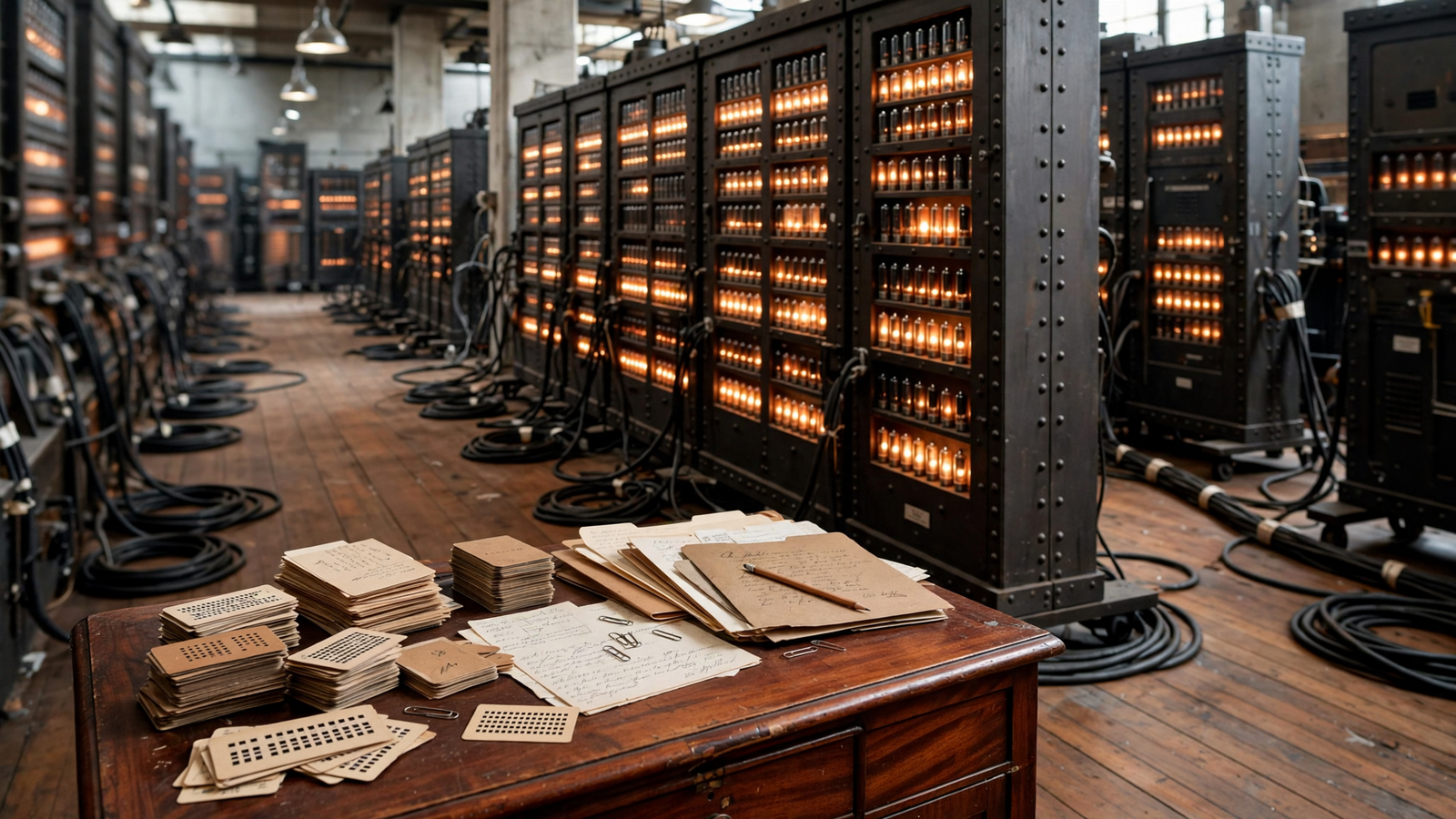
ENIAC—the Electronic Numerical Integrator and Computer—was a machine of glowing vacuum tubes, dense wiring and constant maintenance. It weighed roughly 30 tons, covered about 1,800 square feet and consumed enough electricity to make its scale impossible to ignore. Yet its most important feature was not its size. ENIAC demonstrated that electronic calculation could be made dramatically faster than the mechanical and electromechanical machines that came before it.
That idea helped establish the modern computer as a practical technology rather than a theoretical possibility.
A wartime problem with an enormous answer
ENIAC was developed during World War II at the University of Pennsylvania’s Moore School of Electrical Engineering. The project was funded by the U.S. Army, which needed large numbers of artillery firing tables. These tables helped gunners determine the angle and timing required to hit targets under different conditions, including distance, weather and the type of ammunition being used.
Creating the tables was slow. Human “computers”—many of them women employed for their mathematical skills—performed calculations by hand with mechanical calculators. The work was essential, but it could take weeks or months to complete a single set of calculations.
Physicist John Mauchly and electrical engineer J. Presper Eckert proposed a radically faster approach: build a general-purpose electronic machine that performed calculations using thousands of vacuum tubes. The Army approved the project in 1943. Construction began under Eckert’s direction, with a team that included engineers, technicians and mathematicians.
The machine was not built from a neat, finished blueprint. Its designers had to solve basic problems as they went, including how to make thousands of fragile tubes operate reliably. Earlier engineers had often assumed that vacuum tubes were too failure-prone for a machine containing so many of them. ENIAC’s designers developed circuits and operating practices that made the system workable. For related reading, see The Manchester Baby: The Small Machine That Started the Modern Computer Age.
What made ENIAC different
Earlier calculating machines could be fast at particular tasks, but they were usually limited by their mechanical parts or by the narrow instructions built into their design. ENIAC used electronic circuits to represent and manipulate numbers. That eliminated the need to move physical components for every calculation.
At its public unveiling in February 1946, the machine could perform thousands of additions per second—an astonishing improvement over hand calculation. It could also handle multiplication, division and more complex numerical operations. The exact speed depended on the task, but the larger point was clear: electronic calculation could operate at a new scale.
ENIAC was a decimal machine rather than a binary one. It stored numbers using groups of ten-position electronic ring counters, reflecting the way people commonly wrote numbers. The system contained more than 17,000 vacuum tubes, along with thousands of resistors, capacitors and other components.
Its programming method, however, was far removed from typing instructions into a keyboard. Operators configured the machine through plugboards, cables, switches and function tables. Changing from one problem to another could require physically rewiring sections of the computer.
The programmers whose work was overlooked
Much of ENIAC’s public story has focused on its male designers, but the machine also depended on a group of women who learned how to make it perform useful work. Kay McNulty, Betty Jennings, Betty Snyder, Marlyn Wescoff, Fran Bilas and Ruth Lichterman were among the programmers who developed operating methods for the machine.
They did more than enter data. Because ENIAC had no modern programming language or familiar software interface, the programmers had to understand its logic, trace its circuits and determine how to arrange its operations. They created flow charts, connected cables and used switches to direct calculations. For related reading, see The Spreadsheet: How VisiCalc Turned the Personal Computer Into a Workplace.
Their work helped turn a mass of hardware into a flexible calculating system. At the time, the job was often classified as clerical or mathematical rather than recognized as a distinct form of engineering. Later accounts of computing helped restore the programmers’ contribution to the history of the machine.
From artillery tables to scientific research
ENIAC was completed in 1945 and formally introduced to the public the following year. By then, the war had ended, but the computer still had important work to do.
Researchers used ENIAC for military and scientific calculations, including work related to weapons research and numerical weather prediction. Its ability to repeat complicated operations quickly made it useful for problems that would have overwhelmed teams of human calculators.
At the same time, ENIAC exposed the limitations of its own design. Reprogramming was laborious. The machine took up enormous space and generated substantial heat. Vacuum tubes could fail, requiring technicians to locate and replace faulty components. It was powerful, but not convenient.
Those drawbacks encouraged its designers and other researchers to think about the next step: a computer that could store instructions in memory rather than requiring operators to reconfigure its wiring for every new problem.
The idea that outlived the machine
ENIAC was not the only early electronic computer, and it was not a direct template for every machine that followed. But it helped prove several ideas that became central to computing. For related reading, see The Computer Mouse: How a Wooden Pointing Device Made Computers Human.
- Electronic calculation could be practical. Vacuum tubes could be assembled into a functioning high-speed system, despite the engineering challenges.
- One machine could handle many kinds of problems. ENIAC was not limited to a single calculation or a single set of tables.
- Programming was a discipline of its own. Directing a computer required planning, logic and an understanding of how hardware carried out instructions.
- Speed changed the questions researchers could ask. Calculations that once took too long to attempt became possible to explore.
Designers of later computers, including the stored-program systems that followed, learned from ENIAC’s strengths and weaknesses. The transition from plugboard programming to stored instructions made computers far easier to adapt. Improvements in memory, components and manufacturing then allowed computers to shrink from rooms to cabinets, desktops and eventually phones.
A machine that made the future visible
ENIAC was retired in 1955, less than a decade after its public debut. By then, newer computers were already offering more efficient designs. Its physical life was relatively short, but its influence was lasting.
The machine changed the public imagination as much as it changed calculation. A computer was no longer merely an abstract proposal or a mechanical curiosity. It could be a working electronic system, built for real problems and capable of calculations at a speed no human team could match.
Today’s computers are measured in processors, memory and software rather than rooms full of tubes. Yet the basic promise that animated ENIAC remains familiar: when information can be represented electronically and instructions can be repeated rapidly, difficult work can become tractable.
That is ENIAC’s enduring lesson. It did not look like the future. It looked like a laboratory had been expanded until it filled a building. But inside that crowded machine was a new idea about what calculation could become—and about how profoundly a machine for numbers could change everyday life.
Use: Used to verify ENIAC’s development at the Moore School, its wartime purpose, physical scale and technical significance.
Use: Used for historical background on the project, its designers, programming method and public introduction.
Use: Used to cross-check technical history, machine capabilities and the transition toward later stored-program computers.
Use: Used as a secondary institutional reference for ENIAC’s place in early electronic computing and its historical legacy.
University of Pennsylvania School of Engineering and Applied Science — ENIAC history — https://www.seas.upenn.edu/about/history-heritage/eniac/ — Used to verify ENIAC’s development at the Moore School, its wartime purpose, physical scale and technical significance.
University of Pennsylvania Archives — ENIAC — https://www.archives.upenn.edu/histy/features/eniac/eniac.html — Used for historical background on the project, its designers, programming method and public introduction.
IEEE Engineering and Technology History Wiki — ENIAC — https://ethw.org/ENIAC — Used to cross-check technical history, machine capabilities and the transition toward later stored-program computers.
Computer History Museum — The Birth of the Computer — https://www.computerhistory.org/revolution/birth-of-the-computer/4/78 — Used as a secondary institutional reference for ENIAC’s place in early electronic computing and its historical legacy.