It is easy to overlook the barcode because it is everywhere: printed on a cereal box, tucked beneath a bottle of shampoo, wrapped around a book, or stamped onto a package moving through a warehouse. Most of the time, it is only a small rectangle of black lines and white space.
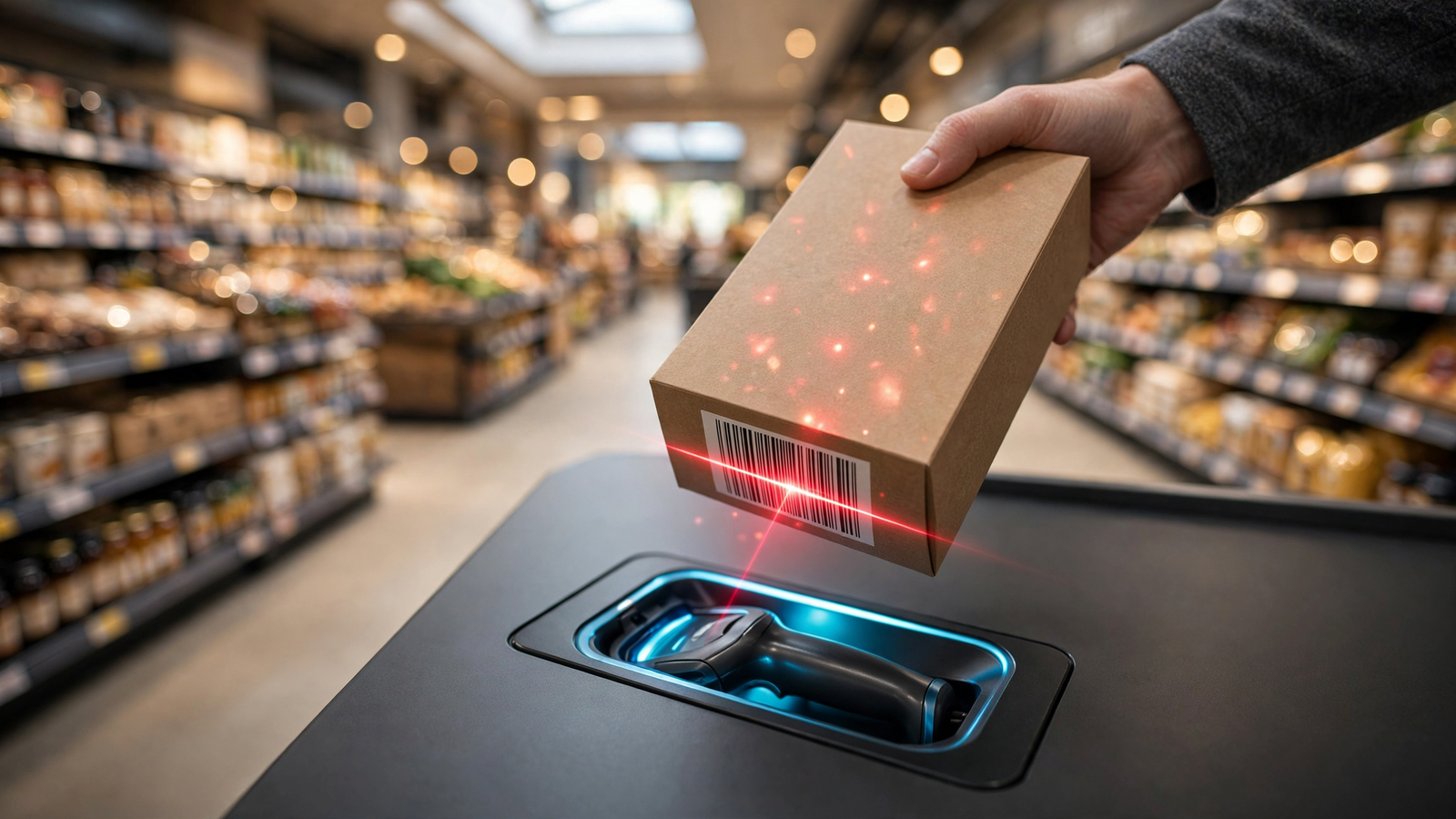
But the barcode is more than a label. It is a compact language that lets physical objects introduce themselves to machines. At a checkout counter, a scanner reads a pattern of reflected light, converts it into numbers, and uses those numbers to retrieve information from a database. A product’s name, price, inventory status, and sometimes its route through a supply chain can appear almost instantly.
The system did not begin with a grand plan to automate the whole store. It grew from a practical question asked in the years after World War II: could grocery shopping be made faster and more organized?
A grocery problem becomes an engineering problem
In 1948, Bernard Silver, a graduate student at Drexel Institute of Technology, heard a grocery executive ask whether a machine could automatically capture product information at checkout. Silver discussed the problem with Norman Joseph Woodland, a former Drexel student who was working as a teacher and researcher.
Woodland became interested in the possibility of representing information with a visual pattern that a machine could read. According to the patent they later received, he explored an approach influenced by Morse code. Instead of using dots and dashes horizontally, he imagined extending the marks into lines that could be read across a package.
The pair filed a patent application in 1949. U.S. Patent No. 2,612,994, granted in 1952, described a “classifying apparatus and method” using printed patterns and an optical reading system. Their original design was not the familiar set of vertical stripes seen today. It resembled a target, with concentric circles that could be scanned from different directions.
The concept was ahead of the available technology. A useful barcode required more than an ingenious drawing. It needed a dependable light source, a sensor, electronics capable of interpreting the signal, and computers able to connect the result to a product record. In the 1950s, those pieces were expensive and difficult to make practical in a busy supermarket. For related reading, see Piggly Wiggly: How Self-Service Grocery Shopping Changed Everyday Life.
Why the lines need a database
A common misconception is that the stripes themselves contain a product’s price. They do not. A typical retail barcode encodes an identification number. When the scanner reads that number, the store’s computer looks it up in a database containing the product description and current price.
That separation is one reason the system became so useful. A retailer can change a price in its database without redesigning and reprinting every package on the shelf. The same product number can also support inventory management, ordering, sales analysis, and recall procedures.
The barcode therefore works as part of a larger arrangement: a printed symbol, a scanner, software, a database, and agreed rules about how numbers are assigned. No single component explains its success. The achievement was making all of them work together reliably enough for ordinary commerce.
From competing ideas to a common standard
By the early 1970s, the grocery industry was looking for a standard that could be adopted across manufacturers and retailers. A code that worked in one supermarket but not another would not solve the larger problem. Companies needed a shared system for identifying products regardless of where they were sold.
The industry committee selected a linear symbol known as the Universal Product Code, or UPC. IBM engineer George Laurer played a central role in developing the version that became the retail standard in the United States. The design used groups of bars and spaces, along with a number printed below the symbol so that a person could enter it if the scanner failed.
The familiar UPC-A symbol normally carries 12 digits. Those digits identify the numbering system, the manufacturer, the individual item, and a final check digit used to detect certain reading or entry errors. The precise organization of product numbers has evolved, but the underlying principle remains: create a stable identifier that machines and people can both use.
Standardization also required agreement about the symbol’s physical design. The bars had to be printed with sufficient contrast. The blank area around the code, called the quiet zone, had to remain clear. Packaging designers had to avoid placing the symbol across seams, curves, or reflective surfaces that could confuse the scanner.
The first beep
On June 26, 1974, a pack of Wrigley’s Juicy Fruit chewing gum became the first retail product scanned with a UPC at Marsh Supermarket in Troy, Ohio. The event was modest by historical standards. There was no rocket launch or dramatic public ceremony. A shopper placed a package on a counter, and a machine read the printed code. For related reading, see The Pacemaker: How a Pocket-Sized Pulse Keeper Changed Modern Medicine.
Yet the beep represented a major change in the relationship between products and information. For the first time, an ordinary item could carry a standardized machine-readable identity from the factory to the store. The checkout process no longer depended entirely on a cashier finding and typing a price.
Adoption was gradual. Retailers had to buy scanners and computers, train workers, label products, and alter checkout procedures. Manufacturers had to print compliant symbols. Consumers had to become comfortable with a new sound and a new rhythm at the register.
The benefits accumulated as more businesses used the same standard. A barcode system becomes more valuable when it connects many participants. Manufacturers can identify goods consistently. Distributors can track cases and pallets. Retailers can see what has sold and what remains. Customers may experience the result simply as a shorter transaction, but the underlying network is much larger.
More than faster checkout
Barcodes changed retail partly by reducing repetitive data entry. A cashier no longer had to type every product number, which could lower keying errors and make it easier to process a steady stream of purchases. Stores could also use sales information to improve ordering and manage shelf space.
The same basic idea spread beyond supermarkets. Libraries use machine-readable labels to identify books and borrowers’ transactions. Hospitals use barcodes to match medicines, specimens, and patients’ records. Manufacturers mark parts and products so that workers and automated systems can follow them through production.
In shipping and logistics, barcodes help connect a package to an order, a destination, and a series of handling events. In a warehouse, the code can tell a worker—or an automated system—which item has been picked and where it belongs next. The label is small, but it can participate in a chain of records stretching across companies and continents.
That expansion has also exposed the limits of the original retail code. A UPC generally identifies a product type, not every individual object of that type. Two identical bottles may carry the same number even if they were manufactured at different times. When businesses need more information—such as a batch number, expiration date, or serial number—they may use other barcode formats, including two-dimensional codes. For related reading, see KDKA: How One Pittsburgh Broadcast Helped Turn Radio Into Everyday Life.
The barcode becomes a square
Two-dimensional codes such as QR codes can hold more information in a compact area than a traditional one-dimensional retail barcode. They can direct a phone to a website, identify a shipment, or carry structured data. Their rise reflects the same broad idea that motivated Woodland and Silver: information attached to an object becomes more useful when machines can read it quickly.
Modern supply chains may combine several identification systems rather than rely on one universal symbol. A product can have a retail identifier, a case code, a pallet label, and an internal warehouse record. Radio-frequency identification and other technologies can add capabilities that ordinary optical scanning does not provide.
Still, the original barcode remains remarkably durable. It is cheap to print, easy to duplicate, readable with simple equipment, and supported by decades of shared standards. Its power comes partly from its restraint. It does not try to store an entire product description in a few lines. It provides a key that lets many systems find the information they need.
An invisible infrastructure in plain sight
The barcode’s history is a reminder that important technologies do not always arrive as dramatic machines. Sometimes they are standards that make unrelated systems agree. Sometimes they are small marks that become meaningful only when connected to databases, scanners, workers, and institutions.
Every beep at a checkout counter is the visible edge of that infrastructure. Behind it is a chain of decisions about identification, printing, software, inventory, and trust. The barcode made products legible to machines without making them difficult for people to handle.
That may be its most lasting achievement. It translated the messy physical world of shelves, boxes, and shipments into a shared digital vocabulary—one ordinary label at a time.
Use: Primary source for the 1952 patent granted to Norman Joseph Woodland and Bernard Silver.
Use: Background on the development and adoption of the Universal Product Code and global barcode standards.
Use: Explanation of how product identifiers and barcode standards function in retail and supply chains.
Use: Technical context on barcode reading and machine-readable identification.