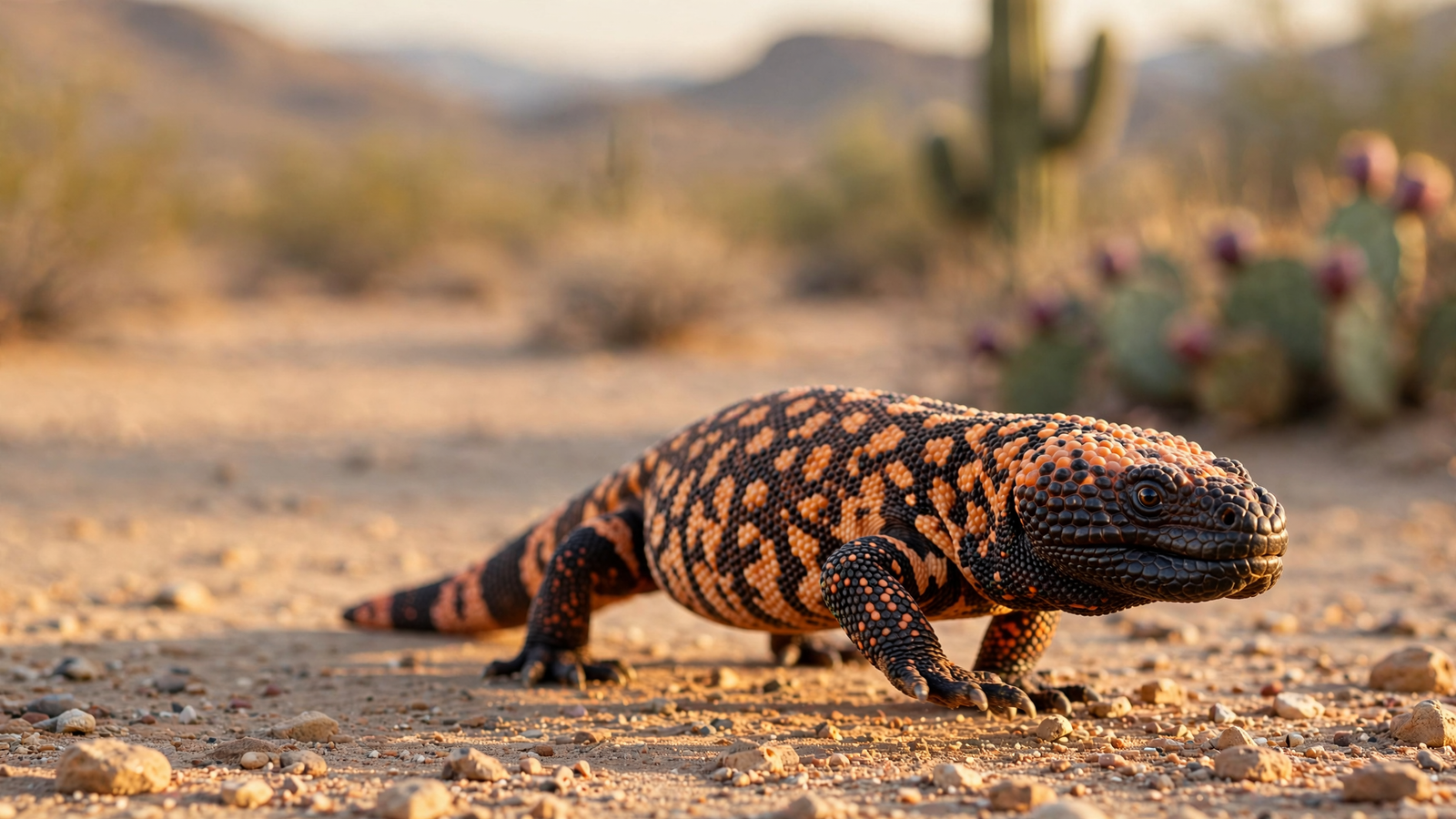
In the bright, dry landscapes of southern Arizona, the Gila monster moves with deliberate patience. Its black-and-orange skin is striking, its body is heavy for a lizard, and its reputation is larger still. The animal is venomous, protected, and rarely seen by most people—even in places where it lives.
Yet one of the most important discoveries connected to the Gila monster did not begin with a dramatic encounter in the desert. It began with a question about how the lizard’s venom worked.
Research on that venom led scientists to exendin-4, a peptide that resembles a naturally occurring human hormone involved in blood-sugar regulation. The discovery helped inspire exenatide, a medicine approved in the United States in 2005 for adults with Type 2 diabetes.
The story is not that a lizard “cured” diabetes. It is more interesting than that. A little-understood feature of an Arizona animal became a clue in basic biology, then a starting point for drug development, and eventually part of the expanding family of medicines modeled on the body’s own metabolic signals.
A desert animal built for scarcity
Gila monsters live in parts of Arizona, New Mexico, Nevada, Utah and northwestern Mexico. In Arizona, they are associated with Sonoran and Mojave Desert habitats, where long periods of heat and dryness make energy conservation essential.
The lizards spend much of their lives hidden in burrows, beneath rocks or in other sheltered places. They are not animals that race across the open desert. Their short legs and broad bodies are better suited to a slow, energy-efficient life than to sustained pursuit. For related reading, see A Personalized Stem-Cell Transplant Helped a Woman With Type 1 Diabetes Make Her Own Insulin Again.
That lifestyle is connected to an unusual metabolism. Gila monsters may eat large meals when food is available and then go for long periods without eating. Their tails store fat, providing an energy reserve. The animal’s ability to manage this feast-and-famine rhythm attracted scientific interest long before anyone imagined a diabetes drug.
The Gila monster’s venom is delivered through grooves in its lower teeth rather than through hollow fangs. When the lizard bites, chewing motions help move venom into the wound. The venom is primarily a defensive and predatory tool, but its chemical components also carry biological information—the kind of information researchers can study molecule by molecule.
The hormone connection
In people, a hormone called GLP-1 helps the body respond to food. Among other functions, GLP-1 can encourage the pancreas to release insulin when blood glucose is elevated. It also slows the movement of food through the stomach and can reduce appetite.
That made GLP-1 scientifically promising, but the natural human hormone breaks down quickly in the body. A medicine based directly on it would have a short working life.
In the early 1990s, endocrinologist John Eng studied compounds in Gila monster venom and identified exendin-4. The peptide had a structure and activity similar to GLP-1, but it remained active much longer. That difference gave researchers a practical path: perhaps a stable molecule modeled on the lizard peptide could engage the same human receptor as GLP-1 and help regulate blood sugar.
Exendin-4 did not replace the body’s hormone. Instead, it provided a durable signal through the GLP-1 receptor. That distinction became central to turning an intriguing venom component into a usable therapy.
From peptide to medicine
The resulting drug, exenatide, is a synthetic version of exendin-4. The U.S. Food and Drug Administration approved it in 2005 under the brand name Byetta as an injection used with diet and exercise to improve blood-glucose control in adults with Type 2 diabetes.
Its effects reflected several actions associated with GLP-1 signaling. Exenatide could help the pancreas release insulin in response to elevated glucose, reduce the release of glucagon after meals, slow gastric emptying and affect appetite. Because its insulin-stimulating effect is linked to higher glucose levels, the treatment works differently from medicines that push insulin release regardless of the immediate blood-sugar level. For related reading, see The San Pedro River: How Arizona’s Desert Refuge Became a Corridor for Life.
That does not make exenatide risk-free or appropriate for everyone. Medicines in this class can have side effects and contraindications, and diabetes treatment must be tailored to the individual. The important point is what the Gila monster discovery demonstrated: animal biology can reveal a mechanism that human medicine can refine, test and regulate.
Exenatide also helped establish a wider therapeutic idea. Once scientists understood how GLP-1 receptor signaling could be used, researchers developed other drugs in the same broad family. Some are used for diabetes; some have also been approved for chronic weight management. These newer medicines are not simply “Gila monster drugs,” and they vary in structure, dosing and approved uses. But exendin-4 helped prove the medical potential of long-lasting GLP-1 receptor agonists.
Why venom can be a biological library
Venoms are often described only as weapons. Scientifically, they are more like complex chemical libraries. Snakes, spiders, scorpions and other venomous animals produce mixtures of molecules that affect nerves, muscles, blood vessels, digestion or immune responses. Each component has evolved in a particular ecological setting, but its effects can also reveal how biological systems work.
That does not mean every venom compound will become a medicine. Most will not. A useful molecule must be isolated, understood, manufactured consistently, tested for safety and shown to help patients in carefully designed clinical studies. The path from natural compound to approved drug is long and uncertain.
The Gila monster example is valuable because it shows what can happen when basic research is allowed to follow an unusual clue. The original question was not necessarily, “Can this animal help treat diabetes?” It was closer to, “What do these molecules do, and why?” Medical possibilities emerged from answering that narrower question carefully.
A lizard that still needs protection
The success of a drug inspired by Gila monster biology should not be confused with a reason to handle or collect the animals. Gila monsters are wild reptiles with a painful and potentially serious bite. They are not pets for casual ownership, and disturbing, harming or illegally collecting them can threaten local populations. For related reading, see The Saguaro: How a Desert Icon Makes Time Visible.
In Arizona, their survival depends on intact desert habitat, connected areas of native vegetation and shelter, and public willingness to leave them alone. Development, roads and the illegal wildlife trade can all create pressure for a species that already spends much of its time out of sight.
For people who encounter one, the safest response is distance. A Gila monster that appears in a yard or on a trail is usually trying to move through its habitat, not seek a confrontation. Watching from far away and allowing the animal an open route is better for the lizard and the observer.
What the Gila monster changed
The Gila monster did not set out to become part of modern pharmacology. It evolved a venom suited to its own survival, in a desert where food and water are unevenly distributed. Scientists then recognized that one of its molecules could illuminate a human biological pathway.
That chain—from desert adaptation to laboratory discovery to patient care—offers a useful picture of how science advances. Breakthroughs do not always begin with a grand plan. Sometimes they begin with attention to an organism that seems strange, slow or easy to overlook.
The Gila monster remains what it has always been: a secretive Arizona reptile, not a symbol designed for human purposes. But its biology has given researchers a better understanding of how the body responds to food and how that response might be supported when metabolism goes wrong.
In that sense, the lizard’s most lasting contribution is not a single brand-name medicine. It is a reminder that the living world contains solutions—or at least questions—that human ingenuity may not discover by working alone.
Use: Approval and safety context for exenatide.
Use: Natural history, habitat, venom delivery and conservation context.
Use: Arizona-focused information about the species’ behavior, ecology and adaptations.
Use: Scientific background on exendin-4, GLP-1 signaling and the development of related medicines.
Use: Species status and broader wildlife-conservation reference.