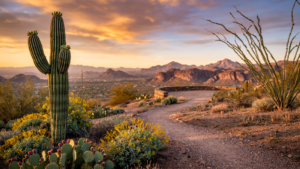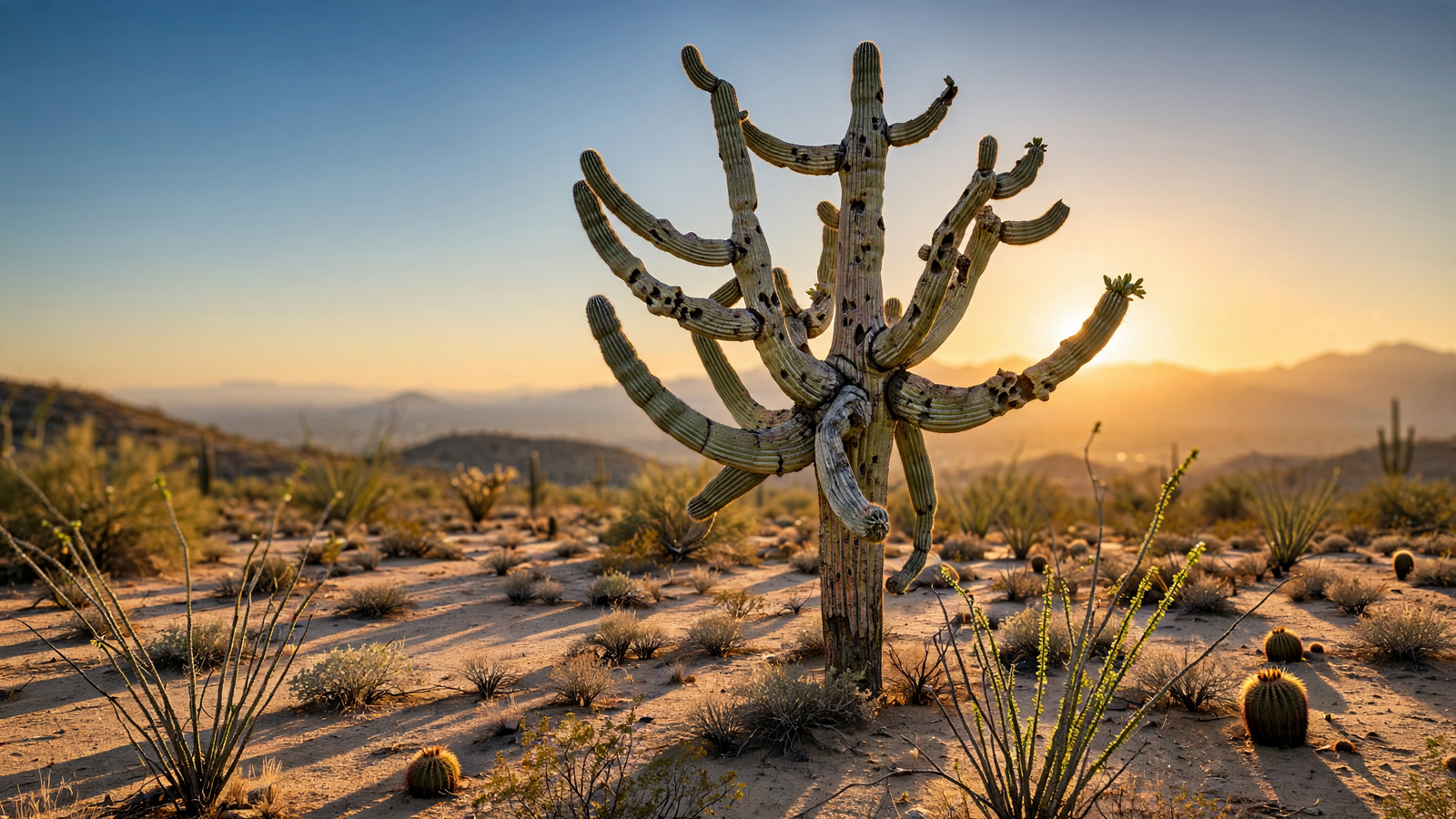
In southern Arizona, a saguaro can look almost motionless. It stands through heat, monsoon storms, cold nights, drought, and the slow expansion of a nearby city. But its stillness is deceptive. A saguaro is constantly doing the quiet work of a desert ecosystem: storing water, producing food, sheltering animals, and turning sunlight into a form that can last for generations.
That long life is what makes the cactus feel almost architectural. Its ribbed trunk rises from the Sonoran Desert like a column, while its arms curve upward in gestures that seem to record age. Some saguaros live for 150 to 200 years. A person can pass beneath the same cactus as a child, return as a parent, and still find it standing.
The saguaro is not the largest plant in Arizona, nor the only cactus that defines the region. Its importance comes from the number of relationships it holds together. Birds excavate nesting chambers in its flesh. Bats and insects visit its flowers. People have gathered its fruit for centuries. Other desert plants grow in the shade of its early years. Even after the cactus dies, its woody ribs and fallen body continue to shape the ground around it.
A cactus built for patience
Carnegiea gigantea grows naturally only in the Sonoran Desert, where conditions are warm enough for much of the year and winter freezes are limited. The species is found in southern Arizona, a small portion of southeastern California, and parts of Sonora, Mexico.
Its famous height arrives slowly. During its first years, a saguaro may be difficult to notice among rocks and low desert plants. Young seedlings are vulnerable to drought, freezing temperatures, animals, and competition from grasses. Many grow beneath “nurse plants,” including palo verdes, mesquites, and other shrubs that provide shade and reduce the intensity of the desert surface.
As the saguaro grows, it develops a broad root system close to the surface. That arrangement allows it to take advantage of brief rainfall, including the summer monsoon storms that can transform dry washes into fast-moving channels. A deeper root may help anchor the plant, but the widespread shallow roots are the main collectors of sudden desert water. For related reading, see Granite Basin Lake: How a Small Prescott Reservoir Makes Room for Desert Life.
The trunk is pleated rather than smooth. Those accordion-like folds allow the cactus to expand as it absorbs water and contract during dry periods. Its waxy skin slows water loss, while a coating of spines discourages many animals from trying to reach the moist tissue inside.
It can eventually reach more than 40 feet, although not every saguaro develops arms. The first arm may appear only after several decades, and the timing varies with growing conditions. A cactus with many arms is not necessarily older than one with none, but its shape often reflects a lifetime of surviving storms, drought, injury, and competition.
One plant, many tenants
The saguaro becomes a kind of vertical neighborhood as it matures. Gila woodpeckers and gilded flickers carve nest cavities into the trunk. The cactus responds by producing a hardened layer of tissue around the wound, creating a chamber known as a boot after the birds leave. Other species, including elf owls, purple martins, and small mammals, may later use abandoned cavities.
This arrangement is unusual because the saguaro gives up some of its own tissue but usually survives the excavation. The nest is not simply a hole in a cactus; it is a temporary home made possible by the plant’s ability to seal and reinforce itself.
The cactus also provides food above the ground. In late spring and early summer, its large white flowers open near the ends of its branches. They are adapted for visits from nectar-feeding bats, birds, and insects. Lesser long-nosed bats, a migratory species that moves between Mexico and the southwestern United States, are among the animals associated with the saguaro’s flowering season.
After pollination, the flowers become bright red fruits filled with seeds. Birds spread some of those seeds across the desert, while people have long harvested the fruit as a seasonal food. The harvest traditionally takes place with long poles made from fallen saguaro ribs, allowing people to reach fruit at the top of the cactus without climbing it. For related reading, see Saguaro National Park: The Tucson Landscape That Lets the Desert Grow Tall.
For the Tohono O’odham, whose homeland includes much of the Sonoran Desert, the saguaro fruit harvest is part of a living cultural tradition rather than a historical footnote. The fruit marks the arrival of the summer rains and has been used for food and syrup. The calendar connected to the harvest also reflects close observation of the desert’s seasonal changes.
The desert’s slow infrastructure
A mature saguaro is easy to notice, but its less visible contributions may be just as important. Its flowers and fruit move energy through the desert food web. Its cavities create shelter where few other trees are available. Its shade can moderate the harsh conditions experienced by smaller organisms. When a saguaro falls, its remains return organic material to a landscape where soil is often thin and nutrients are scarce.
The cactus also helps people read the landscape. Saguaros tend to grow in particular combinations of elevation, temperature, soil, and rainfall. Their presence signals a recognizable Sonoran Desert environment. In and around Tucson, the cactus has become a visual shorthand for the region, appearing on road signs, public buildings, business names, and tourism material.
That familiarity can hide how specific the plant’s needs are. A saguaro is not simply a cactus that can be moved anywhere in the Southwest. Freezing weather limits its range. Development can remove older plants and disrupt the conditions that allow new seedlings to survive. Wildfire, especially where invasive grasses create continuous fuel, can damage saguaros that evolved in a desert where fire was less frequent.
Climate conditions add another layer of uncertainty. Individual saguaros can endure long dry periods, but young plants are more vulnerable than established ones. A sequence of unusually dry or cold years can affect recruitment—the arrival of new plants into the population—even when many older saguaros remain standing. That can make a population appear stable while its future is quietly changing.
A protected landscape with a living archive
Saguaro National Park, on the east and west sides of Tucson, protects two distinct sections of the cactus’s habitat. The park’s history began with national monument designations in the 1930s, and the area became a national park in 1994. Together, the districts preserve thousands of acres of desert, mountain slopes, washes, archaeological sites, and saguaro forests. For related reading, see Prescott National Forest: How a Working Forest Holds a High-Desert City Together.
Protection does not freeze the landscape in time. Park scientists monitor vegetation, weather, fire, and other conditions to understand how the desert is changing. The saguaros themselves provide part of that record. Their age, height, injuries, branching patterns, and survival can reveal something about past weather and present pressures, especially when observations are combined with long-term ecological data.
Outside the park, saguaros also persist in neighborhood washes, private land, preserves, and other protected areas. Arizona law restricts the removal of native desert plants, including saguaros, from many properties. Those rules recognize that an old cactus is not an interchangeable landscaping object. Moving one may preserve its appearance, but it can separate the plant from the soil, animals, and ecological relationships that made it part of a particular place.
What the saguaro asks of us
The saguaro offers a different definition of speed. Its most important work is measured in seasons rather than headlines. It grows slowly, flowers briefly, feeds many species, and remains useful long after its death. Its survival depends on relationships that are easy to overlook: a nurse shrub protecting a seedling, a bat carrying pollen, a bird making a nest, a family recognizing when the fruit is ready.
That is why the cactus feels larger than its silhouette. It is a timekeeper, but not an isolated one. The saguaro records the conditions of the desert through its body while also helping create conditions for others. Its presence says that water has arrived before, that a seed once found shelter, and that generations of life can be connected by one plant.
In a region often described through extremes—heat, drought, flash floods, rapid growth—the saguaro makes another story visible. The desert is not empty, and resilience is not the same as invulnerability. A living landscape can be tough and still require care. The tall cactus on the horizon is both a survivor and a reminder: some of the most valuable things in a place are the ones that take the longest time to become.
Use: Saguaro growth, habitat, anatomy, flowers, fruit, wildlife relationships, and threats.
Use: Park history, protected landscape, ecological setting, and conservation context.
Use: Tohono O’odham cultural connection to the saguaro fruit harvest and traditional harvesting methods.
Use: Natural-history background on saguaro ecology, growth, pollination, and desert relationships.