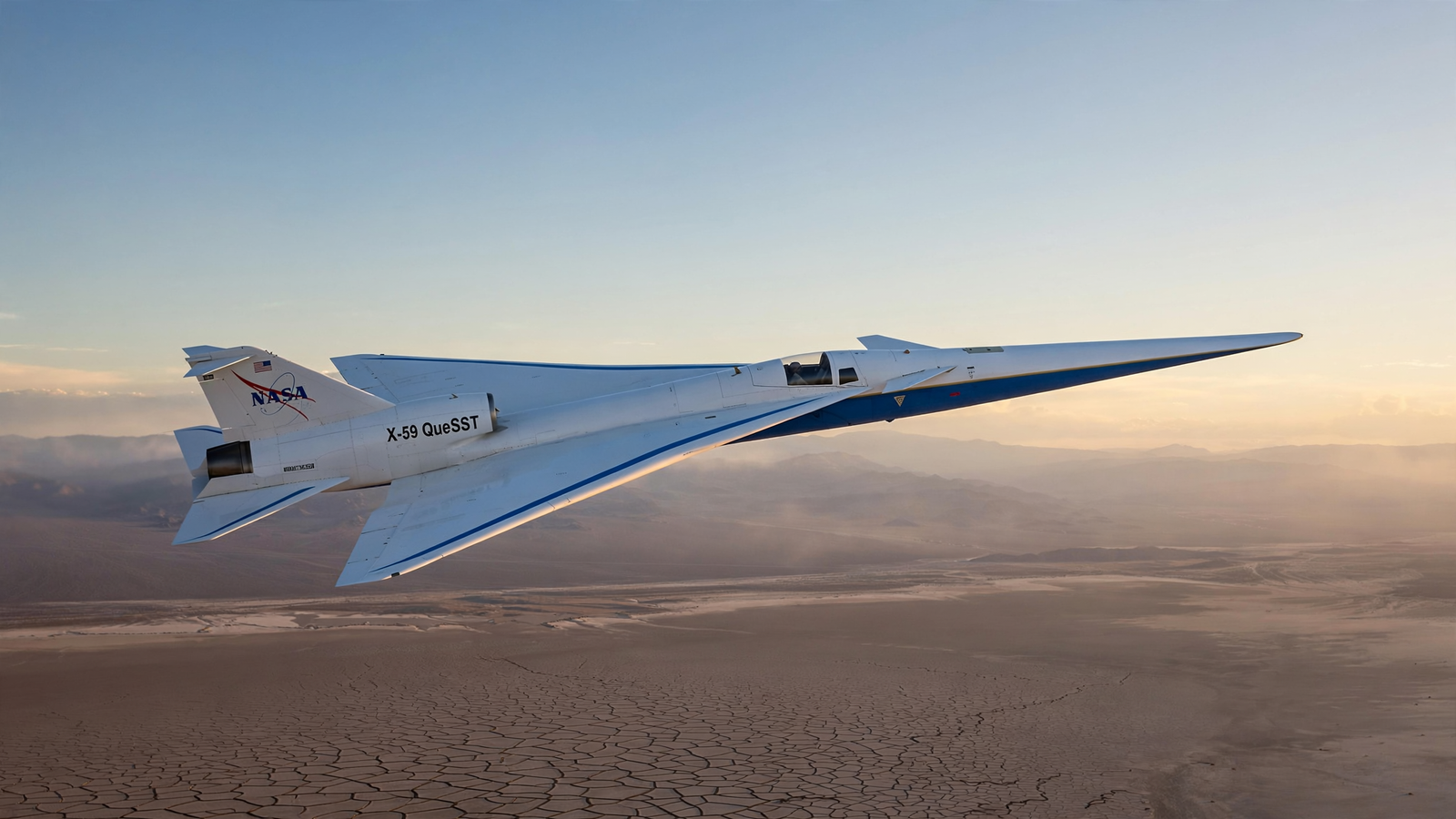
For decades, supersonic passenger flight has carried a stubborn limitation: speed is possible, but the noise that comes with it is difficult to accept on the ground.
When an aircraft travels faster than sound, pressure waves build into a shock wave. From the ground, that wave can arrive as a sudden boom—loud enough to rattle windows, disturb communities and make routine overland supersonic travel politically difficult. In the United States, federal rules generally prohibit civil aircraft from flying faster than sound over land unless specially authorized.
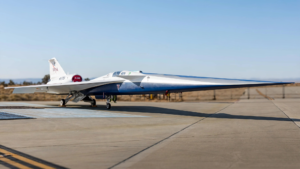
NASA is testing a different possibility. Its X-59 experimental aircraft is being built to demonstrate that an aircraft can travel at supersonic speed while producing a much softer sound on the ground. The project does not promise silent flight, and it is not itself a passenger aircraft. Its purpose is more practical: gather the evidence regulators may need to consider new rules for commercial supersonic travel.
A speed problem with a noise problem attached
Supersonic flight has never been only a question of powerful engines. The central challenge is what happens to the atmosphere around the airplane.
At subsonic speeds, pressure changes can move ahead of an aircraft in a relatively gradual way. Once the aircraft passes the speed of sound, those changes can no longer move out of the way fast enough. They merge into shock waves that trail behind the aircraft and spread toward the surface.
A conventional supersonic aircraft can therefore create two major pressure disturbances—one near the front and another near the rear. Heard from the ground, they can blend into the familiar sharp report called a sonic boom.
The X-59’s design attacks that problem by stretching and carefully shaping the aircraft. Its long, narrow nose is intended to keep the strongest pressure changes from joining together abruptly. The aircraft’s shape, engine placement and control surfaces have all been considered as parts of one aerodynamic system rather than as separate features. For related reading, see NASA’s X-59 Is Preparing to Make Supersonic Flight Quieter.
NASA describes the desired result as a “sonic thump,” not an absence of sound. That distinction matters. The research question is not whether supersonic flight can become invisible to the ear. It is whether the sound can be reduced enough that people on the ground experience it as an occasional, manageable noise rather than a startling blast.
An airplane built as a measuring instrument
The X-59 is being developed for NASA’s Quesst mission, with Lockheed Martin serving as the aircraft’s prime contractor. It is based at Lockheed Martin’s Skunk Works facility in Palmdale, California, where the aircraft has undergone assembly and ground testing.
Although the X-59 looks like an airplane, its most important role is experimental. It is a flying instrument designed to produce a carefully controlled sound signature that can be measured, analyzed and eventually evaluated by people who live beneath its flight path.
The aircraft is expected to cruise at about Mach 1.4—roughly 925 miles per hour—at an altitude of around 55,000 feet. Those figures are targets for the research aircraft’s intended operating profile, not a promise of a new commercial route. The airplane will carry a single pilot and is much smaller than a future passenger jet.
Its design includes an especially important visual innovation: the pilot does not have a conventional forward-facing windshield. Instead, cameras and displays form what NASA calls an eXternal Vision System. The system gives the pilot a digital view of the area ahead while allowing engineers to keep the aircraft’s long nose intact.
That arrangement illustrates the tradeoffs involved in quiet supersonic design. The nose is useful aerodynamically, but it blocks the view a pilot would normally have during takeoff and landing. Rather than shorten the nose and give up some of the intended pressure-wave control, engineers developed a new way to see over it.
Why the ground matters as much as the airplane
Reducing the sound in a wind tunnel is only part of the task. NASA also needs to learn how people perceive the aircraft’s noise in real communities.
After the X-59 begins its flight-test program, NASA plans to fly it over selected communities in the United States. Residents will be asked to report what they hear and how they react. Those responses will be combined with acoustic measurements collected by instruments on the ground. For related reading, see XB-1’s Supersonic Flight Gives Civil Aviation a New Test Case.
This approach recognizes that sound is not judged only by its decibel level. A short, sharp boom can feel more disruptive than a softer, less startling sound, even when a meter records the events differently. Repetition, time of day, local background noise and expectations can also affect how a community experiences an aircraft overhead.
The community studies are therefore not a public-relations exercise added after the engineering is complete. They are part of the experiment. NASA wants to connect the physical signature of the X-59 with the human response to it.
The agency intends to provide the resulting data to the Federal Aviation Administration and international regulators. Those authorities—not NASA alone—would decide whether existing supersonic noise rules should change and what standards any future aircraft would need to meet.
What the X-59 can and cannot do
The X-59 will not carry passengers, open a new airline route or make every supersonic aircraft quiet. It is a technology demonstrator, and its success will depend on more than whether the airplane reaches its planned speed.
Engineers must show that the aircraft can operate safely, that its systems work together in flight and that its sound signature is consistent enough to measure. Researchers then have to determine whether the ground-level noise is genuinely less disruptive across different environments.
There are also practical limits beyond the sonic boom. Supersonic travel can require more fuel than subsonic travel, and aircraft operating at very high altitude raise questions about emissions and climate effects. A quieter boom would remove one major barrier, but it would not settle the broader environmental and economic debate over faster air travel.
Nor would a regulatory change automatically create a new generation of supersonic airliners. Aircraft manufacturers would still need to design, certify and operate commercial airplanes that meet safety, efficiency and noise requirements. Airlines would need routes and customers that justify the cost. For related reading, see Europa Clipper: How NASA Built a Spacecraft to Investigate an Ocean Hidden Under Ice.
The value of the X-59 is more focused. It is intended to answer a question that has remained difficult to resolve with models and laboratory tests alone: what does a deliberately softened supersonic sound mean to people below?
A possible change in the map of air travel
If NASA’s measurements and community surveys support a new noise standard, the effect could reach beyond one aircraft. Commercial supersonic designers could use the findings to develop airplanes permitted to fly over land at speeds that are currently restricted.
That would not make every trip dramatically shorter. The advantage would be greatest on long routes where a substantial portion of the journey could be flown faster than sound. But even limited overland supersonic travel could change the geography of airline planning, especially for connections that now must remain subsonic over populated areas.
The project also offers a broader lesson about aviation research. The key innovation is not a single engine or material. It is the decision to treat the airplane, the atmosphere, the measurement equipment, regulators and the public as one connected system.
Aircraft have often been judged from the cockpit or the runway. The X-59 adds another vantage point: the neighborhood below. A successful test will not simply show that an experimental airplane can fly fast. It will show whether that speed can be made compatible with the everyday lives of the people who hear it.
That is why the X-59 matters even before it carries a traveler. It is an attempt to turn supersonic flight from a demonstration of raw speed into a more careful bargain with the ground—one in which the future of faster travel depends not only on what an aircraft can do, but on what communities are willing to live with.
Use: Primary source for the X-59 program, its research goals, community response studies and the proposed regulatory data.
Use: Technical background on the aircraft’s design, intended speed, altitude and external vision system.
Use: Regulatory background on restrictions governing civil supersonic flight over land in the United States.
Use: Contractor background on Lockheed Martin’s role in developing the experimental aircraft and its quiet-supersonic design.