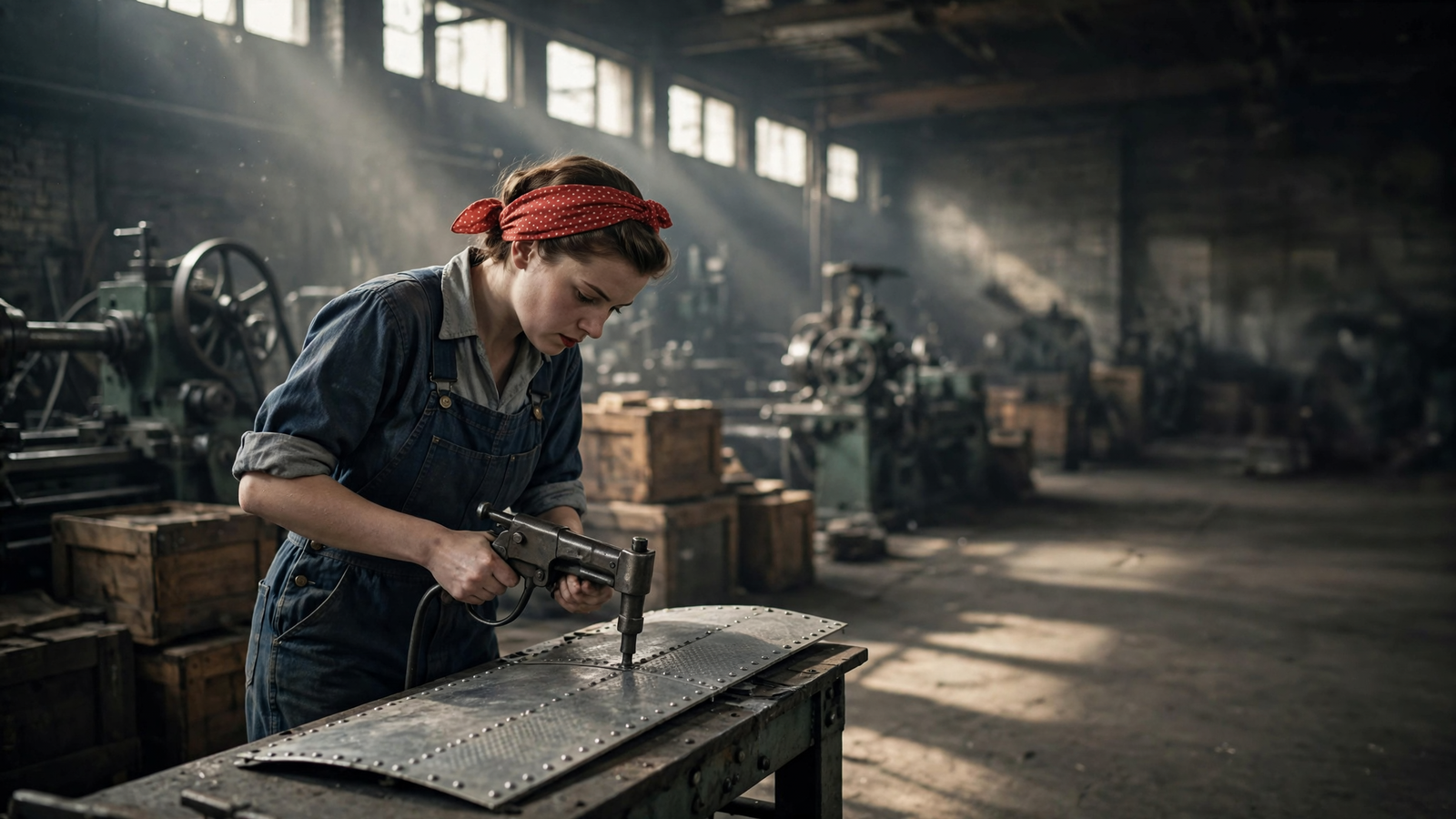
Few American posters have traveled farther from their original purpose than We Can Do It! The image shows a woman in a blue work shirt, red polka-dot bandanna, and rolled-up sleeve, raising one arm beneath a compact message of confidence. Today, she is widely recognized as Rosie the Riveter. In 1943, however, the poster was not introduced as Rosie—and almost nobody outside the workplace campaign that commissioned it saw it. For related reading, see The Circus Poster: How American Lithographers Made Spectacle Larger Than Life.
A message for the factory floor
Artist J. Howard Miller created the poster for Westinghouse Electric & Manufacturing Company during the Second World War. It belonged to a series of motivational posters intended for display inside company plants, where they encouraged employees to maintain productivity and morale. The posters were not mass-market advertisements. They were workplace communications, displayed for limited periods and then replaced. For related reading, see The WPA Poster: How the New Deal Put Art in Public Life.
That context matters. The woman in Miller’s design was not originally a named individual, and the poster was not a general government recruitment campaign. Its direct audience was the industrial workforce helping produce the ships, aircraft, vehicles, and equipment needed for the war. For related reading, see Lascaux: How Four Teenagers Found a Window Into Ice Age Life.
Women’s work changed the picture
The wartime emergency transformed the American labor force. As millions of men entered military service, women moved into jobs that had often been presented as exclusively male: welding, machining, riveting, inspection, and assembly. The shift was not complete or permanent—many women were pushed out of industrial work after the war—but it changed public ideas about what women could do and where they belonged.
Other wartime images made that change more explicit. Norman Rockwell’s 1943 Saturday Evening Post cover portrayed a different, more muscular “Rosie,” complete with lunch pail and rivet gun. Popular memory gradually blended several representations: real women workers, government recruitment campaigns, Rockwell’s illustration, and Miller’s striking poster.
From forgotten notice to cultural symbol
We Can Do It! did not become famous immediately. After its brief factory display, the image largely disappeared from public view. Its revival came decades later, as historians, publishers, museums, and feminist movements looked again at the visual record of women’s wartime labor. By the 1980s, the poster was being reproduced widely and read as a symbol of women’s strength and independence.
That later meaning is not identical to the original one. The wartime poster was designed to support production inside a corporate workplace; its modern life has made it a statement about capability, solidarity, and equal participation. Its familiar slogan can now appear on museum walls, classroom materials, protest signs, merchandise, and public art.
Why the image still works
The poster’s endurance comes partly from its economy. Miller used a limited palette, a strong diagonal arm, an assertive pose, and only four words. The design can be understood at a glance, even when reproduced as a small print or digital icon.
But its staying power is also historical. We Can Do It! preserves a moment when national necessity opened industrial doors to women, while its later revival records a new generation claiming the image for itself. The poster began as a temporary workplace message. It became something more durable: an American visual shorthand for the belief that ability should be demonstrated, not assumed.
Use: Background on the poster’s creation, Westinghouse workplace context, and its later association with Rosie the Riveter.
Use: Poster identification, artist attribution, date, and collection record.
Use: Context on women’s wartime industrial work and the broader Rosie the Riveter image.
Smithsonian Institution — “We Can Do It!” poster and Rosie the Riveter resources — https://www.si.edu/spotlight/rosie-the-riveter — Background on the poster’s creation, Westinghouse workplace context, and its later association with Rosie the Riveter.
Library of Congress — “We can do it!” poster by J. Howard Miller — https://www.loc.gov/pictures/item/2004679794/ — Poster identification, artist attribution, date, and collection record.
U.S. National Archives — Rosie the Riveter reference resources — https://www.archives.gov/research/alic/reference/military-history/rosie-the-riveter — Context on women’s wartime industrial work and the broader Rosie the Riveter image.