Every time a phone opens an app, a laptop loads a webpage, or a car adjusts its engine, countless electronic decisions are taking place on tiny pieces of silicon. Those pieces are not simply miniature circuit boards. They are integrated circuits: carefully manufactured chips that combine transistors, connections, and other components into a compact electronic system.
The idea sounds ordinary now because nearly every modern computer depends on it. But the integrated circuit solved one of early computing’s most stubborn problems: how to make machines more powerful without making them larger, more fragile, and harder to maintain.
Before the chip, computers were assemblies
Early electronic computers were built from individual parts. Vacuum tubes served as switches and amplifiers. Later, transistors replaced many tubes because they were smaller, consumed less power, and were more dependable. But even transistorized machines still required thousands of separate components connected by wires.
That construction method created a practical limit. A computer could be made more capable by adding components, but every additional part also meant more connections that could fail. Engineers had to fit those parts into crowded machines and find ways to keep signals moving reliably between them.
The problem was not only size. Manufacturing a complicated circuit one component at a time was slow and expensive. A computer might contain a large number of transistors, but the system’s performance was also constrained by the distance between those transistors and the quality of the wiring that connected them.
The integrated circuit offered a different approach: instead of assembling a circuit from many separate parts, manufacture much of the circuit as one unit.
Jack Kilby’s demonstration
In 1958, engineer Jack Kilby at Texas Instruments built a working demonstration of an integrated circuit. His prototype used a small piece of germanium and connected several electronic elements so they could operate together as a single device.
Kilby’s demonstration showed that the components of an electronic circuit did not necessarily need to be separate objects. They could be formed together on a semiconductor material. That was a conceptual breakthrough, even though the first device was not yet the convenient, mass-produced chip that would later become familiar. For related reading, see ENIAC: How a Room-Sized Machine Started the Computer Age.
Kilby shared the 2000 Nobel Prize in Physics for his part in the invention of the integrated circuit. The Nobel committee also recognized the broader importance of the technology: integrated circuits made it possible to build increasingly complex electronic systems in smaller spaces.
Robert Noyce and the practical silicon version
At Fairchild Semiconductor, Robert Noyce independently developed an integrated-circuit approach using silicon and a manufacturing technique known as planar processing. The method helped engineers build components and their connections on the surface of a silicon wafer, creating a more practical path toward producing many chips consistently.
Noyce’s work built on the development of the transistor and on advances in semiconductor manufacturing. One especially important technique was the use of a thin insulating layer of silicon dioxide. That layer could protect the surface and help engineers control the electrical behavior of the devices formed beneath it.
The competing contributions of Kilby and Noyce are often described together because they addressed different parts of the same challenge. Kilby demonstrated the basic possibility of combining components. Noyce’s silicon-based process helped make integrated circuits suitable for reliable, repeatable production.
That distinction mattered. A useful invention is not only something that can work once in a laboratory. It must also be manufacturable, testable, and affordable enough to find a place in the real world.
What is inside an integrated circuit?
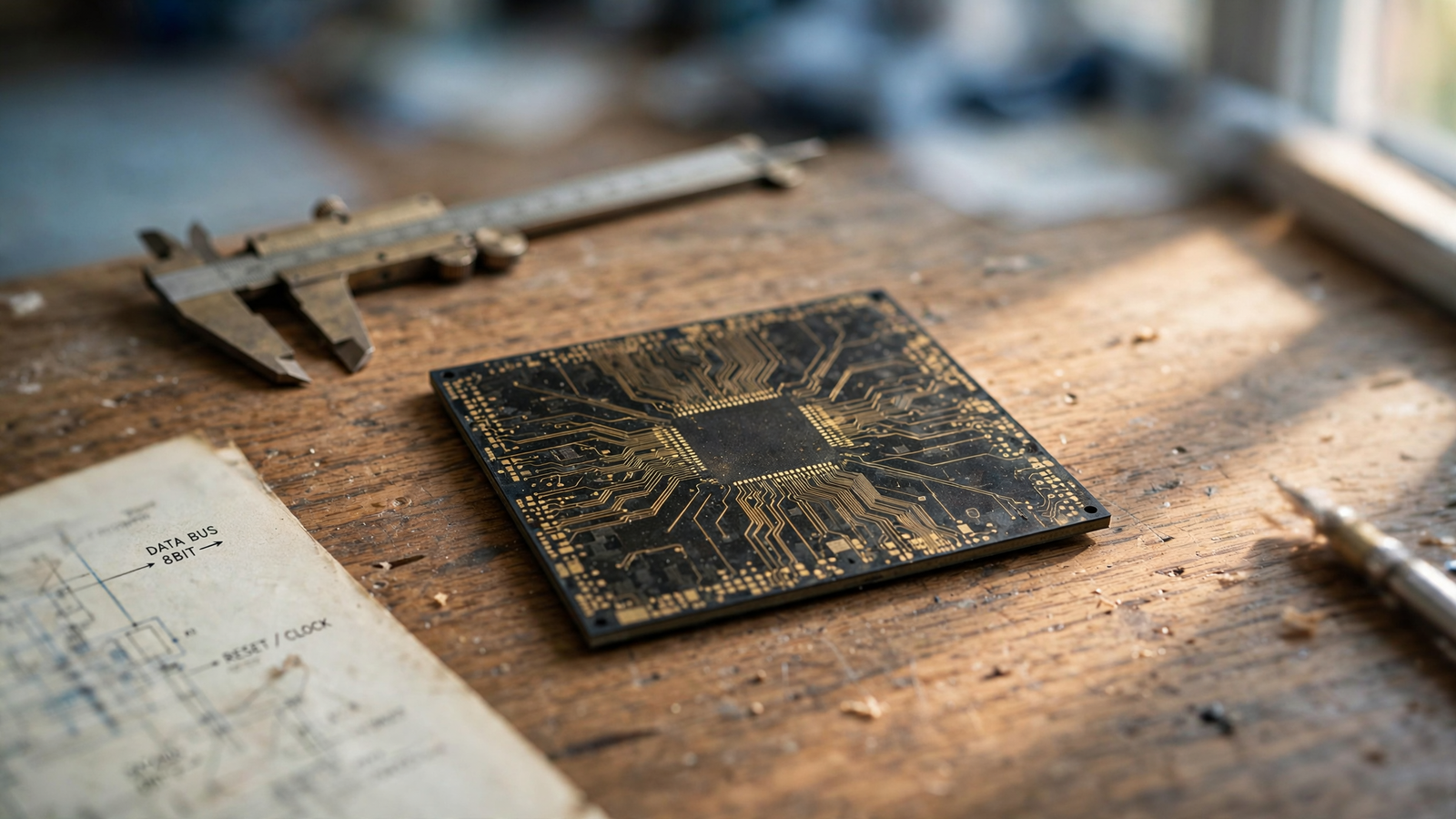
At its simplest, an integrated circuit contains electronic components and the pathways that connect them on a semiconductor substrate. The most important component is the transistor, which can act as a switch or help amplify a signal.
By arranging transistors into patterns, engineers can create logic gates. Logic gates perform basic operations such as determining whether inputs are both true, whether either input is true, or whether an input should be reversed. Larger combinations of gates can perform arithmetic, store information, compare values, and control other devices.
A processor is therefore not a mysterious object separate from the basic principles of electronics. It is an extraordinarily dense arrangement of switching devices organized to follow instructions. Memory chips use related semiconductor structures to preserve bits. Graphics processors, communications chips, and sensors also rely on integrated-circuit design, though each is optimized for a different task.
Modern chips may contain enormous numbers of transistors, but the underlying idea remains recognizable: electrical behavior is organized into a carefully manufactured network that can represent and manipulate information.
From circuits to the microprocessor
Integrated circuits first appeared in specialized systems, including military and aerospace equipment, where their small size and potential reliability were especially valuable. They also became important in systems that needed to reduce weight and power consumption. For related reading, see The Spreadsheet: How VisiCalc Turned the Personal Computer Into a Workplace.
The next major step was to place the central processing functions of a computer onto one integrated circuit. In 1971, Intel introduced the 4004, a commercially available microprocessor developed through work by Federico Faggin, Ted Hoff, Stan Mazor, and Masatoshi Shima.
The 4004 was modest by modern standards. It was designed for a calculator and processed relatively small groups of bits. It could not run today’s operating systems, stream video, or power a general-purpose laptop. Its importance was architectural: a processor that had once required many separate chips could be packaged into a single small device.
That change opened the door to smaller calculators, control systems, and eventually personal computers. As engineers learned to place more transistors on each chip, computers became less expensive and more widely available.
Why smaller transistors changed computing
The benefits of integrated circuits came from more than saving space. Shorter connections could allow signals to move more quickly. Smaller components generally required less material and could support lower power consumption. Manufacturing large numbers of similar devices also made it possible to improve consistency and reduce cost.
For decades, the semiconductor industry increased the number of components that could fit on a chip. This trend is often associated with Moore’s observation that the number of components on an integrated circuit tended to grow rapidly over time. It was not a law of nature, and continued progress required enormous investment in research, factories, design tools, and manufacturing precision.
Still, the direction of development transformed everyday technology. Mainframes gave way to minicomputers, then personal computers and portable devices. Computing moved from specialized rooms into offices, classrooms, homes, vehicles, and eventually objects small enough to wear or carry without noticing.
The manufacturing process is a form of layered drawing
Making a modern chip begins with a wafer of highly purified semiconductor material, usually silicon. Engineers create patterns on the wafer through a sequence of processes that may include depositing thin films, applying light-sensitive materials, exposing patterns, etching selected areas, and introducing carefully controlled impurities.
This process is repeated through many layers. Each layer contributes part of the transistors or the metal pathways that connect them. The patterns are created with specialized equipment because even tiny defects can affect a chip’s performance. For related reading, see The Computer Mouse: How a Wooden Pointing Device Made Computers Human.
The result is not one chip at first, but many copies of a design arranged across a wafer. The wafer is later cut into individual pieces, tested, packaged, and connected to the outside world. A finished processor may be small enough to hold between two fingers, yet its design represents years of engineering and a manufacturing chain that crosses multiple countries.
The hidden infrastructure of everyday life
Integrated circuits are easy to overlook because they have become embedded in ordinary objects. A computer’s processor is the most obvious example, but chips also control displays, regulate power, interpret touch, manage wireless signals, measure temperature, and coordinate storage.
Some integrated circuits are designed to perform a wide range of tasks. Others are built for one narrow purpose, such as converting an analog signal into digital data or controlling a motor. This specialization is one reason modern products can combine computing with sensing and communication without requiring a separate machine for every function.
The technology also changed the meaning of a computer. A computer no longer had to be a visible box dedicated only to calculation. It could be a feature inside a camera, a medical instrument, a traffic signal, or a household appliance.
The continuing challenge
Integrated circuits made computing smaller, but they did not make the underlying engineering simple. Designers must balance speed, heat, power use, manufacturing cost, security, and reliability. As features become smaller, controlling defects and managing energy becomes more difficult.
The industry has responded with new materials, three-dimensional structures, advanced packaging, and specialized processors. Some recent gains come not from placing every function on one piece of silicon, but from connecting several chips or chip sections in more efficient ways.
That evolution shows why the integrated circuit remains an evergreen technology story. It is not a single finished invention. It is a manufacturing idea that continues to shape how engineers build electronic systems.
The modern computer began as a machine assembled from many separate parts. The integrated circuit changed the question from “How can we connect more components?” to “How much of the system can we build together?” Nearly every computer people use today is an answer to that question.
Use: Research on the invention and development of the integrated circuit, including the work of Jack Kilby and Robert Noyce.
Use: Background on Kilby’s 1958 integrated-circuit demonstration and the technology’s significance.
Use: Research on the emergence of the microprocessor and the transition toward placing processing functions on a single chip.
Use: Background on the 4004, its development team, and its 1971 introduction.
Computer History Museum — The Silicon Engine: Integrated Circuit — https://www.computerhistory.org/siliconengine/integrated-circuit/ — Research on the invention and development of the integrated circuit, including the work of Jack Kilby and Robert Noyce.
Nobel Prize — Jack S. Kilby, Nobel Lecture — https://www.nobelprize.org/prizes/physics/2000/kilby/lecture/ — Background on Kilby’s 1958 integrated-circuit demonstration and the technology’s significance.
Computer History Museum — The Silicon Engine: Microprocessor — https://www.computerhistory.org/siliconengine/microprocessor/ — Research on the emergence of the microprocessor and the transition toward placing processing functions on a single chip.
Intel — The Story of the Intel 4004 — https://www.intel.com/content/www/us/en/history/museum-story-of-intel-4004.html — Background on the 4004, its development team, and its 1971 introduction.