For most of modern history, a black hole was an object known by inference. Astronomers could observe stars orbiting something invisible, detect hot gas falling toward a hidden gravitational source, or measure the energy of powerful jets. But the black hole itself remained out of sight.
That changed in 2019, when an international team released an image of the black hole at the center of the distant galaxy Messier 87. The picture was not a photograph in the ordinary sense. It was a carefully reconstructed image made from observations gathered by radio telescopes around the world. At its center was a dark region surrounded by a glowing ring of superheated material.
The image offered something scientists had never seen directly before: the silhouette created when a black hole’s gravity bends light so strongly that some of it cannot escape. The achievement belonged to the Event Horizon Telescope, a global observing project that transformed Earth into a single virtual radio dish.
Seeing the outline of something that emits no light
A black hole is not a conventional dark object sitting against a brighter background. Its defining boundary, the event horizon, is the point beyond which light and matter cannot return to the outside universe. Because no light comes from inside that boundary, the event horizon cannot be photographed directly.
What astronomers can observe is the region around it. Gas and dust drawn toward a black hole can become extraordinarily hot, producing radiation across the electromagnetic spectrum. Light traveling near the black hole is also distorted by its gravity. Some rays are captured, while others are bent into paths that allow distant observers to see a bright, warped outline around a central darkness.
That central darkness is the black hole’s shadow—not a solid surface, but an apparent absence of light shaped by gravity. The shadow is larger than the event horizon itself because the black hole’s gravitational field affects light approaching from several directions.
Why one telescope was not enough
The target in Messier 87 is enormous by human standards. Its mass is roughly 6.5 billion times that of the Sun. Yet it is so far away—about 55 million light-years from Earth—that its apparent size in the sky is remarkably small.
Resolving the shadow required an angular resolution comparable to reading a newspaper on the Moon from Earth. No single existing radio telescope has a dish large enough to do that. The solution was to connect observatories separated by thousands of miles. For related reading, see The Pacemaker: How a Pocket-Sized Pulse Keeper Changed Modern Medicine.
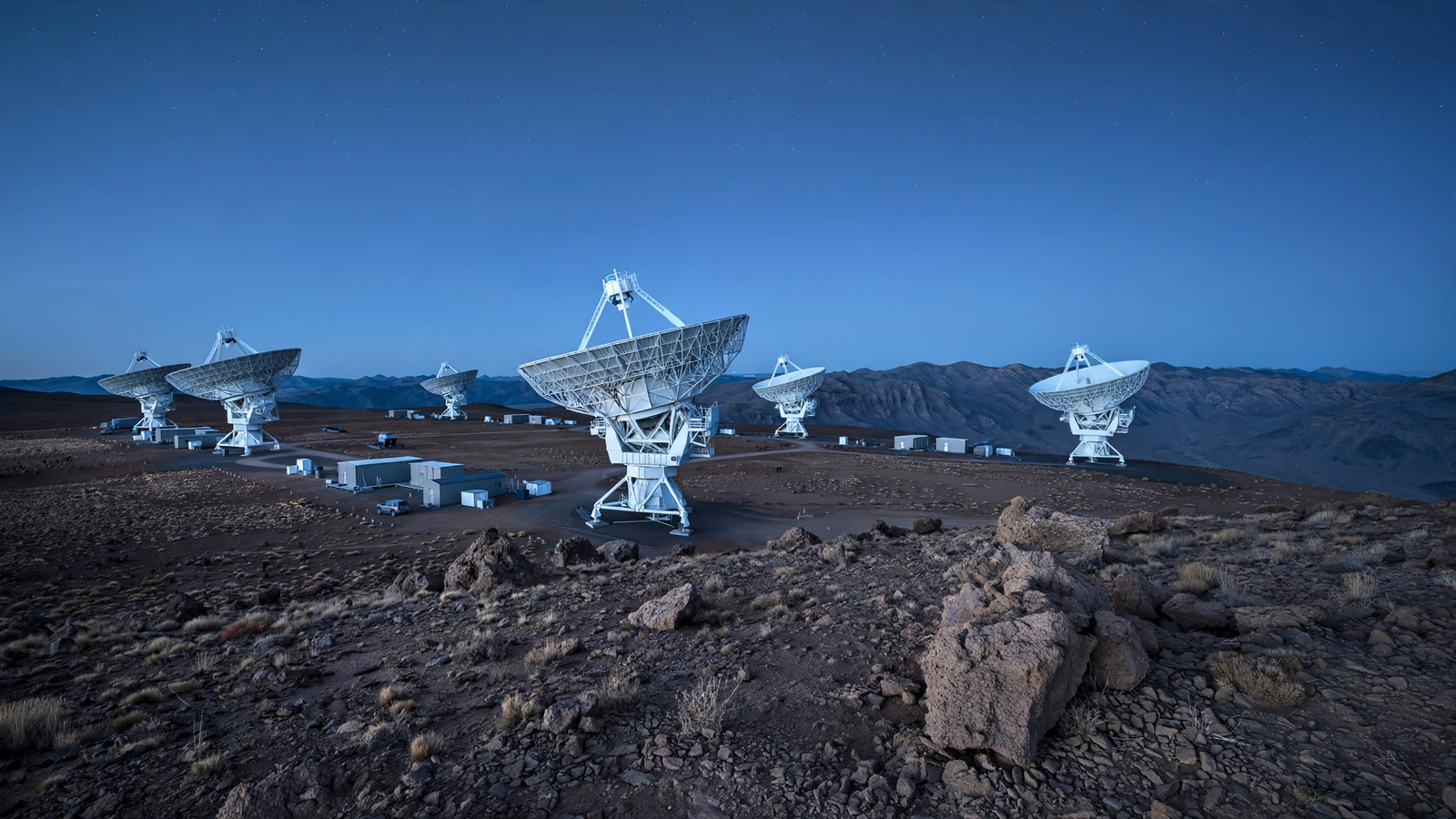
The Event Horizon Telescope used a technique called very-long-baseline interferometry. In simple terms, signals recorded at widely separated telescopes can be combined as if they came from one instrument the size of the distance between the sites. The larger the separation, or baseline, the finer the detail the virtual telescope can resolve.
The network included facilities in locations such as Hawaii, Arizona, Mexico, Chile, Spain and the South Pole. Each station recorded huge volumes of data during coordinated observing sessions. Atomic clocks provided precise timing, allowing the separate recordings to be aligned later.
The telescopes did not send a finished picture to a central computer. Instead, they captured raw radio signals that had to be transported, correlated and analyzed. Hard drives containing the South Pole data were even held until aircraft could safely carry them north after the Antarctic winter.
A global experiment in April 2017
The observations that produced the first black-hole image took place during a coordinated campaign in April 2017. Weather mattered. The team needed clear conditions at several observing sites at the same time, because the scientific value came from combining measurements across the network.
The project gathered observations at a wavelength of about 1.3 millimeters. At that wavelength, radio waves can pass through much of the material between Earth and the black hole, while the network has enough resolving power to study the compact region around it.
Processing the observations took almost two years. The team separated the data into independent analysis groups and asked them to work without simply copying one another’s results. That approach was designed to reveal whether a ring-like structure appeared consistently under different methods.
In April 2019, the collaboration presented the result: a bright, uneven ring enclosing a dark center. The ring’s asymmetry was expected. Material orbiting the black hole moves at extreme speeds, and relativistic effects make some regions appear brighter than others. The overall size and shape also matched predictions from general relativity for a black hole with the measured mass and orientation.
From an image to a test of gravity
The first image was visually simple, but its scientific importance was substantial. It provided a new way to test Einstein’s theory of general relativity in one of the most extreme environments known.
General relativity predicts that mass and energy curve spacetime. Around a black hole, that curvature becomes so intense that light can travel along paths very different from those predicted by ordinary, everyday geometry. The observed ring was consistent with the predicted appearance of a black-hole shadow. For related reading, see Sesame Street: How a Neighborhood on Television Made Learning Feel Like Belonging.
The result also strengthened the connection between the central object and the enormous jet launched from the core of Messier 87. The galaxy’s jet extends thousands of light-years into space. Although the image did not show the entire jet, it examined the compact region from which the jet’s energy originates.
That distinction matters. A black hole does not act like a cosmic vacuum cleaner that pulls in everything nearby. Matter must lose energy and angular momentum before it can fall inward. Some material instead becomes part of an orbiting accretion flow, and magnetic fields in that environment can help direct plasma outward in powerful jets.
The harder target in our own galaxy
After imaging the distant black hole in Messier 87, the Event Horizon Telescope turned toward Sagittarius A*, the compact object at the center of the Milky Way.
Sagittarius A* is much closer to Earth, at a distance of roughly 26,000 light-years, and its mass is about 4 million times that of the Sun. Its apparent shadow is similar in size to the one in Messier 87. But the closer target presented a different problem: the gas around it changes rapidly while the observations are being collected.
The black hole in Messier 87 is so massive that its surrounding structure changes relatively slowly during an observing session. Sagittarius A* completes an orbiting dance in the gas near its center on a much shorter timescale. The team therefore had to account for a moving, changing source rather than combine observations of something that looked almost fixed.
In 2022, the collaboration released the first image of Sagittarius A*. Again, the result was a glowing ring around a dark center. The image was less sharply defined than the public might expect from a conventional camera, but it agreed with models of a black hole having the mass measured from stellar orbits near the center of the Milky Way.
Seeing both objects was valuable because they represent very different environments. Messier 87’s black hole is a giant in an active galaxy, while Sagittarius A* is comparatively quiet and much less massive. The fact that both showed the predicted ring-and-shadow structure gave the project a broader test of black-hole physics.
Polarization reveals the magnetic environment
The Event Horizon Telescope has not stopped at ordinary intensity images. Radio waves also carry information about polarization, which can reveal how magnetic fields are arranged in the glowing material around a black hole. For related reading, see The James Webb Space Telescope: How an Infrared Eye Is Rewriting Our View of the Universe.
Polarized observations of Messier 87 showed organized magnetic structures near the black hole. Those fields are important because they may help explain how matter is prevented from simply falling inward and how some plasma is guided into the galaxy’s enormous jet.
This is one reason the project is better understood as an observatory rather than a single historic picture. Each improvement—more telescopes, better calibration, additional wavelengths or more sophisticated analysis—can add information about motion, magnetic fields and the relationship between an accretion flow and a jet.
A new kind of astronomical instrument
The Event Horizon Telescope changed the meaning of a telescope. It is not a single building, and it does not produce a picture by pointing one mirror or dish at the sky. It is a collaboration among observatories, engineers, data specialists and theorists working as one instrument across the planet.
That arrangement brings practical difficulties. Stations must coordinate their observing schedules. Weather can close one site while conditions remain clear at another. Data from separate facilities must be calibrated so that differences in equipment do not masquerade as features in the source. Algorithms must reconstruct an image from incomplete measurements without adding details that the observations do not support.
The team’s use of multiple independent imaging methods was therefore more than a technical footnote. It was part of the evidence. A compelling image must emerge from the data in ways that survive different assumptions and checks.
Black holes are still not visible in the everyday sense. No camera has captured a surface, because a black hole has no solid surface to photograph. But the Event Horizon Telescope has made the effects of extreme gravity visible at the scale where they become unmistakable.
The achievement is a reminder that astronomy often advances by turning an apparently impossible measurement into a problem of cooperation, timing and patience. A planet-sized array did not make the invisible ordinary. It made the invisible testable—and gave humanity its first direct view of a shadow cast by gravity itself.
Use: Primary project announcement and explanation of the first image of the black hole in Messier 87.
Use: Authoritative overview of the observing network, image and scientific significance.
Use: Technical and observational background on the 2017 campaign and the M87 result.
Use: Primary announcement and context for the 2022 image of Sagittarius A*.
Use: Published research papers covering the image, observations, modeling and interpretation.