On Mars, the air is almost entirely carbon dioxide. It is far too thin to breathe, the pressure is less than one percent of Earth’s sea-level pressure, and the planet’s surface offers no obvious supply of oxygen for visiting astronauts.
Yet for more than two years, a small machine riding inside NASA’s Perseverance rover repeatedly took that hostile atmosphere and pulled oxygen from it.
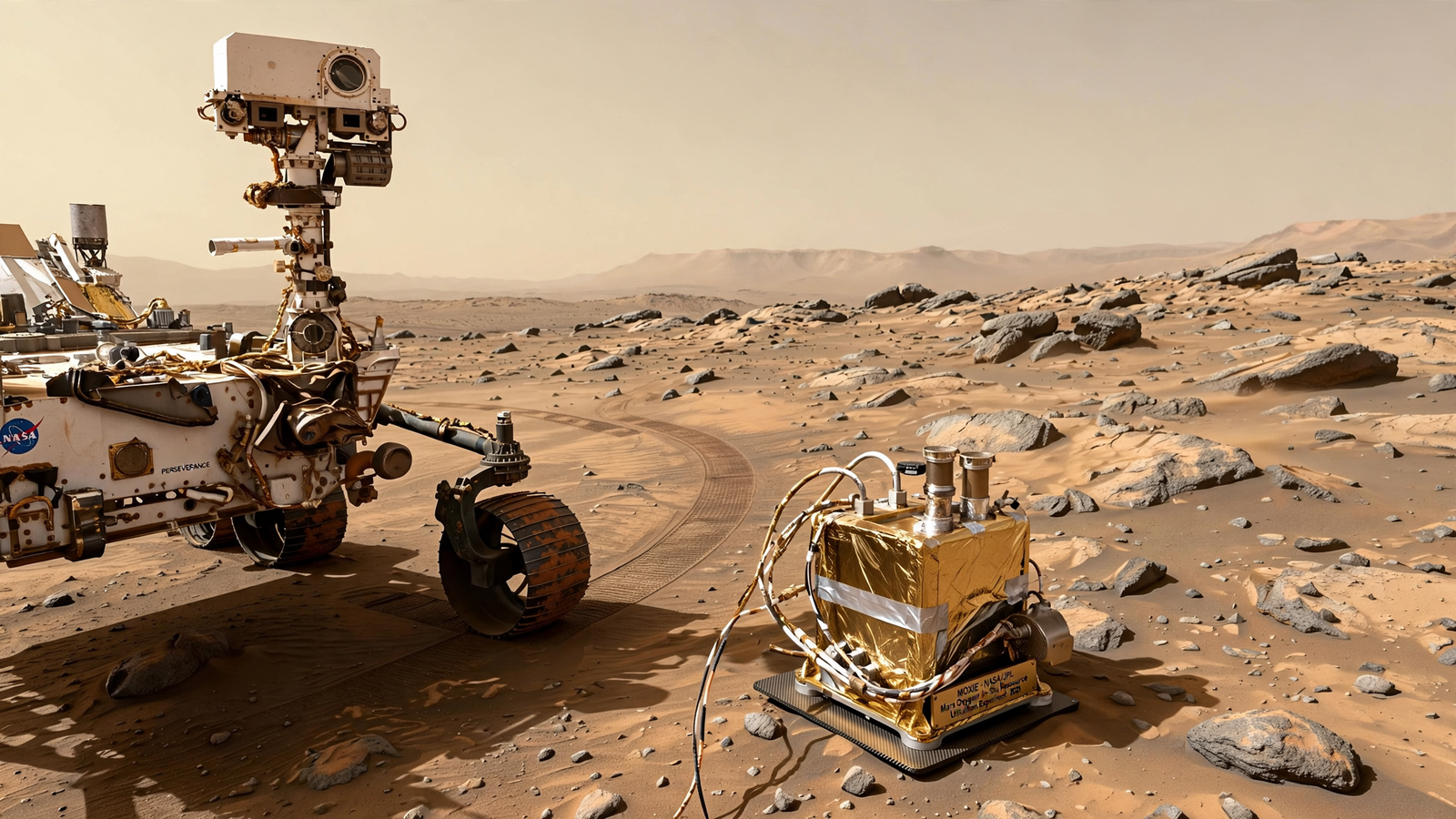
The device was called MOXIE, short for the Mars Oxygen In-Situ Resource Utilization Experiment. About the size of a car battery, it was not designed to support astronauts or fill a spacecraft’s tanks. It was a technology demonstration: a carefully scaled experiment intended to answer one practical question before humans attempt to land on Mars.
Could explorers make some of what they need after they arrive?
A different way to travel to Mars
Every kilogram sent to Mars must be launched from Earth, carried across interplanetary space and delivered safely to the surface. That makes mass one of the central problems of human spaceflight. Food, habitats, tools, scientific equipment, water and fuel all compete for room on a mission that may already require several launches.
Oxygen would be especially valuable. Astronauts would need it for breathing, but a much larger quantity could be used as an oxidizer in rocket propellant. A vehicle returning from Mars would need fuel and oxidizer to leave the planet’s surface and begin the journey home. Carrying all that oxygen from Earth would add a significant burden to the mission.
Mars, however, already has a huge reservoir of oxygen—locked inside carbon dioxide molecules in its atmosphere. The challenge is to separate it efficiently and reliably in a place where temperatures, dust and power conditions are very different from those on Earth.
MOXIE was built to test that idea.
How the experiment worked
The instrument drew in Martian air and filtered out dust. It then compressed and heated the gas before sending it through an electrochemical device called a solid oxide electrolyzer. For related reading, see Closed Captioning: How Television Learned to Speak to More People.
Inside that system, electricity and heat helped split carbon dioxide into oxygen ions and carbon monoxide. The oxygen ions moved through a ceramic electrolyte and combined to form molecular oxygen—the same O2 found in Earth’s atmosphere. Sensors checked the composition and purity of the resulting gas before it was released.
MOXIE did not store large quantities of oxygen. Its purpose was to demonstrate the conversion process, measure performance and learn how the equipment behaved under real Martian conditions.
That distinction matters. A laboratory demonstration can run under carefully controlled conditions. A machine on Mars must cope with a changing atmosphere, limited power, intense cold, abrasive dust and the long delay between Earth and the rover. Engineers cannot simply reach out and repair it when something goes wrong.
A shoebox-sized proof of concept
Perseverance landed in Jezero Crater in February 2021. MOXIE began operating soon afterward, carrying out production runs at different times of day and during different seasons. This allowed engineers to see whether its performance changed as the density and temperature of the atmosphere shifted.
Over the course of the rover’s primary mission, MOXIE produced oxygen 16 times. NASA reported a total output of 122 grams—roughly enough to provide a small dog with oxygen for about 10 hours. That amount sounds modest, but the experiment was intentionally small. Its achievement was not the quantity; it was the repeatability.
At its best, MOXIE produced about 12 grams of oxygen per hour. NASA also reported that the oxygen reached a purity of at least 98 percent. The instrument continued working after meeting its original goal, giving the team additional information about operating the system under changing environmental conditions.
For a machine that had to function remotely on another planet, repeated success was the important result. MOXIE showed that carbon dioxide gathered directly from the Martian atmosphere could become a usable oxygen supply.
Why the demonstration was deliberately small
The instrument’s compact size was a strength for a technology test. It could ride with the rover without competing with Perseverance’s cameras, drills and scientific instruments. But a human mission would need a much larger system.
NASA engineers estimate that a full-scale oxygen generator would need to produce far more than MOXIE did—potentially several hundred times its output—to support a crewed expedition. Such a plant would also need a dependable power source, thermal-control equipment, compressors, filters, gas storage and systems capable of operating for long periods without maintenance. For related reading, see X-59: How NASA Is Trying to Make Supersonic Flight Neighbors Can Live With.
The scale-up would bring new problems. A larger machine would draw more electricity and produce more heat. It would need to run through dust storms and seasonal changes. Its components would have to survive years of use, because a Mars mission could require equipment to operate before, during and after the arrival of astronauts.
MOXIE did not solve all of those engineering challenges. It answered a narrower question, but it answered it on the surface of Mars rather than in a terrestrial test chamber.
Oxygen is only one part of the equation
Making oxygen locally would not make Mars easy to inhabit. The planet remains extremely cold, dry and exposed to radiation. Its atmosphere cannot support unprotected human life. Water, food, shelter, power and reliable communications would still be essential.
Even so, oxygen production could change how a mission is designed. Instead of launching every kilogram needed for a return trip from Earth, planners could send equipment ahead of the crew and allow it to manufacture and store oxygen before the astronauts arrive. That approach could reduce the amount of mass launched with the crew—or create a larger margin for emergencies.
The timing would be crucial. A production plant would need to operate successfully long before a crew committed to the landing. It would also need enough storage capacity to hold the oxygen until it was needed. The mission architecture would therefore depend not only on the chemistry, but on years of dependable operation.
MOXIE’s results help make that kind of planning more realistic because they turn an appealing idea into a measured engineering performance. Scientists and engineers now have data about power use, heat, production rates, purity and operation across Martian conditions.
The broader lesson: use what is already there
MOXIE belongs to a larger idea known as in-situ resource utilization, or ISRU. Rather than transporting every resource from Earth, explorers could use local materials wherever possible. For related reading, see The Earth Day Poster: How a New Environmental Movement Learned to Speak in Public.
On Mars, the atmosphere might provide oxygen. Subsurface ice could eventually provide water, if accessible locations are found and extraction systems can operate there. Water could support life-support systems and, after processing, become part of rocket propellant. Martian soil might also supply construction materials.
None of these possibilities is simple, and none should be treated as a substitute for careful exploration. But every resource produced locally could reduce the amount that must cross millions of miles of space.
That is what made MOXIE’s quiet work significant. It did not discover life, photograph an ancient river or travel across the planet. It sat inside a rover and processed air that humans could never breathe. Yet its success addressed one of the most concrete obstacles between robotic exploration and human travel.
A machine that changed the question
Before MOXIE, producing oxygen from Martian air was mainly a proposal supported by chemistry and engineering calculations. After MOXIE, it became a demonstrated operation performed repeatedly on Mars.
The experiment’s final output was small, but its implication was larger: the planet may not be only a destination to which supplies are delivered. Some of the materials needed for exploration could be made there.
That does not make a human journey to Mars imminent, and it does not remove the risks of such a mission. It does provide something space exploration often needs before the next major step—a tested piece of knowledge, earned in the place where it will matter.
On a world where the air is thin, cold and unbreathable, MOXIE found a way to make a little oxygen. The next generation of machines will have to learn how to make a lot more.
Use: Mission results, total oxygen produced, production runs and implications for future human exploration.
Use: Instrument performance, operating conditions and the significance of producing oxygen directly from the Martian atmosphere.
Use: Technical background on the instrument, its peak production rate and the engineering path toward a larger oxygen plant.
Use: Peer-reviewed research on MOXIE’s oxygen production and performance on the Martian surface.