For four days each year, a quiet form of participation spreads across neighborhoods, farms, schoolyards, city parks, and apartment balconies. People look outside, identify the birds they can find, count them, and submit their observations.
The activity may take only 15 minutes. It does not require a rare bird, expensive equipment, or a remote wilderness destination. A house sparrow on a fence, a chickadee at a feeder, or a gull moving over a parking lot can all become part of the record.
This is the Great Backyard Bird Count, a citizen-science project that began in North America in 1998 and eventually became a worldwide collaboration. Its central idea is simple: when many people make standardized observations at the same time, ordinary sightings can reveal patterns that no individual observer could see alone.
A science project built for ordinary attention
The Great Backyard Bird Count was created by the Cornell Lab of Ornithology and the National Audubon Society. Birds Canada later joined the partnership, helping the project expand beyond its original North American focus. The Cornell Lab’s eBird platform provides the main online infrastructure for submitting and organizing observations.
The project was designed around accessibility. Participants do not have to travel to a protected area or consider themselves expert birders. They can count from wherever they are, using binoculars, field guides, mobile apps, or simply the birds they already recognize.
That low barrier matters. A wildlife survey conducted only by professional researchers can be precise, but it can cover only a limited number of places at one time. A public count can gather observations from thousands of locations, including places scientists may not regularly visit.
The Great Backyard Bird Count turns a familiar human habit—looking out a window—into a shared observation system. Its value comes not from any single checklist, but from the accumulation of many checklists made under a common set of instructions. For related reading, see The QR Code: How a Factory Tool Became a Global Language for Information.
How the count works
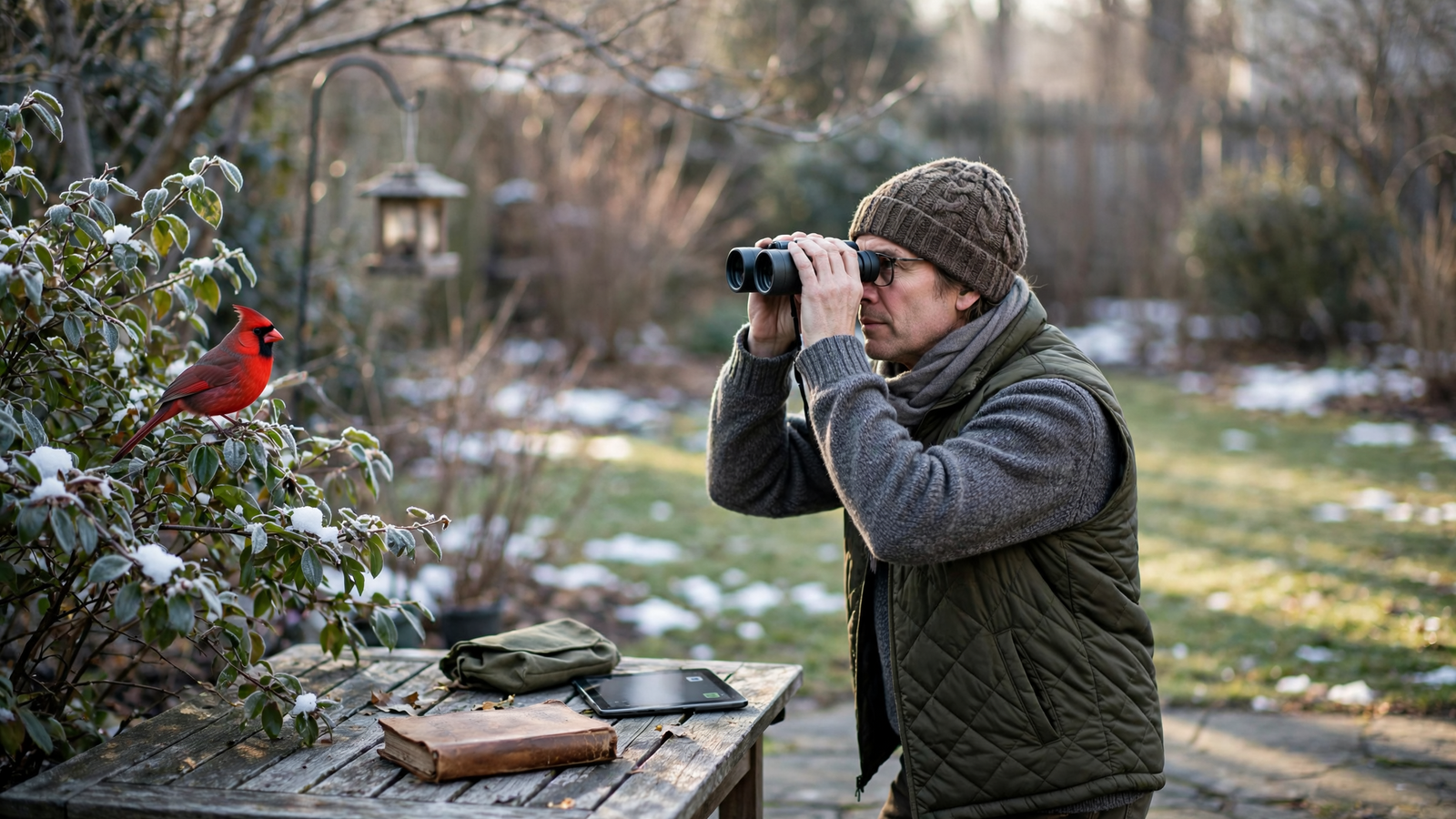
During the annual event, participants choose a place to watch birds. The location might be a backyard, a school campus, a community garden, a beach, or a public trail. They spend at least 15 minutes counting the birds they see or hear and record the number of each species.
Participants can count for longer and can submit more than one checklist from different locations or periods. The important discipline is to record the highest number of individuals of each species seen together, rather than adding every bird seen across the entire observation period. That helps prevent the same individual from being counted repeatedly.
After the observation, participants submit their lists through the Great Backyard Bird Count website or compatible eBird tools. The project also encourages people to report birds they cannot confidently identify by using photographs, recordings, or help from other observers.
The count is not a competition to find the most unusual bird. Common species are important because they help establish a picture of what is present in ordinary environments. A familiar northern cardinal, American robin, or house finch may tell researchers more about local abundance than a single out-of-range visitor.
Why a short observation can matter
Birds are unusually useful indicators of environmental change. They occupy nearly every kind of habitat, respond to weather and food availability, and can move across large distances. Changes in their numbers, timing, and distribution may reflect broader changes in forests, wetlands, grasslands, coastlines, farms, and cities.
A four-day count cannot answer every ecological question. It is a snapshot, not a complete census. Weather can affect which birds are visible, and the people who participate are not distributed evenly across the planet. Some species are easier to identify than others, and some regions receive much more attention than others.
Those limitations do not make the information useless. They show why scientists interpret the observations alongside other sources, including long-term surveys, banding programs, habitat studies, and year-round eBird records. Repeated public observations can help highlight where more focused research is needed.
The project also produces a shared annual portrait. Maps and summaries show where birds were reported, which species appeared in particular regions, and how participation spread across countries and communities. For a participant, the result may be a personal checklist. For researchers, it becomes one part of a much larger dataset. For related reading, see Lascaux: How Four Teenagers Found an Ice Age Gallery.
From backyard hobby to global network
The first Great Backyard Bird Count was deliberately local in concept. It invited people in the United States and Canada to report birds during the same winter period, creating a broad but manageable snapshot of bird populations.
As digital reporting tools improved, the project became easier to join from elsewhere. In 2013, the count expanded internationally. That change transformed it from a North American event into a global one, allowing people in many climates and habitats to contribute during the same annual window.
Global participation also changes the meaning of the word “backyard.” In one place, it may mean a suburban garden with a bird feeder. In another, it may be a courtyard, a village field, a mountain settlement, or the edge of a tropical forest. The project’s strength is not that every participant observes the same landscape. It is that people in different landscapes use a shared method to describe the birds around them.
The resulting record reflects both nature and human presence. Some observations come from heavily developed areas, while others come from coastlines, wetlands, agricultural land, and remote regions. Together, they show that birdlife is not confined to formal nature preserves. It is woven into everyday places.
The social side of citizen science
The Great Backyard Bird Count is also a lesson in how scientific participation can be made welcoming. A person can begin with one recognizable species and gradually learn more. Families can count together. Teachers can use the event to connect biology with weather, geography, writing, and data interpretation. Community groups can organize walks or compare observations from different neighborhoods.
That social dimension is not merely an extra benefit. People are more likely to notice changes in their surroundings when they have a reason to look closely. A child who learns to distinguish a crow from a raven may later recognize seasonal patterns. A gardener who starts recording visitors may become more aware of native plants, insects, water, and shelter. Attention can become the beginning of stewardship.
The project also gives participants a way to contribute without pretending that every observation is perfect. Learning bird identification involves uncertainty. A responsible checklist can include only species the observer can identify with reasonable confidence. That expectation makes the project more useful and teaches an important scientific habit: knowing what you know, and what you do not. For related reading, see Eunice Foote: How a 19th-Century Scientist Helped Put Climate Science on the Record.
What the count cannot replace
Public participation is powerful, but it is not a substitute for professional monitoring. Scientists still need carefully designed surveys, standardized field protocols, habitat measurements, and long-term studies. A bird count made from a city balcony cannot provide the same information as a systematic survey of breeding habitat.
Nor should a large number of observations automatically be treated as proof that a species is thriving. Participation varies from year to year, and birds may be easier or harder to find depending on weather and local conditions. The data become most informative when interpreted carefully and combined with other evidence.
That caution is part of the project’s value. The Great Backyard Bird Count does not promise that a few minutes of observation can explain an entire ecosystem. It offers something more practical: a structured way for many people to contribute observations that can be checked, compared, and placed in context.
A small habit with a wide horizon
There is something quietly democratic about the count. It does not ask participants to wait for a dramatic wildlife encounter. It asks them to notice what is already present.
That may be a flock moving through a city, a wren calling from a hedge, or a hawk circling above a schoolyard. Each observation is local and limited. Together, thousands of observations create a wider view of how birds share the planet with people.
The Great Backyard Bird Count succeeds because it connects three things that are often separated: scientific information, public participation, and everyday wonder. Its participants are not simply collecting sightings. They are helping build a record of the living world at the scale where most people actually encounter it.
For anyone who wants to take part, the first step is modest: choose a place, watch for at least 15 minutes during the count period, record only what can be identified, and submit the list. The larger discovery comes afterward, when one backyard becomes part of a map that reaches far beyond it.
Use: Participation instructions, project overview, annual count format, and reporting guidance.
Use: Project history, citizen-science context, and relationship to Cornell Lab programs.
Use: Background on the count and its role in community-based bird observation.
Use: Information on the Canadian partnership and public participation in the count.
Use: Context on the bird-observation platform used to collect and organize bird records.