In the spring of 1974, farmers outside Xi’an, in China’s Shaanxi Province, began digging a well. The region was dry, and a reliable water source mattered. Their work was ordinary in purpose, but the ground had been holding an extraordinary secret for more than two thousand years.
Instead of clean earth, the diggers encountered fragments of fired clay: pieces of a head, broken limbs, and bricks. At first, the discovery did not look like a royal burial complex. It looked like debris from an old kiln or a damaged shrine. But the fragments belonged to human figures, and beneath them lay something much larger.
Archaeologists soon recognized that the farmers had found part of the burial complex of Qin Shi Huang, the ruler who unified much of China in 221 BCE and became its first emperor. Buried in underground pits near his mausoleum was an immense clay army: infantry, cavalry, chariots, officers, and other figures arranged as though prepared to guard the emperor in another world.
A discovery beneath the fields
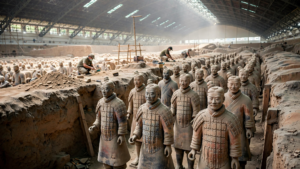
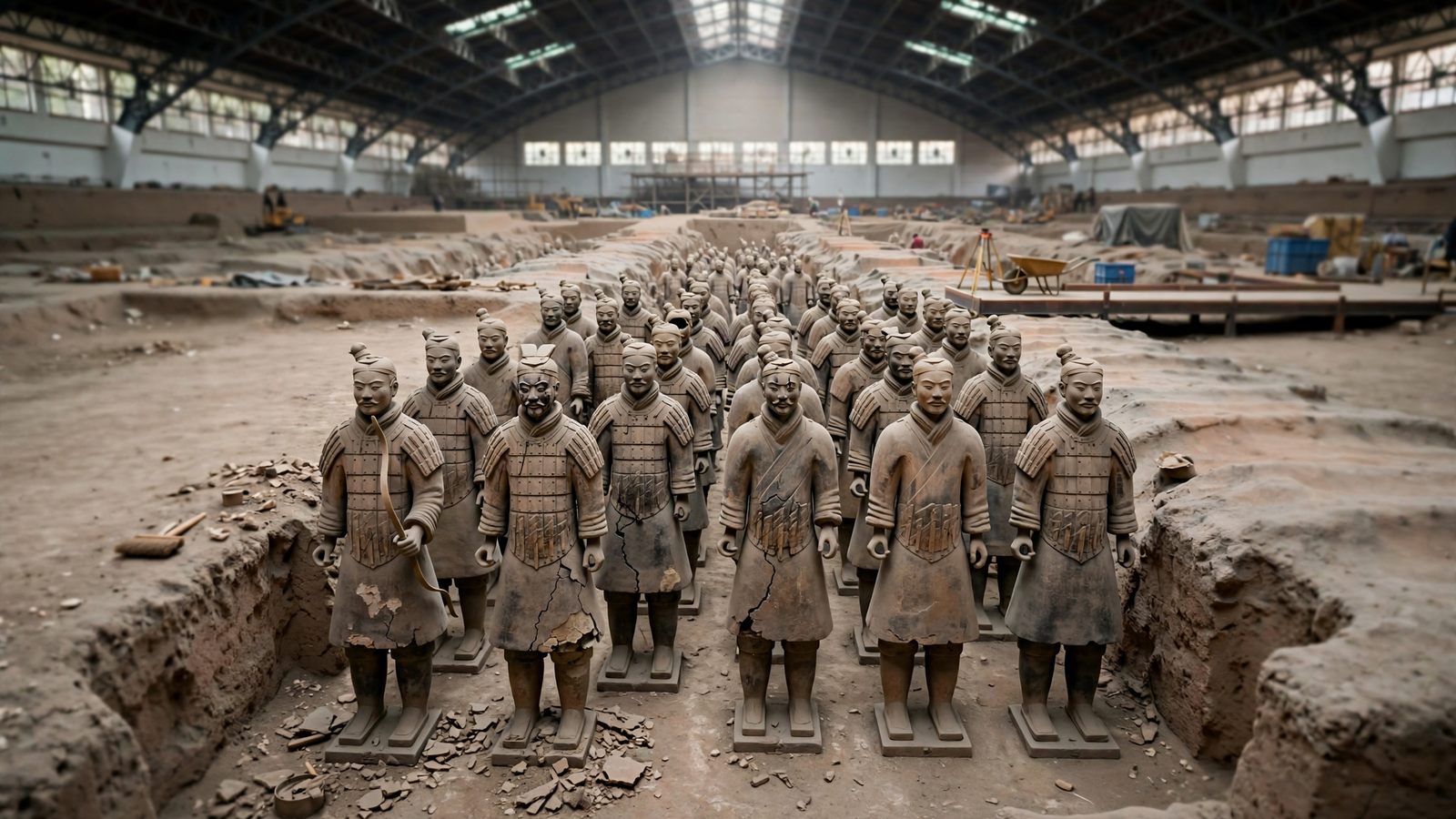
The first reports of the find reached local cultural officials in 1974. Archaeologists investigated the well site and began recovering more fragments. As excavation expanded, the scale of the discovery changed dramatically. The figures were not isolated statues placed around a tomb. They stood in long, organized formations inside large timber-roofed pits.
The site became known as the Terracotta Army, or Terracotta Warriors. It is part of the mausoleum complex built for Qin Shi Huang near modern Xi’an. UNESCO describes the wider complex as one of the largest and most important imperial tomb projects ever created, covering roughly 56 square kilometers. The underground army was only one part of a much bigger landscape of burial mounds, ritual buildings, processional routes, and related remains.
The farmers had not found the emperor’s main burial chamber. They had uncovered the army intended to protect him.
Why Qin Shi Huang needed an army after death
To understand the discovery, it helps to understand the ruler who commissioned it. Qin Shi Huang was born in 259 BCE, during the Warring States period, when rival kingdoms competed for territory and survival. In 221 BCE, the Qin state defeated its remaining rivals. The new ruler took the title “First Emperor” and established an empire that would shape the political idea of a unified China for centuries. For related reading, see The Terracotta Army: How Farmers Unearthed China’s Silent Imperial Guard.
His government standardized systems across the empire, including weights and measures, currency, and forms of writing. It also built roads and defensive works while ruling through a highly centralized and demanding administration. Qin Shi Huang’s reign was short: he died in 210 BCE. Yet the mausoleum project had begun decades earlier, soon after he became king of Qin, and continued through much of his life.
Ancient Chinese rulers were often buried with objects intended for use in the next world. In earlier periods, that could include real weapons, animals, servants, and even people. The Terracotta Army reflects a major transformation in burial practice. Instead of sending thousands of living attendants to accompany the ruler, the builders created substitutes in clay.
These figures were not simply decorative. Their arrangement suggests a military organization. Infantrymen stand in ranks. Officers occupy positions of authority. Cavalrymen appear with horses, while chariots and weapons complete the force. The underground formations offered an image of the emperor’s power continuing beyond death.
Thousands of figures, made one piece at a time
The warriors are life-size, but they were not carved from single blocks of stone. Workshops produced many parts separately, including heads, hands, arms, torsos, legs, and feet. Workers then assembled the components and added details such as armor, hairstyles, facial features, and clothing.
That method made large-scale production possible, but the finished figures still display striking variation. Faces, beards, expressions, uniforms, and hairstyles differ. Some appear to be senior officers; others represent ordinary soldiers. The differences may have helped create the impression of a vast living force, though scholars continue to debate exactly how much individuality was intended and how the workshops organized production.
The army was once brightly painted. Traces of pigments have survived on some fragments, even though exposure to air causes many colors to fade or disappear. The familiar gray-brown appearance of the figures is therefore not how the army originally looked. In its first setting, the underground force would have included painted clothing, colored armor, and vivid details against the dark timber interiors of the pits.
Real bronze weapons were also placed with the figures. Archaeologists have found swords, spears, halberds, arrowheads, and other military equipment. The weapons demonstrate the technical sophistication of Qin metalworking and provide evidence about the equipment used during the period of unification. For related reading, see The Antikythera Mechanism: How a Shipwreck Revealed the Ancient World’s Mechanical Cosmos.
The three great pits
Excavation revealed several pits, but three became the principal archaeological areas associated with the army. Pit 1 is the largest and contains long ranks of infantry and chariots. Its scale makes the military design immediately visible: rows of figures extend beneath the earth, separated by earthen walls and arranged along corridors.
Pit 2 contains a more varied force, including archers, cavalry, chariots, and infantry. Pit 3 is smaller and is generally interpreted as a command post because of its different arrangement and the kinds of figures found there. A fourth pit was discovered but contained no completed army. Its emptiness may indicate that construction stopped before the project was finished.
The pits were not designed as permanent exhibition halls. They were large underground structures covered with timber beams, mats, and layers of earth. Over time, roofs collapsed, fires damaged parts of the complex, and many figures were broken. Some destruction may have occurred soon after the Qin dynasty ended, during upheavals associated with the transition to the Han dynasty.
That damage created one of the excavation’s greatest challenges. Archaeologists did not uncover a perfectly preserved parade. They found thousands of scattered pieces that had to be recorded, stabilized, and fitted together. Reconstructing a single warrior can require the patient matching of fragments from the same pit.
A new kind of archaeological work
The Terracotta Army changed not only what the public knew about Qin China, but also how large archaeological discoveries could be studied. Excavation had to be combined with conservation, materials analysis, digital recording, and careful site management. Paint layers, wood, bronze, soil, and fired clay each presented different preservation problems.
The work also encouraged researchers to look beyond the individual statues. The pits contain evidence about labor, workshop organization, military equipment, transport, construction engineering, and imperial administration. Marks on some components have been studied as possible indicators of workshop groups or production teams. Rather than being only a collection of artworks, the site is an archive of how a state mobilized people and resources on a massive scale.
The discovery also corrected an older assumption that ancient sculpture had to be either purely symbolic or produced only for elite artistic display. The warriors are symbolic, but they are also practical in design. Their armor, weapons, ranks, and equipment communicate a specific military order. Their existence reveals how political power could be represented through an entire underground institution. For related reading, see The Ghost Army: How American Soldiers Won Battles With Illusions.
What remains hidden
The emperor’s central tomb mound remains largely unexcavated. Ancient accounts describe the burial chamber in dramatic terms, including rivers of mercury and a miniature representation of the empire. Some modern studies have reported elevated mercury levels in the soil around the mound, but the full condition and contents of the chamber have not been established by excavation.
That restraint is deliberate. Opening a fragile tomb is not simply a matter of removing soil. Archaeologists must consider whether conservation technology can protect materials that have been sealed for centuries. The history of the Terracotta Army itself shows what can be lost when painted surfaces meet air or when collapsed structures are disturbed too quickly.
As a result, the untouched parts of the mausoleum remain part of the discovery’s story. Archaeology here is not only about uncovering the past. It is also about deciding when not to dig, and how to preserve evidence for methods that may be better in the future.
From local well site to world heritage
The farmers who began digging for water could not have known that the fragments beneath them belonged to one of the defining archaeological discoveries of the modern era. Their find connected an ordinary landscape to the ambitions of an emperor who had tried to organize an entire world around himself.
Today, the Terracotta Army is protected as part of the Mausoleum of the First Qin Emperor, a UNESCO World Heritage site. Visitors see restored ranks of warriors in vast excavation halls, but the deeper meaning of the site lies in the contrast between appearance and reality. The army looks like a frozen military formation, yet every figure is also evidence of human labor: clay molded by hand, bronze cast and polished, timber raised underground, and fragments patiently reunited after centuries of damage.
The discovery did more than reveal an ancient army. It opened a record of how a new empire imagined authority, how technology served ritual, and how a ruler’s desire for permanence shaped the lives of countless workers. Beneath fields outside Xi’an, a search for water uncovered a civilization’s answer to an enduring question: what should power take with it into eternity?
Use: Authoritative information on the mausoleum complex, its archaeological importance, World Heritage status, and the Terracotta Army pits.
Use: Historical context on Qin Shi Huang, the discovery, the figures, and the organization of the underground army.
Use: Context on the 1974 well discovery, excavation history, the figures’ original colors, and conservation challenges.