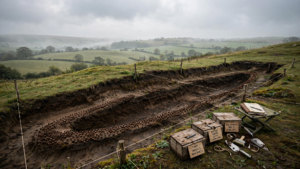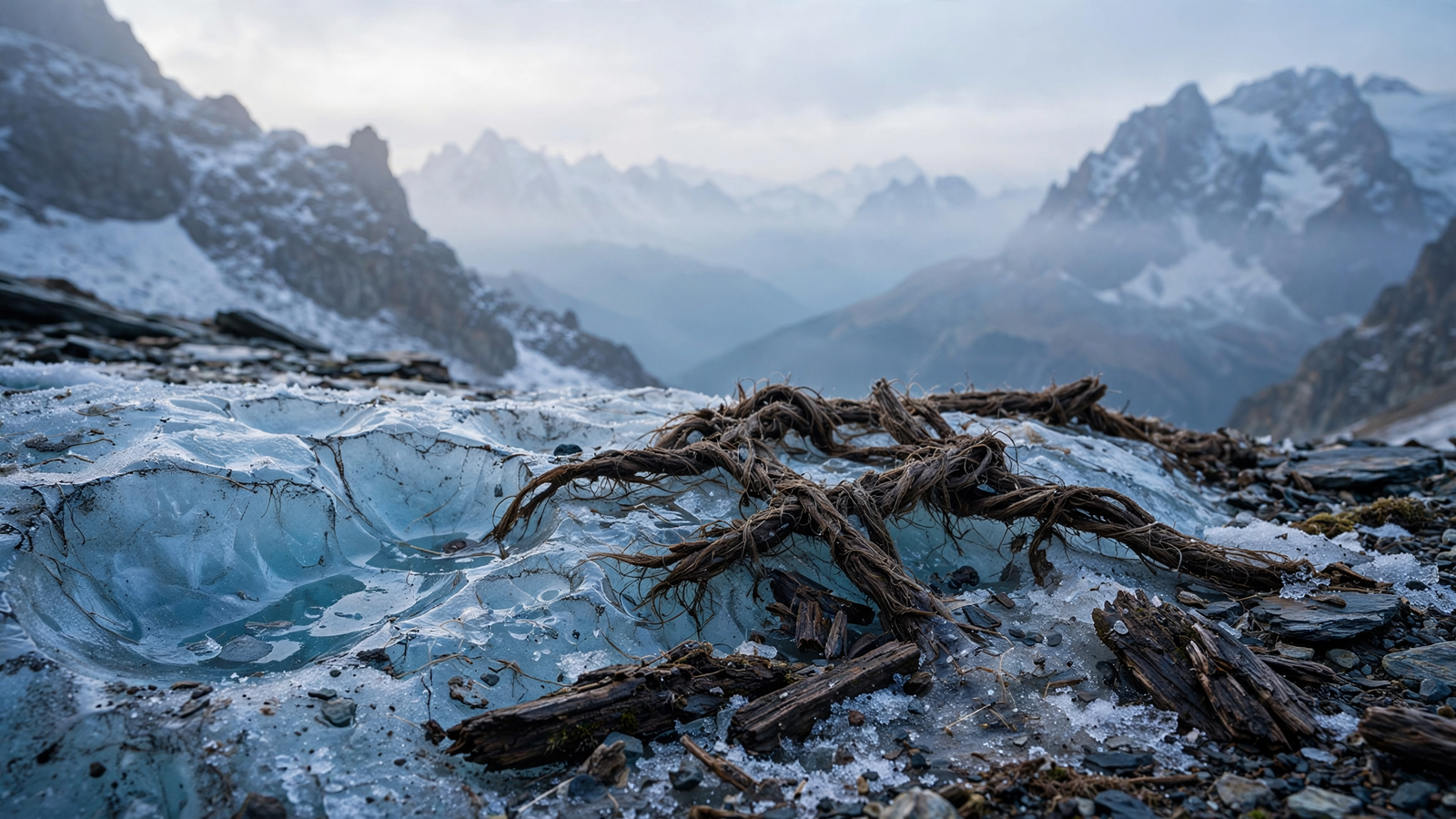
On September 19, 1991, Erika and Helmut Simon were walking near the Tisenjoch pass in the Ötztal Alps when they noticed something dark protruding from melting ice. At first, the hikers assumed they had found the remains of a recent mountaineering accident. The body lay in a shallow depression near the Austrian-Italian border, at an elevation of roughly 3,210 meters.
The discovery would eventually become one of the most important archaeological finds of the modern era. Preserved by cold, ice and extraordinary circumstances, the man became known as Ötzi the Iceman. His body, clothing and equipment offered researchers an unusually detailed view of a person who lived more than 5,000 years ago—during the Copper Age, when communities across Europe were experimenting with metals while still relying heavily on stone, wood, leather and bone.
A body mistaken for a modern victim
The first hours of the discovery were marked by confusion. The site was difficult to reach, and the body was partly embedded in ice and water. Rescue workers used tools to free it, damaging some of the surrounding material in the process. The remains were taken to Innsbruck, where experts began examining them.
For a short time, investigators thought the body might belong to someone who had died recently. That interpretation changed when archaeologists recognized that the remains were extraordinarily old. Radiocarbon testing later placed Ötzi’s death at approximately 5,300 years ago, around 3300 BCE.
The location also became significant. Although the discovery site is now associated with Italy, the remains were initially transported to Innsbruck in Austria. A later survey established that the body had been found on the Italian side of the border. Ötzi is now conserved and displayed at the South Tyrol Museum of Archaeology in Bolzano, Italy, under carefully controlled conditions.
Why the ice preserved so much
Ötzi was not simply a skeleton. The glacier had preserved soft tissue, clothing and tools, creating what scientists call a natural mummy. The conditions were not perfectly stable over the entire period, but the body spent most of its long burial protected by ice and low temperatures. For related reading, see The Antikythera Mechanism: How a Shipwreck Revealed the Ancient World’s Mechanical Cosmos.
That preservation made it possible to study details that rarely survive in archaeological sites. Researchers could examine the man’s skin, muscles, stomach contents, clothing fibers and personal equipment. They could also investigate pollen and other microscopic traces connected to the landscape he crossed shortly before his death.
The result was not a single story written in one moment. It was a growing body of evidence assembled over decades. New imaging techniques, genetic analysis and chemical testing have continued to refine what researchers know about Ötzi and the world around him.
A traveler carrying the tools of daily life
Ötzi’s possessions showed that he was equipped for movement through a demanding mountain environment. Among the objects found with him were a copper axe, a flint dagger, a quiver containing arrows, a bow that was not yet finished, and tools for working flint. He also carried pieces of birch fungus, probably useful for starting or maintaining fire, along with other materials that may have had practical or medicinal purposes.
His clothing was made from several animal and plant materials. Researchers identified components including leather, fur, grass and bark. He wore a grass cape and footwear designed for cold, rough terrain. The clothes were not a simple uniform; they represented a collection of practical solutions—insulation, protection, carrying capacity and repair.
The copper axe is especially revealing. Copper objects were valuable and technologically significant during this period. Ötzi’s axe was not merely a household tool. Its metal blade and wooden haft indicate access to a specialized object, while the condition of his other equipment suggests that he was traveling with a working kit rather than being buried ceremonially with a collection of pristine possessions.
His gear also challenges the idea that prehistoric people moved through the Alps without planning or technical knowledge. The equipment reflects material expertise: how to shape stone, prepare wood, process hides, make cordage and assemble clothing capable of handling a harsh climate.
What his body revealed
Scientific examinations found evidence of a man who had experienced physical stress before his death. Ötzi was approximately 40 to 50 years old, an advanced age by the standards of many prehistoric populations, although comparisons with modern life expectancy can be misleading because infant mortality heavily affected ancient averages.
He had worn teeth, signs of joint degeneration and evidence of earlier injuries. Researchers also identified more than 60 tattoos, many formed from small groups of lines or crosses. Their placement often corresponded with areas where Ötzi showed degenerative changes or discomfort. This has led to the possibility that the tattoos were connected to therapeutic practices, although their exact meaning remains uncertain. For related reading, see Jerome State Historic Park: How a Copper Town’s Mansion Became a Mountain Archive.
Analysis of his stomach contents suggested that Ötzi had eaten shortly before he died. Researchers found evidence of animal meat and plant foods, including cereal grains. The contents helped establish not only what he had consumed, but also clues about the environments he had recently passed through.
Other studies have revealed exposure to smoke, traces of metals and a complex medical history. Ötzi carried intestinal parasites, and his preserved body showed evidence of several health problems. Yet the remains should not be reduced to a list of illnesses. The broader picture is of an active person who had traveled, worked and adapted to a demanding landscape.
The evidence of violence
For years, researchers debated how Ötzi died. The decisive clue came from new medical imaging in 2001, when scientists identified a flint arrowhead lodged near his left shoulder. The arrow had entered from behind and damaged a major blood vessel. A deep cut on his right hand provided further evidence that he had been involved in a violent encounter shortly before death.
Ötzi also suffered a blow to the head, although researchers have debated its timing and precise role. The available evidence does not reconstruct every moment of the event. It does, however, make clear that his death was not simply the result of exposure or an accidental fall.
His final hours remain an open archaeological question. He may have been pursued, attacked or caught in a conflict whose causes are lost. The arrow, defensive wound and position of the body offer clues, but not a complete narrative. That uncertainty is important: archaeology can establish evidence without pretending to know more than the evidence allows.
A discovery that changed the study of prehistory
Before Ötzi, archaeologists had studied Copper Age communities largely through settlements, graves, pottery, tools and scattered human remains. The Iceman added something different: a remarkably detailed individual life assembled from body, clothing, food and equipment. For related reading, see Ibn Battuta’s Rihla: How One Traveler Turned the Medieval World Into a Book.
His discovery helped demonstrate how much information can survive in environments that are usually hostile to preservation. It also showed why archaeological context matters. The body was valuable, but so were the objects around it, the position of the remains, the sediments, the pollen and the mountain landscape itself.
Ötzi has since become a major subject for interdisciplinary research. Archaeologists study his possessions and cultural setting. Anthropologists examine his body. Geneticists investigate ancestry and population history. Chemists analyze metals, food and environmental traces. Conservation specialists work to keep the mummy stable without exposing it to damaging changes in temperature or humidity.
The museum display reflects that scientific responsibility. Visitors do not see the body in ordinary room conditions. Ötzi is kept in a refrigerated chamber with high humidity, and a small window allows the public to view him without placing the remains in a conventional open exhibit. The arrangement is a reminder that preservation is an active process, not something the glacier accomplished once and for all.
The man behind the evidence
It is tempting to treat Ötzi as a time capsule rather than a person. But the details that make the discovery important also make it human. He carried food, repaired or used tools, wore layered clothing, suffered injuries, crossed mountains and relied on knowledge that had been built into the objects he carried.
The find does not provide a complete portrait of Copper Age society. One individual cannot represent an entire continent, and the circumstances of his death may have made his belongings unusual. Even so, Ötzi offers a rare encounter with the practical world of a particular person: what he ate, how he dressed, what he carried and how his body had been shaped by life.
More than three decades after the hikers saw a dark shape in the melting ice, the Iceman continues to change as research advances. The discovery began with a mistaken assumption about a recent accident. It became a carefully protected archive of ancient life—and one of the clearest reminders that history can emerge from places where nobody expected to find it.
Use: Official information on the discovery, preservation, body, clothing, equipment, tattoos and museum conservation of Ötzi.
Use: Institutional background on Ötzi’s discovery and the University of Innsbruck’s role in early scientific examination.
Use: Peer-reviewed research on the projectile injury and archaeological evidence associated with Ötzi’s death.
Use: Peer-reviewed genetic research contributing to scientific understanding of Ötzi’s biological background.