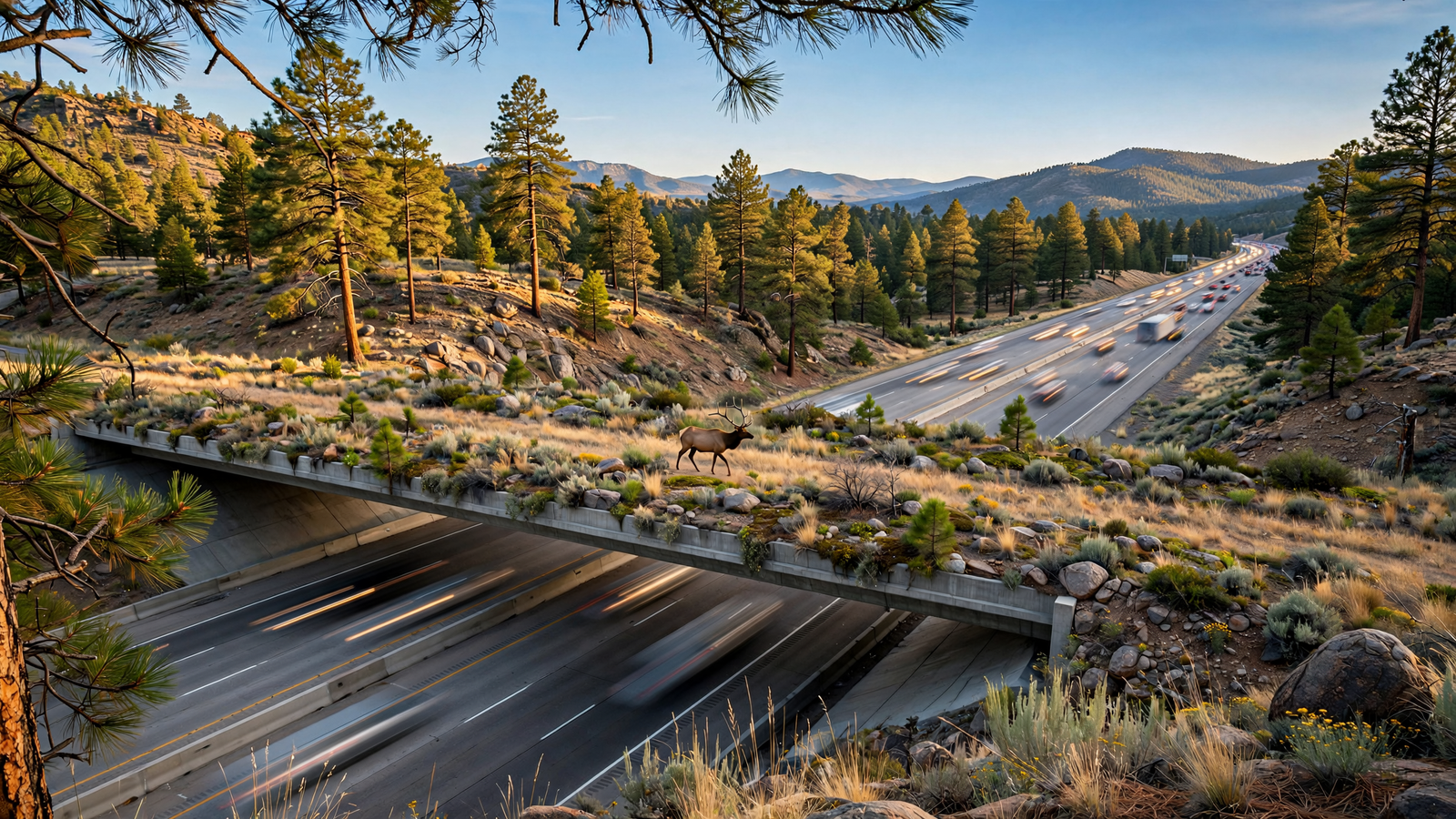
On Interstate 17 north of Phoenix, the road rises from the Sonoran Desert toward the forests around Flagstaff. The landscape changes dramatically along the way, but one feature remains constant: a broad ribbon of pavement dividing habitat that wildlife has used for generations. For related reading, see Wyoming’s Wildlife Crossings Are Giving Mule Deer a Safer Road Home.
For elk, deer, black bears, mountain lions and smaller animals, crossing that ribbon can be dangerous. For people behind the wheel, an animal entering the highway can turn an ordinary trip into a sudden emergency. Arizona is now planning a major change to that relationship. For related reading, see Granite Creek Corridor: How Prescott Is Making Room for Water, Wildlife, and Daily Life.
The Interstate 17 Munds Mountain Wildlife Crossing Project will create dedicated routes for wildlife to pass over and beneath the highway in the Coconino County landscape between Flagstaff and the Verde Valley. The project is intended to reconnect habitat while reducing the chance that animals and vehicles meet in the traffic lanes.
It is a practical form of transportation infrastructure—one that treats wildlife movement as part of highway design rather than as an afterthought.
A highway through an old animal corridor
Interstate 17 is one of Arizona’s major north-south routes. It links the Phoenix metropolitan area with Flagstaff and carries freight, vacation traffic, commuters and residents traveling between northern and central Arizona. The highway also passes through a landscape used by a wide range of species.
The Munds Mountain area, east of I-17 near the turnoff toward Oak Creek Canyon and Sedona, sits within a network of forests, canyons and mountain ranges. Animals do not recognize the boundaries that people draw around roads. Seasonal movement can take them across the highway in search of food, water, shelter or mates.
When a large animal reaches a roadway, the danger is shared by everyone involved. A collision can kill or injure the animal, damage a vehicle and cause serious harm to the people inside it. Even when a crash is avoided, a driver swerving to miss an animal can create a second hazard for nearby traffic.
Wildlife crossings address the problem at its source. Instead of asking animals to judge gaps in fast-moving traffic, engineers can guide them toward structures built specifically for passage.
Arizona’s planned solution
The Arizona Department of Transportation, working with the Arizona Game and Fish Department and federal transportation agencies, received a $24.3 million grant through the Federal Highway Administration’s Wildlife Crossings Pilot Program. The federal program was created to support projects that reduce wildlife-vehicle collisions and improve habitat connectivity.
Plans for the Munds Mountain project call for a combination of crossing structures along I-17, including a wildlife overpass and underpasses, together with fencing that guides animals toward the safer routes. The exact design reflects the varied needs of animals that use the area. A structure suitable for elk may not be the best route for smaller mammals, reptiles or other species.
Fencing is an especially important part of the concept. A crossing structure by itself does not guarantee that wildlife will use it. The surrounding barriers help prevent animals from entering the roadway at random points and funnel them toward the designated passages.
That combination—crossings plus fencing—is now a standard feature of many successful wildlife-mitigation projects. It turns a dangerous section of highway into a more controlled connection between two sides of a habitat.
Why an overpass can work better than a warning sign
Arizona drivers already see signs warning them about elk, deer and other animals near highways. Those signs are useful reminders, but they place the entire burden on drivers and animals at the exact moment when conditions may be difficult: at night, during storms, in heavy traffic or around a blind curve.
A wildlife crossing takes a different approach. Rather than relying only on human reaction time, it changes the physical environment. The road remains available for vehicles, while animals receive a separate route above or below it.
Overpasses can be covered with soil and planted or landscaped so that they resemble the surrounding terrain. Underpasses can be shaped to provide a darker, sheltered passage. Designers may include natural ground, rocks, vegetation and other features that make a structure feel less like a tunnel or bridge and more like part of the landscape.
Wildlife does not necessarily begin using a new crossing immediately. Animals may need time to encounter it, investigate it and learn that it provides a safe route. For that reason, monitoring is an important part of the project. Cameras and other field tools can help biologists determine which species are using the structures and whether animals are continuing to approach the highway in unsafe locations.
A safety project with an ecological benefit
The most immediate transportation benefit is the potential reduction in collisions. The Federal Highway Administration identifies wildlife-vehicle crashes as a nationwide safety and infrastructure concern. The crashes can be expensive, disruptive and dangerous, especially when they involve large animals or occur on high-speed roads.
But the value of a crossing is larger than the number of crashes it may prevent. Roads can divide animal populations into smaller groups, making it harder for wildlife to reach seasonal resources or maintain connections with neighboring populations. Over time, that separation can affect the health and resilience of a population.
A crossing gives animals a way to move through a landscape that has been split by development. It can help preserve access to feeding areas, water sources and breeding habitat while allowing people to continue using an important highway.
That balance matters in a state where communities, recreation areas and transportation routes occupy the same broad spaces as working landscapes and wildlife habitat. Arizona’s growth has increased the importance of planning roads that serve people without unnecessarily closing off the surrounding environment.
Part of a larger shift in highway design
The I-17 project is not an isolated experiment. Wildlife crossings have been built or proposed in many parts of the United States, including western states where highways pass through large, relatively connected habitats. Some projects focus on a single notorious collision zone. Others create a series of crossings over a longer stretch of road.
Research and experience from those projects have helped transportation agencies understand that crossing design must be matched to local wildlife. A structure for pronghorn may require a different approach from one intended for mountain lions. A crossing in a forested mountain range may look different from one in open desert.
Arizona’s project also reflects a change in how transportation agencies define a successful highway. A road is no longer viewed only as pavement, lanes and interchanges. It is part of a larger system that includes drainage, vegetation, habitat and the movement of living creatures.
That broader view can produce benefits for drivers and wildlife at the same time. Fewer animals in traffic lanes can mean fewer dangerous surprises. Better connections between habitats can make it easier for wildlife to persist. And a carefully designed structure can become nearly invisible to motorists, doing its work without slowing the highway above it.
What drivers can do now
The new crossings will not eliminate the need for caution. Wildlife can still appear on roads outside the project area, and animals may remain active near highways during dawn, dusk and nighttime hours. Drivers traveling through northern Arizona should watch for warning signs, reduce speed when conditions call for it and scan the shoulders as well as the lane ahead.
It is also important to remember that animals often travel in groups. If one deer or elk crosses the road, others may follow. A driver who sees an animal should brake in a controlled manner and avoid abrupt swerving whenever possible.
Those individual choices remain important. The larger promise of the Munds Mountain project is that drivers will eventually have more help from the road itself.
A safer connection across the landscape
Infrastructure is often associated with separation: a highway divides one place from another, and a bridge carries people over an obstacle. The I-17 wildlife project offers a more generous idea of what infrastructure can do. It can also repair a connection.
When the planned overpass, underpasses and fencing are in place, animals will have dedicated routes across a highway that currently cuts through their range. Drivers will have a safer roadway, and biologists will gain a way to observe how wildlife responds when a dangerous barrier becomes passable again.
That is the encouraging part of this project. Arizona is not being asked to choose between mobility and nature. It is using transportation design to make room for both.
Use: Project scope, location, agencies involved and planned wildlife-crossing infrastructure.
Use: Federal program purpose and context for reducing wildlife-vehicle collisions and improving habitat connectivity.
Use: Federal funding context, including the Arizona project award.
Use: Arizona wildlife-movement and wildlife-vehicle-collision context.
Arizona Department of Transportation — I-17 Munds Mountain Wildlife Crossing Project — https://azdot.gov/projects/flagstaff-area-projects/i-17-munds-mountain-wildlife-crossing — Project scope, location, agencies involved and planned wildlife-crossing infrastructure.
Federal Highway Administration — Wildlife Crossings Pilot Program — https://highways.dot.gov/federal-lands/wildlife-crossings-pilot-program — Federal program purpose and context for reducing wildlife-vehicle collisions and improving habitat connectivity.
Federal Highway Administration — Wildlife Crossings Pilot Program awards — https://highways.dot.gov/newsroom/biden-harris-administration-announces-110-million-wildlife-crossings-improve-safety-and-connect — Federal funding context, including the Arizona project award.
Arizona Game and Fish Department — Wildlife Crossings — https://www.azgfd.com/wildlife/conservation-and-management/wildlife-crossings/ — Arizona wildlife-movement and wildlife-vehicle-collision context.