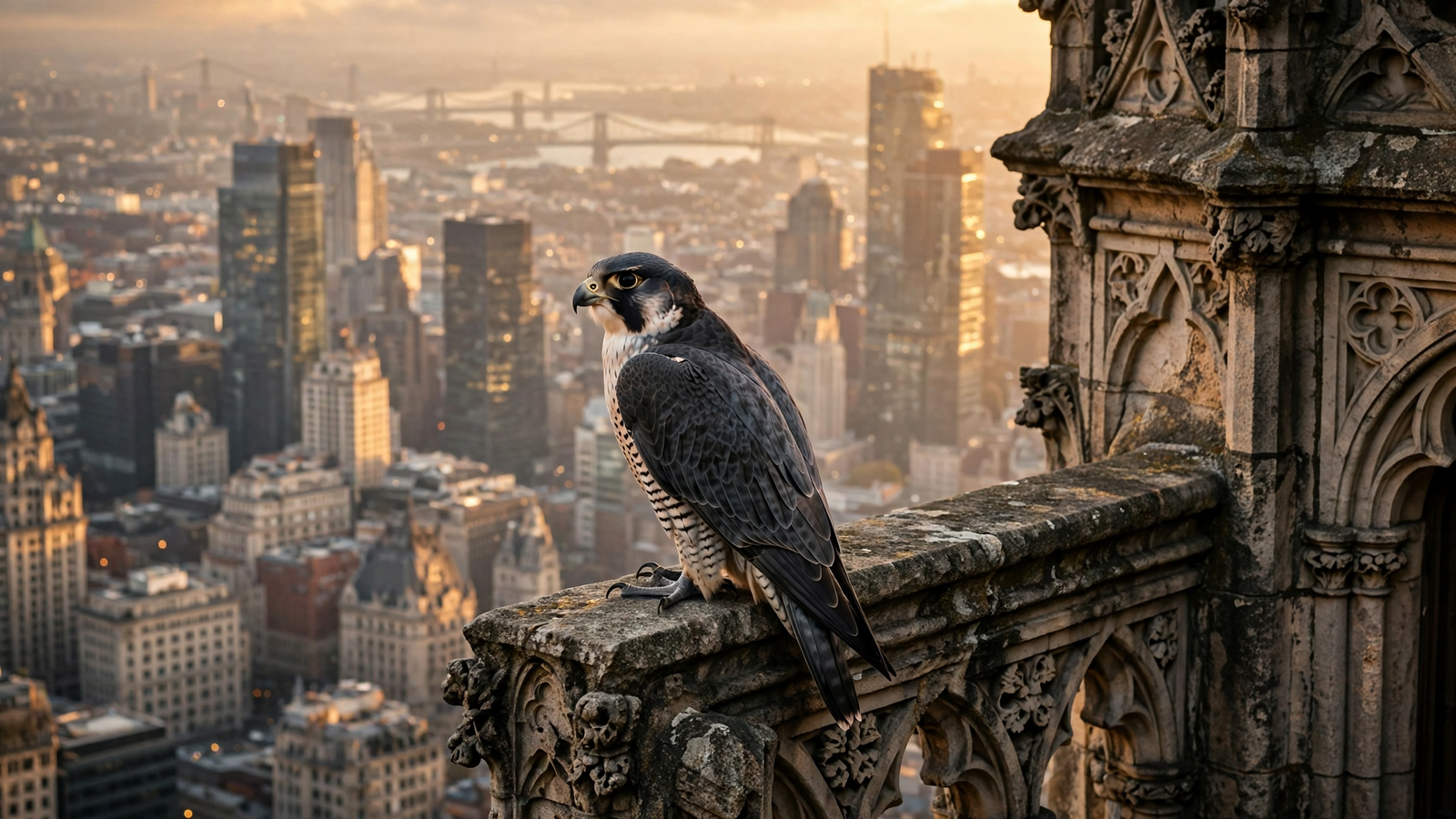
Look up from a downtown street and the skyline may seem to belong entirely to people: glass towers, concrete ledges, antennas, and traffic. Yet in many cities, those same structures have become habitat for one of the planet’s most remarkable birds.
The peregrine falcon, a powerful hunter built for speed, has made an extraordinary return from a population collapse caused by chemical pollution. After disappearing from much of its former range in North America, it was restored through a combination of legal protection, scientific research, captive breeding, habitat care, and persistent monitoring.
Today, peregrines nest on natural cliffs and bridges, office towers and cathedral ledges. Their recovery is more than a conservation success story. It is evidence that damaged wildlife populations can respond when people address the cause of decline and give nature room to work.
A bird built for open skies
Peregrine falcons live across much of the world, from Arctic tundra to temperate forests, coastlines, deserts, and urban centers. Their name comes from a word meaning “wandering,” a fitting description for a species whose range spans every continent except Antarctica.
They are recognizable by their dark hood, barred underparts, pointed wings, and long tail. Peregrines usually hunt other birds in flight. From above, they can fold their wings and enter a steep hunting dive called a stoop. The dive is one of nature’s most dramatic displays of controlled motion: the falcon turns its body into a streamlined shape, adjusts its wings and tail, and aims for a moving target with extraordinary precision.
That specialized way of life also made the species vulnerable. Peregrines depend on healthy landscapes filled with prey, safe nesting sites, and successful reproduction. When a pollutant interferes with any of those links, the consequences can spread quickly through a population.
How a pesticide emptied the cliffs
During the middle decades of the 20th century, the pesticide DDT became widespread in agriculture and other pest-control programs. As it moved through food webs, it accumulated in predators such as peregrine falcons. One of its most damaging effects was eggshell thinning.
Thin shells could break under the weight of an incubating adult, leaving fewer young birds to replace the adults that died. In parts of North America, peregrines vanished from eastern mountains and became scarce across the West. The problem was not simply that individual birds were being poisoned. The chemical was disrupting the species’ ability to reproduce.
Scientists, conservationists, and government agencies gradually connected the population decline to DDT and related chemicals. The work helped change environmental policy, including restrictions on DDT in the United States, while the peregrine received protection under the Endangered Species Act.
Recovery required more than one solution
Removing the immediate pressure was essential, but it did not instantly refill empty cliffs. Conservation programs began breeding peregrines in captivity and releasing young birds into areas where the species had disappeared or become rare. Biologists also protected nesting sites, tracked surviving pairs, and studied the birds’ movements and breeding success.
The effort involved government agencies, universities, zoos, falconers, wildlife organizations, and volunteers. Some young falcons were placed in carefully built nest boxes or “hack” sites, where they could mature with protection before taking their first flights. The goal was not to make birds dependent on people. It was to give them a safe start in places where natural nesting populations needed reinforcement.
Results accumulated over years rather than weeks. Released birds began returning to suitable cliffs and buildings. Pairs formed. Chicks hatched. New generations expanded into territories that had been empty for decades.
In 1999, the United States removed the peregrine falcon from the federal list of endangered and threatened species. The decision followed a documented recovery and did not mean the work was finished. Delisted species remain subject to monitoring, and conservationists continue to watch peregrine numbers, reproduction, contaminants, and habitat conditions.
Why cities became part of the comeback
Peregrines are often associated with remote cliffs, but a tall building can offer many of the same features: height, shelter, a ledge for nesting, and a broad view over open airspace. Cities also support large populations of pigeons and other birds, giving peregrines access to prey.
Urban nesting has become one of the most visible signs of the species’ recovery. Wildlife organizations and building managers have installed nest boxes, restricted access near active nests, and used cameras to observe chicks without disturbing them. In some locations, residents can watch young peregrines test their wings from a rooftop or bridge.
These city nests create an unusual form of public conservation. A recovery that once depended on specialist knowledge now unfolds above sidewalks and train lines. People who might never visit a remote nesting cliff can see the work of restoration in their own neighborhood.
A recovery with a lesson attached
The peregrine’s return is sometimes described as a simple victory: a threatened bird was protected, and the population came back. The fuller story is more useful. Recovery depended on identifying a specific cause, changing human behavior, rebuilding a population, protecting habitat, and continuing to measure what happened next.
It also shows why removing a species from a danger list should be understood as a milestone rather than a finish line. Peregrines still face local threats, including collisions, disturbance at nest sites, environmental contaminants, and changes in prey or habitat. Some regional populations remain more vulnerable than others. Continued observation helps conservationists respond before a new problem becomes a crisis.
For now, the falcon’s presence offers a daily reminder that environmental repair can become visible. A dark shape crossing between towers, a pair perched on a bridge, or a nestling appearing on a ledge represents years of patient work. The peregrine did not return because nature was untouched. It returned because people learned what was harming it—and then changed course.
Use: Species status, conservation history, habitat, and ongoing management.
Use: Primary source for the 1999 U.S. delisting decision and the documented recovery rationale.
Use: Range, physical characteristics, behavior, diet, nesting, and urban ecology.
Use: Global range and conservation context.