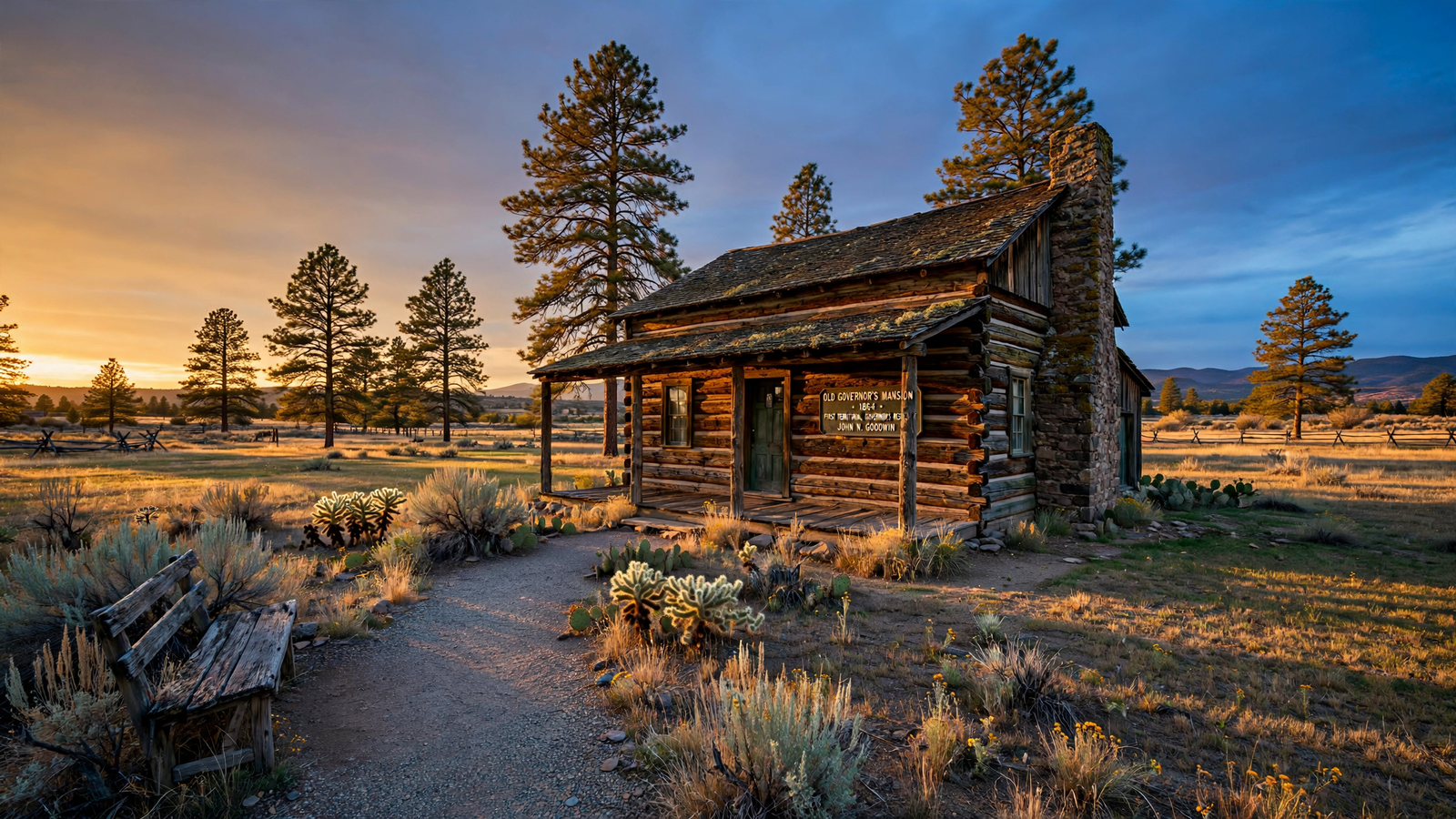
Prescott’s territorial history is often told through capitals, governors and laws. But one of its most tangible links to that era is a modest wooden house: the Territorial Governor’s Mansion, built in 1864. Its survival was not inevitable. Decades after the territory’s early political center shifted elsewhere, the house faced an uncertain future. Historian and writer Sharlot M. Hall helped turn it from an aging residence into a place where Arizona’s past could be preserved and shared.
The mansion took shape during a brief but consequential period. In 1863, the United States organized the Arizona Territory, and Prescott became its first capital. The new territorial government needed somewhere to work and somewhere for its governor to live. The house erected the following year served as the governor’s residence and was closely associated with the territory’s early administration.
Prescott’s role as capital did not last continuously. The territorial government moved to Tucson in 1867, returned to Prescott in 1877, and moved to Phoenix in 1889. Those changes reflected shifting political and economic centers across a vast territory. The Governor’s Mansion remained behind as a physical reminder of the years when decisions for the new territory were made in Prescott.
A house outlasts its original purpose
As Arizona changed, the mansion’s original function faded. It was a home, not a purpose-built public archive, and its historical importance did not automatically protect it from ordinary pressures: age, changing ownership and the appeal of using valuable town property for something new. The building’s survival depended on people recognizing that an unassuming structure could carry more than domestic history.
Hall was one of those people. Born in Kansas in 1870, she came to Arizona as a child and grew into a poet, journalist, educator and collector of the region’s history and material culture. She wrote about the Southwest and gathered objects and records that might otherwise have been scattered or lost. Her interest was not limited to famous political figures. The everyday things people made, used and left behind could also help explain how a community had developed.
In 1909, Hall moved into the old Governor’s Mansion. Her presence gave the historic building a new purpose and helped keep it in use. Rather than treat the house simply as a relic, she made it a base for the work of collecting and interpreting Arizona history. That choice joined preservation to public education: saving the structure mattered, but so did giving visitors a reason to enter it and learn from what it represented.
From private collection to public museum
Hall’s collecting continued over many years. In 1928, she opened the Sharlot Hall Museum in Prescott, establishing a public home for the historical objects and stories she had assembled. The museum grew beyond the old mansion, but the building remained central to its identity. It connected the institution’s collections to a real place where territorial life had unfolded.
That connection changes how the past can be understood. A list of governors can tell visitors who held office; a preserved residence can help make the scale and texture of their world more imaginable. The house also invites questions that official records may not answer on their own: how people lived, what they built with local materials, and how a frontier town adapted as government and population shifted around it.
The mansion should not be mistaken for a complete picture of territorial Arizona. A governor’s home naturally represents a narrow slice of society, and the political story of the territory involved Indigenous nations, settlers, workers and communities whose experiences differed sharply. A museum can make room for those wider histories by placing a prominent building in context rather than treating it as the whole story.
Preservation as an ongoing act
Today, the old Governor’s Mansion is part of the Sharlot Hall Museum campus. Its significance rests both in its early association with territorial government and in the later effort to protect and interpret it. Hall’s work shows that preservation is not only the act of repairing an old building. It also means deciding that the evidence a place holds is worth keeping—and creating a public institution that can help people encounter it.
Prescott’s mansion is especially revealing because it is not a grand capitol. Its scale makes the territory’s beginnings feel less abstract: government was once conducted from a small community, in a wooden house that could easily have been treated as obsolete. The structure’s continuing presence offers a direct link to that period, while the museum built around Hall’s work demonstrates how one person’s collecting and advocacy can become a lasting civic resource.
More than a century after Hall moved into the house, the mansion remains a reminder that historical landmarks often survive through deliberate choices. Prescott’s territorial past did not preserve itself. A building endured because people recognized its value, kept it in use and connected it to a broader effort to tell Arizona’s story.