Some of astronomy’s most important discoveries begin with a dramatic object: a dying star, a violent galaxy, or a planet crossing the face of its sun. The Hubble Deep Field began with almost nothing at all.
In December 1995, the Hubble Space Telescope spent roughly ten days staring at a small, apparently empty region in the constellation Ursa Major. To the eye, the patch contained no remarkable landmark. It was chosen partly because it had relatively few nearby stars, clouds of gas, and other foreground distractions.
The plan was simple but risky. Hubble would keep looking at the same piece of sky, collecting faint light in repeated exposures. Astronomers hoped the long observation might reveal distant galaxies too dim to see in ordinary images. They did not know exactly how many galaxies would appear, or whether the resulting picture would show anything especially surprising.
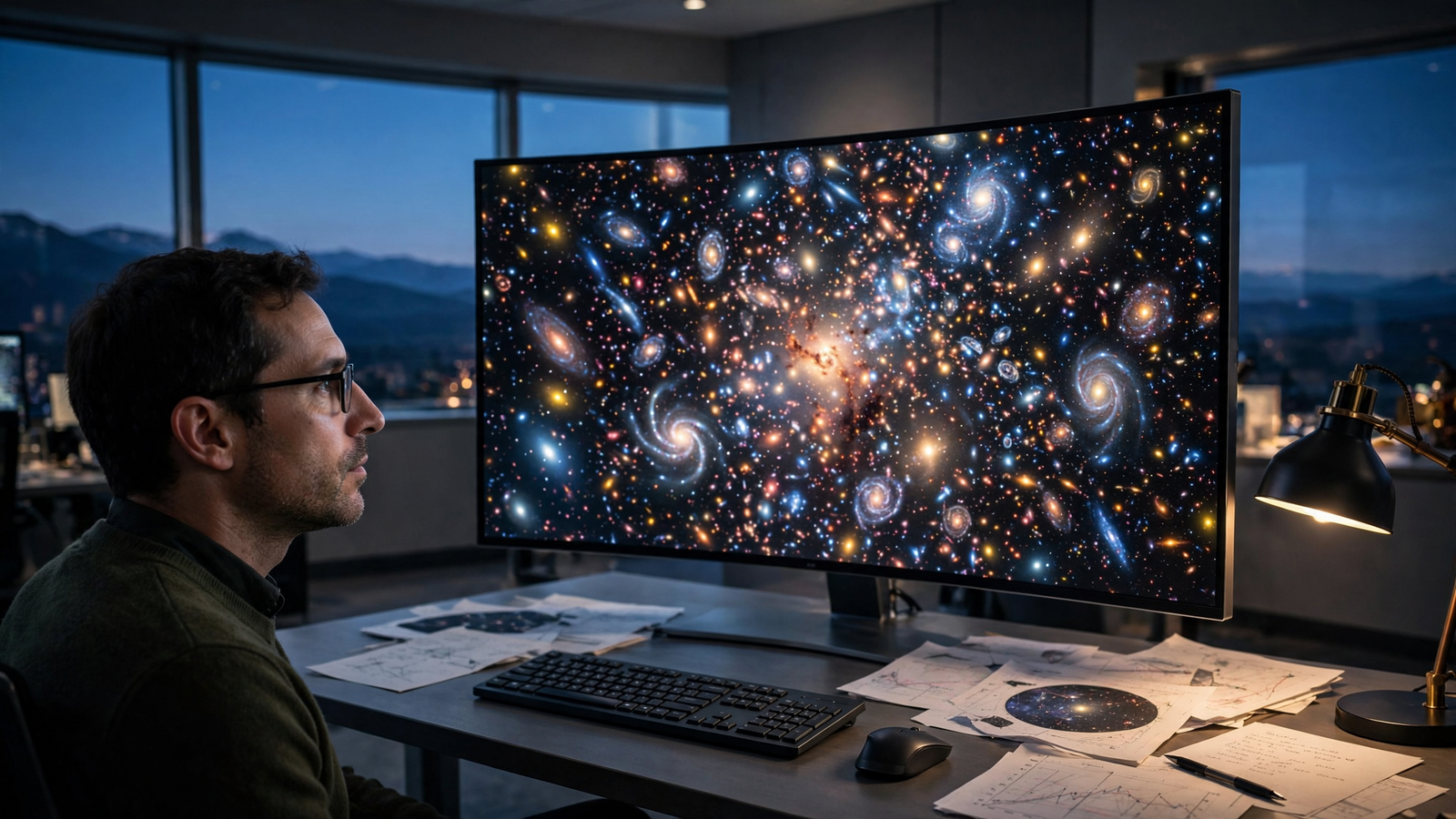
When the images were combined and processed, the blank patch was transformed. It contained thousands of galaxies, many of them so remote that their light had been traveling across the universe for billions of years. The result, released in January 1996, became known as the Hubble Deep Field North.
The picture did more than make a striking poster. It changed how astronomers thought about the deep universe. A small area of darkness had become a kind of time machine, allowing researchers to study galaxies at different stages of cosmic history in a single frame.
Why stare at an empty patch?
Space is crowded with stars and galaxies, but the sky between familiar objects can look empty because most astronomical sources are extremely faint. A galaxy may contain billions of stars and still be invisible to an ordinary telescope if it is far enough away.
Hubble’s advantage was a combination of location and persistence. Operating above Earth’s atmosphere, it avoided much of the blurring and light absorption that affect ground-based observations. By taking many exposures of the same target, astronomers could gather more light than they could in a short snapshot. For related reading, see The Emergency Alert System: How Radio and Television Became America’s Public Warning Network.
The Deep Field team also selected a narrow viewing area. A smaller field meant less chance that a bright foreground star would overwhelm the image. The target was located near the handle of the Big Dipper, an easily recognized pattern within Ursa Major, but the familiar constellation was only a foreground guide. The real subject lay far beyond it.
Hubble’s cameras recorded the region through several filters, including visible and near-infrared wavelengths. Combining the exposures allowed researchers to distinguish objects by brightness and color and to identify galaxies that appeared especially red because their light had been stretched by the expansion of the universe.
A picture made from patience
The original observation used hundreds of separate exposures. Together, they amounted to about 100 hours of viewing time. Each individual exposure contained only a small amount of information, but the combined image brought out objects too faint to appear in any one frame.
This is a recurring pattern in astronomy: the universe rewards sustained attention. A short observation tends to show the brightest and nearest objects. A longer one reveals a much larger population, including sources that may be millions or billions of times fainter than the limits of unaided vision.
The final image covered only a tiny fraction of the sky, roughly comparable to the area occupied by a tennis ball viewed from several dozen meters away. Yet within that small window, astronomers counted approximately 3,000 galaxies. Some appeared relatively mature and well defined. Others were smaller, less regular, and more actively forming stars.
That mixture gave scientists something more valuable than a total count. It offered a way to compare galaxies across time.
Seeing history through light
Light does not arrive instantly. The farther away an object is, the longer its light takes to reach a telescope. Looking into deep space therefore means looking into the past.
The galaxies in the Deep Field were not all seen at the same moment in cosmic history. Nearby galaxies were observed closer to their present condition. More distant galaxies appeared as they were when the universe was much younger. The image placed different eras side by side. For related reading, see Frances Arnold: How Evolution Became a Tool for Better Chemistry.
That made the Deep Field useful for studying how galaxies change. Astronomers could examine their shapes, colors, brightness, and rates of star formation. They could ask whether early galaxies were smaller than modern ones, how quickly they assembled, and when the universe experienced periods of particularly intense star birth.
The image also helped demonstrate that the universe contains enormous numbers of galaxies beyond those visible in relatively shallow surveys. A small patch that looked empty at first was not empty at all. It was simply full of objects too faint for a quick look.
The experiment was repeated
A single field could have been dismissed as unusual, so astronomers repeated the basic idea. In 1998, Hubble observed a second deep field in the southern sky. The Hubble Deep Field South produced another large collection of distant galaxies and gave researchers a different direction for comparison.
Later observations went even farther. The Hubble Ultra Deep Field, released in 2004, combined hundreds of images taken over many months. It revealed roughly 10,000 galaxies in an even smaller region of sky, including some of the most distant galaxies then observed.
Further projects added new wavelengths and longer observing times. The eXtreme Deep Field, assembled from earlier Hubble observations, pushed the same strategy deeper still. These surveys were not simply attempts to create prettier pictures. Each one extended the reach of galaxy studies and improved the statistical picture of the young universe.
They also showed why different kinds of light matter. A galaxy that is faint in visible wavelengths may stand out in infrared light. Infrared observations can reveal cooler objects, penetrate some obscuring dust, and capture light that has been stretched from shorter wavelengths during its journey across expanding space.
A small window with a large lesson
The Hubble Deep Field changed the emotional scale of astronomy. The image was small, but its contents were not. Every visible galaxy represented a system of stars, gas, dust, planets, and dark matter. Each was also a separate chapter in the universe’s long development. For related reading, see The James Webb Space Telescope: How an Infrared Eye Is Rewriting Our View of the Universe.
At the same time, the picture came with an important scientific caution. Astronomers cannot assume that one tiny region perfectly represents the entire cosmos. Galaxies are distributed unevenly, and a narrow field might contain an unusually dense or sparse group. That is why deep surveys in different parts of the sky are so important.
Even with that limitation, the image became a powerful demonstration of how observation works. It showed that a question does not always require a larger target. Sometimes the best strategy is to remove distractions, choose a representative location, and look longer than anyone has looked before.
From a photograph to a method
The Deep Field’s influence extends beyond the original image. Its methods became part of a broader approach to astronomy based on deep, carefully calibrated surveys. Researchers now combine observations from space telescopes, ground-based observatories, radio arrays, and other instruments to build increasingly detailed maps of cosmic history.
The James Webb Space Telescope has extended this work into infrared wavelengths, allowing astronomers to investigate galaxies that formed even earlier than many Hubble observations could reach. Webb does not replace the Deep Field idea; it expands it. The basic question remains familiar: What appears when humanity looks longer, farther, and in more kinds of light?
The answer first became unforgettable in 1996. Hubble looked at a place where almost nothing seemed to be happening and found a universe crowded with history.
That is the enduring power of the Deep Field. It is not only a record of distant galaxies. It is a reminder that darkness can mean distance rather than emptiness—and that patient observation can turn a blank patch of sky into a map of cosmic time.
Use: Background on the original Hubble Deep Field, later deep-field observations, and their significance for studying distant galaxies.
Use: Overview of the Hubble Deep Field observations, the small sky area surveyed, and the galaxies revealed by long exposures.
Use: Historical context for the 1995 observation, image-making process, and the scientific impact of the Deep Field.