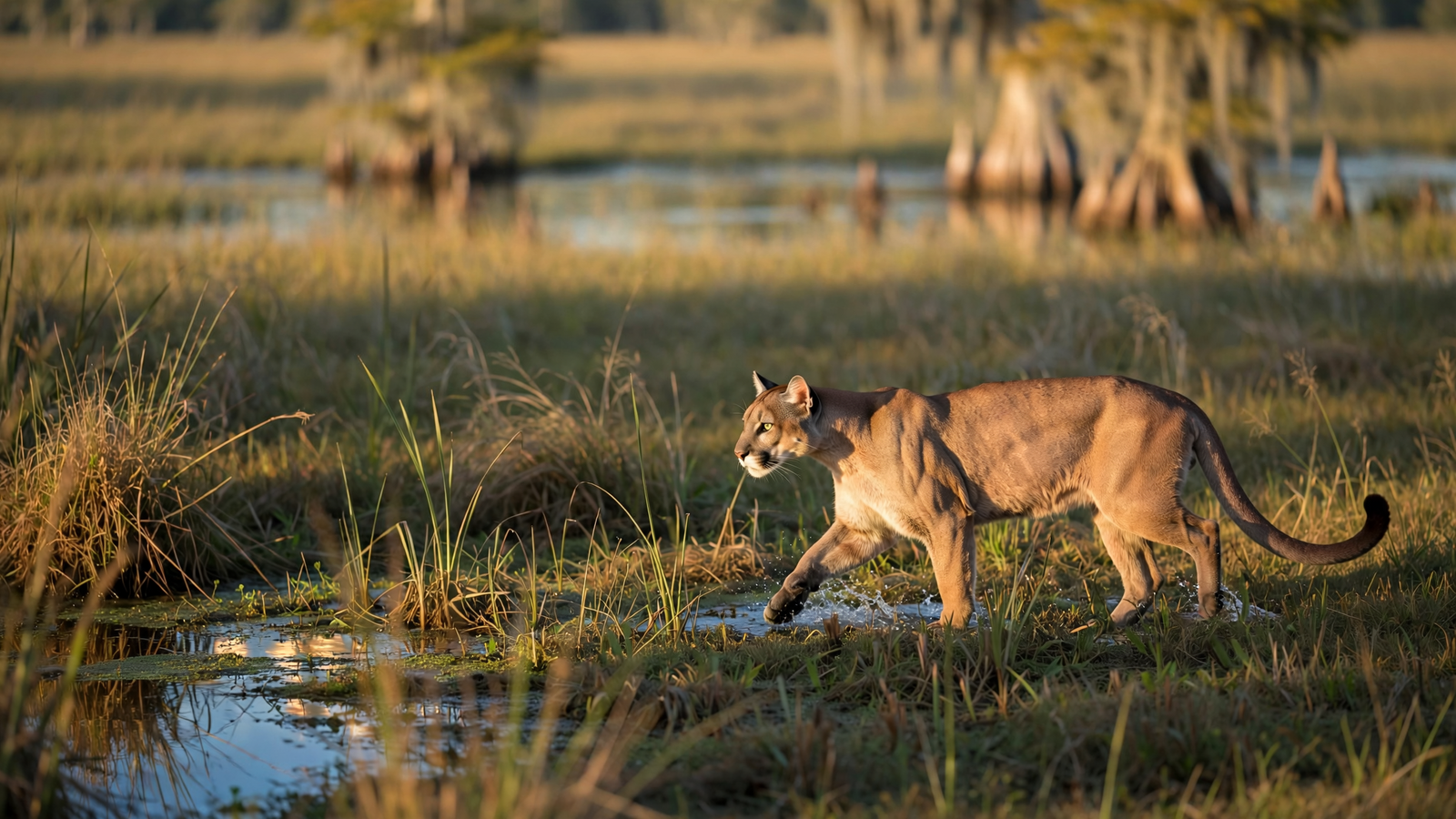
In the forests and wetlands of southern Florida, a large cat can still move almost invisibly through the landscape.
The Florida panther is rarely seen, even by people who spend their lives studying it. It travels mostly at night, slips through dense vegetation, and can cover wide territories in search of deer, wild hogs, raccoons, and other prey. Yet its presence tells an important story: a population that once appeared destined to disappear is still finding ways to live in one of the fastest-changing regions of the United States.
The panther’s recovery is not a simple tale of numbers rising and danger vanishing. The cat remains federally endangered. Roads cut across its range, development continues to consume habitat, and a small population remains vulnerable to disease, storms, accidents, and the loss of genetic diversity. But decades of work by wildlife agencies, researchers, landowners, and conservation groups have created something valuable—a larger and more connected chance for the animal to persist.
A cat pushed to the edge
Florida panthers are mountain lions, members of the species Puma concolor. Their ancestors once occupied a broad swath of the United States, including much of the Southeast. By the 20th century, however, hunting, habitat loss, and human development had reduced the eastern population to a small remnant in southern Florida.
The panther was listed under the federal Endangered Species Act in 1967, before the law was later expanded into its modern form. At the time, the population faced several overlapping problems. There was less suitable habitat, fewer safe routes between natural areas, and little room for a population isolated at the southern tip of the peninsula.
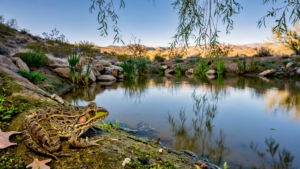
Isolation created a biological problem as well as a geographic one. With so few animals breeding within a limited population, inherited defects became more common. Wildlife biologists observed problems associated with inbreeding, including poor reproductive performance and physical abnormalities. Protecting habitat alone could not solve every threat. For related reading, see The Chiricahua Leopard Frog: How Arizona Is Giving a Vanishing Amphibian Room to Return.
A carefully managed genetic rescue
In 1995, wildlife managers made a controversial but consequential decision. They brought eight female Texas mountain lions into Florida and allowed them to breed with the remaining panthers. The animals were closely related enough to produce offspring, but came from a different population with greater genetic variation.
The intervention became known as a genetic rescue. It was not intended to replace the Florida panther with another animal. Instead, it was designed to give the isolated population more genetic diversity and improve its prospects for reproduction and survival.
According to the U.S. Fish and Wildlife Service, the effort helped reduce several signs of inbreeding and improved the population’s overall condition. It also demonstrated an important conservation principle: sometimes saving a threatened population requires managing not only the place where animals live, but also the biological connections that have been broken.
The decision remains part of the panther’s complicated history. The animals living in Florida today carry genes from both the historic Florida population and the introduced Texas cougars. For conservation purposes, the goal is not to preserve an imagined snapshot of the past. It is to maintain a healthy, self-sustaining wild population that can continue adapting to the future.
Protecting more than a cat
Florida panthers need space. Adult males can occupy very large home ranges, while females establish territories that overlap less often with other females. A healthy population therefore requires more than a small refuge surrounded by development. It needs forests, wetlands, prairies, and the corridors that connect them.
That need has made the panther an umbrella species. Efforts to protect its habitat also preserve breeding areas for wading birds, wetlands that store and filter water, and forest communities used by many smaller animals. In southwest Florida, public lands such as the Florida Panther National Wildlife Refuge and Big Cypress National Preserve form part of a much larger network of protected habitat.
The Florida Panther National Wildlife Refuge was established in 1989 to protect habitat for the endangered cat. Its landscape includes cypress forests, marshes, pinelands, and wet prairies. Much of the refuge is difficult to explore on foot, but that relative quiet is part of its value. A refuge does not have to be dramatic to be important. Sometimes its greatest contribution is simply allowing animals to move, feed, rest, and raise young without being displaced.
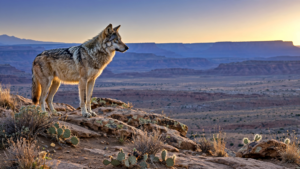
Conservation also extends beyond public boundaries. Private ranches, conservation easements, wildlife crossings, and land-use planning can help keep pieces of habitat connected. In a region where housing, agriculture, transportation, and wildlife all compete for room, the future of the panther depends on many separate decisions adding up in the same direction. For related reading, see The Mexican Gray Wolf: How a Tiny Wild Population Is Reclaiming the Southwest.
The road is part of the habitat
For a wide-ranging animal, a highway can function like a wall. For a panther attempting to reach food, a mate, or new territory, crossing a road can also be fatal.
Vehicle collisions are among the most visible threats to Florida panthers. Wildlife officials track road deaths and use that information to identify dangerous stretches, improve crossing opportunities, and alert drivers in areas where panthers are known to travel.
Wildlife crossings can include underpasses, fencing that guides animals toward safer routes, and other structures designed to reconnect habitat without asking animals to compete with traffic. These projects are practical rather than glamorous, but they can benefit many species at once. Deer, bears, bobcats, otters, turtles, and other wildlife may use the same protected passageways.
The crossings also reveal a broader change in conservation thinking. Protecting a parcel of land is not enough if animals cannot safely move between protected parcels. Connectivity—the ability to travel across a functioning landscape—has become one of the central ideas in modern wildlife conservation.
How scientists know where panthers go
Much of what is known about Florida panthers comes from patient, long-term monitoring. Biologists capture selected animals, fit them with radio or GPS collars, and track their movements. They collect photographs from remote cameras, examine tracks and other signs, and test genetic material from animals found alive or dead.
These methods help researchers answer questions that casual sightings cannot. Which corridors do panthers use? Where are females raising kittens? Which roads pose the greatest risk? Are animals expanding into new areas, and are those areas suitable for long-term survival? For related reading, see The National Wildlife Refuge System: How America’s Wild Places Give Recovery Room.
Monitoring can also make an elusive animal part of a public conversation without turning it into a spectacle. A panther does not need to be frequently seen to be valued. In fact, a healthy wild population may spend much of its time away from people. The goal is not to make the animal easy to find. It is to make the landscape safe enough for the animal to remain difficult to find.
A recovery measured in possibilities
Wildlife agencies have reported that the number of Florida panthers increased substantially from the very low levels observed in the late 20th century. Estimates vary by year and by counting method, but the breeding population is generally understood to number in the hundreds rather than the few dozen animals once feared to be all that remained.
That progress matters, but it does not mean the work is finished. A population concentrated in one region can still be undone by a major disease outbreak, a series of severe storms, habitat fragmentation, or continued road mortality. Conservation plans therefore focus on maintaining the population in southern Florida while also considering whether panthers can eventually occupy additional suitable areas.
Expansion is not automatic. A cat needs prey, cover, water, room to establish a territory, and a level of human tolerance that cannot be assumed. Reintroducing or allowing animals to move into new landscapes would require careful study and public involvement. For now, the central task is to keep the existing population healthy and its habitat connected.
The Florida panther offers a grounded kind of hope. Its recovery did not come from one dramatic discovery or a single protected park. It came from many forms of attention: a genetic intervention when isolation threatened the population, land protection across a working landscape, cameras and collars that revealed animal movements, and engineering projects that made roads less dangerous.
That combination has given the panther something conservation often seeks but cannot promise: room to continue. In southern Florida, a wild cat still moves through the shadows—not as a relic held safely in memory, but as a living animal with a future that remains possible.
Use: Federal status, species history, conservation challenges, population context, and genetic-rescue background.
Use: Current state wildlife-management information, monitoring, threats, road mortality, and panther biology.
Use: Refuge history, habitat, and role in protecting southwest Florida’s panther landscape.
Use: Background on the panther’s range, ecology, endangered status, and conservation in southern Florida.