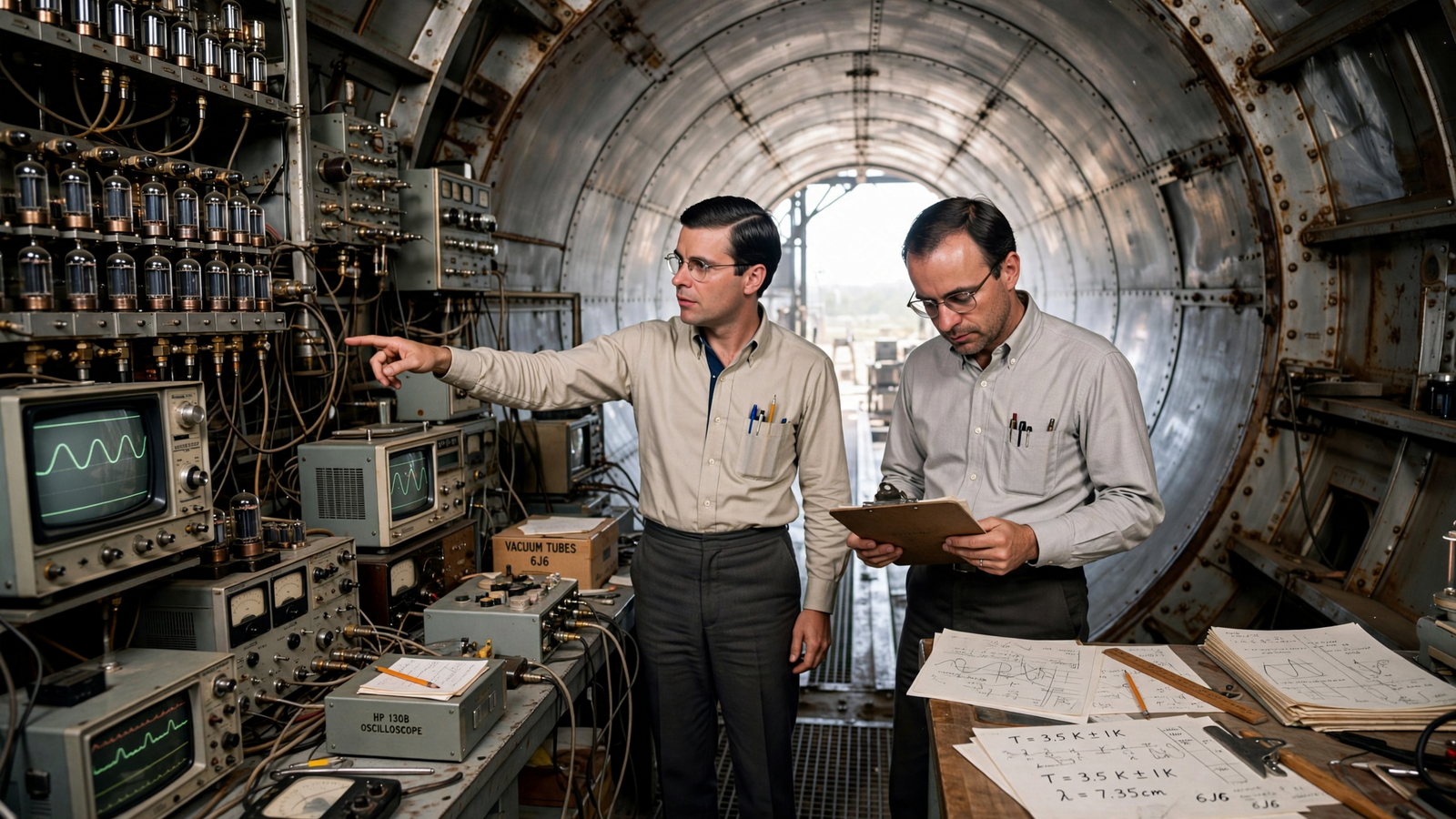
In the spring of 1964, two engineers in New Jersey were trying to make a radio antenna behave itself.
Arno Penzias and Robert Wilson worked at Bell Telephone Laboratories in Holmdel, where a large horn-shaped antenna had been built for satellite communications and radio astronomy. The instrument was sensitive enough to detect extremely faint signals. It was also sensitive enough to reveal a problem: a persistent hiss that seemed to come from everywhere at once.
The noise did not behave like an ordinary transmission. It remained after the engineers checked their equipment. It did not disappear when the antenna was pointed in different directions. It was not connected to the day, the season, or the position of the Milky Way. Something was filling the antenna’s field of view with a weak, steady microwave glow.
At first, the discovery looked like an engineering nuisance. In time, it became one of the most important observations in the history of science. The signal was the cosmic microwave background: cooled radiation left over from the hot, dense early universe.
A question hidden inside a radio hiss
Penzias and Wilson had not set out to test the origin of the universe. Their work grew from the practical and scientific ambitions of postwar communications research. Radio astronomy was opening a new way to study the sky, while Bell Labs was exploring technologies that could carry signals over long distances.
The Holmdel antenna had been used to receive signals reflected from the Echo balloon satellites. Its broad, carefully designed shape made it useful for radio astronomy as well. When Penzias and Wilson began using it for observations, they encountered an unexplained excess signal at a wavelength of about 7.35 centimeters.
The first task was to eliminate ordinary causes. They examined the receiver and antenna. They considered whether nearby sources of radio interference were responsible. They also investigated whether the antenna’s interior contained unwanted material. A family of pigeons had taken up residence inside the horn, leaving behind what the engineers called “white dielectric material” in their technical account. The birds were removed, and the antenna was cleaned. The signal remained.
That persistence was the clue. A local problem should have changed when the instrument or its surroundings changed. Instead, the excess radiation appeared remarkably uniform. It seemed to arrive from every direction in the sky.
The theory was already waiting
Years before the Holmdel measurements, physicists had considered what a hot beginning for the universe would leave behind. If the universe had once been much hotter and denser, radiation from that early phase should still exist. As the universe expanded, the radiation would lose energy and cool, shifting into the microwave part of the electromagnetic spectrum.
In the late 1940s, Ralph Alpher and Robert Herman estimated that this relic radiation should have a temperature of only a few degrees above absolute zero. Their prediction was not widely pursued at the time. Cosmology remained divided between competing ideas about whether the universe had begun in a hot, dense state or had always maintained roughly the same large-scale appearance.
The debate was not simply between two neat teams, and the early prediction did not immediately produce a successful search. But the possibility of leftover radiation gave Penzias and Wilson’s unexplained signal a remarkable interpretation.
In 1964, the two engineers contacted Bernard Burke of the Massachusetts Institute of Technology, who recognized that their result might be important. Burke directed them toward Robert Dicke, a physicist at Princeton University who was developing an experiment to look for precisely this kind of radiation. Dicke, along with James Peebles, Peter Roll, and David Wilkinson, was working on the theoretical and observational consequences of a hot early universe.
According to the later Nobel account, Dicke understood the significance of the call quickly. His group had been preparing to search for the radiation; Penzias and Wilson had already found it.
Two papers, one turning point
The discovery was presented in two short papers published side by side in the Astrophysical Journal in 1965. Penzias and Wilson reported their measurement without claiming more than the data directly showed: an unexplained excess antenna temperature that appeared uniform across the sky. Dicke, Peebles, Roll, and Wilkinson published the cosmological interpretation in a companion paper, identifying the signal as radiation from the early universe. For related reading, see The Large Hadron Collider: How Engineers Built a Machine to Explore the Smallest World.
The arrangement reflected an important distinction in science. One group had measured an effect. Another had connected it to a physical theory. The two contributions strengthened each other without being the same piece of work.
The background radiation was not a visible image of the beginning. It was a faint microwave afterglow. The universe had been opaque when it was young, because light repeatedly interacted with charged particles. As the cosmos expanded and cooled, electrons combined with nuclei, allowing photons to travel much more freely. The light released at that transition has been traveling ever since, stretched by cosmic expansion into the microwave wavelengths detected today.
Scientists now describe the cosmic microwave background as having a temperature of roughly 2.7 kelvins, or about 270 degrees Celsius below zero. It is extremely cold by everyday standards, but it carries information from a time when the universe was only a small fraction of its present age.
From disputed model to precision cosmology
The Holmdel discovery did not settle every question immediately. Scientists needed further observations to test whether the radiation truly had the spectrum expected from a hot early universe and whether it came from the entire sky. Later measurements did just that.
NASA’s Cosmic Background Explorer satellite, launched in 1989, measured the background radiation with much greater precision. Its instruments showed that the radiation has an almost perfect thermal spectrum, closely matching the prediction for light released from a hot early universe. COBE also detected tiny variations in temperature across the sky—differences of only a few tens of millionths of a degree.
Those variations mattered. A perfectly smooth universe could not easily develop the galaxies, clusters, and larger structures seen today. The faint irregularities in the background radiation represented early differences in density. Over billions of years, gravity amplified them, helping shape the cosmic web.
Later missions, including NASA’s Wilkinson Microwave Anisotropy Probe and the European Space Agency’s Planck spacecraft, mapped the background in still greater detail. Their measurements helped scientists estimate the age, composition, geometry, and expansion history of the universe. The cosmic microwave background became not merely evidence that the universe had once been hot, but a detailed early record that could be read for clues about everything that followed.
The importance of a stubborn measurement
Penzias and Wilson received the 1978 Nobel Prize in Physics for their discovery of cosmic microwave background radiation. Their work is often remembered as a dramatic moment when two engineers unexpectedly heard the echo of the Big Bang. The story is memorable, but its deeper lesson is quieter.
The discovery depended on refusing to dismiss a small inconsistency. The antenna was not producing the result its operators expected. Rather than adjust the data to fit the apparatus, Penzias and Wilson investigated every plausible source of error. Their careful approach turned an unwanted signal into a measurement of the universe itself.
It also showed how discoveries can emerge from the meeting of different kinds of expertise. Communications engineering provided the instrument. Radio astronomy supplied the observational habits. Theoretical physics supplied a possible explanation. Independent teams, working from different directions, made the result more convincing.
Today, the cosmic microwave background reaches Earth from every direction. It is not a message sent by an ancient civilization or a sound traveling through empty space. It is electromagnetic radiation, stretched and cooled by the expansion of the universe. Yet “echo” remains a useful metaphor: the signal is a surviving trace of an early cosmic state, still present after nearly everything about the universe has changed.
What began as a stubborn hiss in a New Jersey antenna became a shared reference point for modern cosmology. In the faintest background glow, scientists found not an ending but a beginning—an ancient light that continues to help explain how the universe became the place we know.
Use: Background on the cosmic microwave background, its origin, thermal spectrum, and role in testing Big Bang cosmology.
Use: Authoritative account of Arno Penzias and Robert Wilson’s discovery and the award recognizing it.
Use: Original 1965 measurement report describing the unexplained excess antenna temperature.
Use: Original 1965 interpretation connecting the measured radiation with a hot early universe.