For most people, the internet feels invisible. A video loads, a message leaves a phone, or a remote meeting begins without revealing the physical network that makes it possible. But beneath those ordinary moments is an enormous construction project: fiber-optic cables running beneath streets, across bridges, through mountains, and under oceans.
Fiber is extraordinarily capable. It can carry huge volumes of information over long distances with low delay. The problem is not its performance. The problem is getting the cable to every place that needs it.
Roads may be difficult to excavate. Rivers and ravines may separate communities from the nearest network. Permits, construction costs, and difficult terrain can turn a short connection into a major infrastructure project. In some locations, a cable route may be technically possible but economically unrealistic.
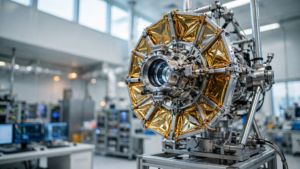
Project Taara, developed by Google’s research and technology organization X, is exploring another option: sending internet traffic through the air on tightly focused beams of light. The system is not designed to replace the global fiber network. Instead, it aims to fill some of the gaps between existing fiber routes and the people, businesses, schools, and public services that remain beyond them.
An invisible bridge made of light
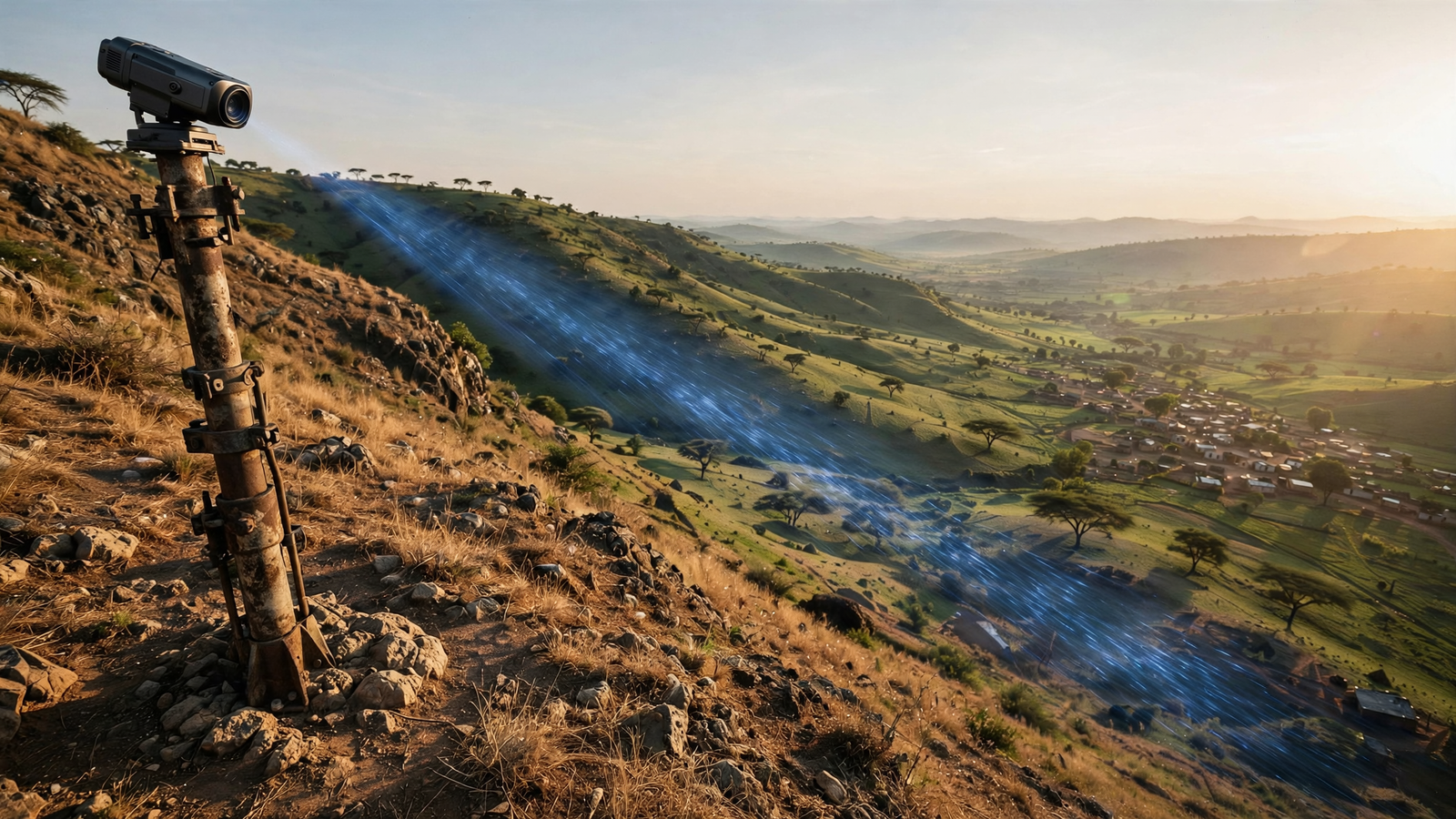
Taara belongs to a family of technologies often called free-space optical communication. Rather than guiding light through glass, as a fiber cable does, the system directs light through the atmosphere between two precisely aligned terminals.
One terminal sends information using a laser or another optical transmitter. A receiving terminal captures the light and converts the signal back into digital data. The result is a wireless link that can carry large amounts of information without requiring a continuous physical cable between the two endpoints.
The idea is not entirely new. Optical communication has long been used inside fiber networks, and engineers have experimented with free-space optical links for decades. What has changed is the combination of compact electronics, automated alignment, high-speed data processing, and demand for broadband in places where conventional construction is difficult.
Taara’s equipment is intended to be mounted on structures such as rooftops, towers, or other elevated points with a clear line of sight. When the endpoints can see one another, the link can act much like a virtual cable across a gap.
The river crossing that showed the possibility
One of the project’s best-known demonstrations involved a connection across the Congo River. Google has described the link as a way to connect Kinshasa in the Democratic Republic of the Congo with Brazzaville in the Republic of the Congo, two cities separated by a broad river and limited conventional connectivity between them.
According to Google’s account, the experimental connection transmitted data across a distance of roughly five kilometers and reached speeds of about 20 gigabits per second. Over a period of several days, it carried hundreds of terabytes of information while dealing with the atmospheric conditions of a real outdoor environment.
The demonstration mattered because the challenge was not simply sending a signal across an empty laboratory. A working outdoor link has to cope with vibration, heat, dust, changing visibility, and the constant difficulty of keeping two narrow beams pointed at one another. The river crossing illustrated how optical wireless equipment might provide a fast connection without putting construction crews, cable ships, or drilling equipment into the middle of the project.
It also highlighted the technology’s intended role. A Taara link can connect two points that already have power and network access, creating a bridge over an obstacle rather than rebuilding the entire network from the ground up.
Why not simply lay more fiber?
In many places, fiber remains the better answer. A buried or protected cable can operate through fog, rain, and darkness, and it does not require the same uninterrupted visual path as an optical wireless system. Fiber also has an established maintenance and upgrade ecosystem.
But building fiber networks is not equally easy everywhere. A cable may need to cross a river, a canyon, a busy highway, a protected area, or a densely built neighborhood. In a remote region, the cost of reaching a small number of customers can be difficult to justify even when the need for connectivity is clear.
A wireless optical bridge can reduce the amount of civil construction required. Instead of digging a trench along an entire route, an operator may be able to bring fiber to one side of an obstacle and use an optical link to reach the other. The approach can be especially useful for temporary networks, rapidly growing communities, disaster recovery, and locations where the terrain makes conventional construction unusually disruptive.
That does not make the technology a universal substitute for cable. It makes it a potential layer in a larger system—one that combines fiber backbones, wireless access networks, satellites, cellular infrastructure, and local community networks.
The hardest part is keeping the beam on target
Light travels in straight lines, which is one of the technology’s strengths and one of its central limitations. The sending and receiving terminals must have a clear line of sight. Buildings, trees, terrain, and construction can interrupt the path.
Alignment is another challenge. The beam is narrow, and even a small shift caused by wind or movement in a supporting structure can reduce the quality of the connection. Taara’s system uses sensors, mirrors, and control software to locate and maintain the receiving terminal. Google has said the equipment can automatically search for its counterpart and keep the link aligned as conditions change.
Weather is a further concern. Heavy rain, dust, smoke, and especially fog can scatter or absorb light, weakening the signal. An optical link therefore needs careful site selection and may require a backup route. In a mature network, that backup could be radio, fiber, or another optical path.
These constraints help define where the system makes sense. A clear, short gap between two tall structures may be an excellent application. A long route through a humid valley with frequent fog may be much less attractive. The question is not whether light can carry the data; it is whether the atmosphere and the geography will allow the connection to remain dependable enough for everyday use.
From a research project to a communications tool
Taara began as part of an effort to solve a practical connectivity problem associated with balloon-based internet experiments. High-altitude balloons could provide coverage from above, but the ground still needed a way to move traffic between nearby points. Optical links offered one possible answer.
The project later developed into a broader terrestrial communications platform. Google has presented Taara as useful for bringing high-capacity connections across physical barriers and for extending networks more quickly than traditional construction can sometimes allow.
The technology’s progress reflects a wider shift in communications engineering. Network designers increasingly use different transport methods together rather than searching for one system that works everywhere. Fiber handles high-capacity long-haul routes. Cellular networks connect mobile users. Satellites reach isolated areas. Fixed wireless serves locations where cable installation is expensive. Optical wireless can provide another bridge between those pieces.
This flexibility may be particularly important as internet demand continues to rise. Connectivity is no longer only about entertainment. Schools use online learning platforms, clinics depend on digital records and telemedicine, small companies sell to customers far beyond their towns, and public agencies increasingly deliver services through online systems. A missing link in the network can therefore become an obstacle to education, commerce, health care, and civic life.
The promise—and the boundary—of laser internet
It would be misleading to describe Taara as a replacement for fiber or as a way to solve the entire global connectivity gap. The equipment still needs power, elevated mounting points, network connections, maintenance, and a clear path through the air. The economics will vary from one location to another, and a high-speed link between two network points does not automatically make service affordable for the people nearby.
Those limits are not signs of failure. They are the normal conditions of infrastructure. A bridge does not eliminate roads, and a wireless optical link does not eliminate cables. Its value comes from making one difficult part of a route simpler.
The most important idea behind Taara is therefore not the laser itself. It is the possibility of treating the last difficult gap as a solvable engineering problem. A river, ravine, crowded corridor, or temporary construction zone may no longer require the same answer as a flat stretch of land.
If the technology proves reliable and affordable in enough settings, future networks could become more modular. Fiber could run as far as practical, and beams of light could carry the connection across the places where digging, drilling, or stringing cable would take too long. In that arrangement, the internet would remain a physical network—but one able to change shape around the world’s obstacles.
Use: Project overview, technology description, use cases, and limitations of free-space optical communication.
Use: Background on the Congo River demonstration, data-transfer performance, and the project’s development.
Use: Technical context on atmospheric effects, line-of-sight requirements, and free-space optical communications.
X, the moonshot factory — Project Taara — https://x.company/projects/taara/ — Project overview, technology description, use cases, and limitations of free-space optical communication.
Google Blog — Project Taara and laser-based internet links — https://blog.google/technology/research/project-taara-laser-internet/ — Background on the Congo River demonstration, data-transfer performance, and the project’s development.
International Telecommunication Union, Radiocommunication Sector — Free-space optical communication report — https://www.itu.int/dms_pub/itu-r/opb/rep/R-REP-F.2106-0-2007-PDF-E.pdf — Technical context on atmospheric effects, line-of-sight requirements, and free-space optical communications.