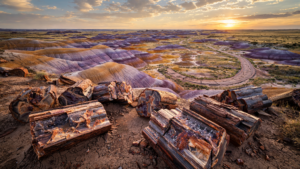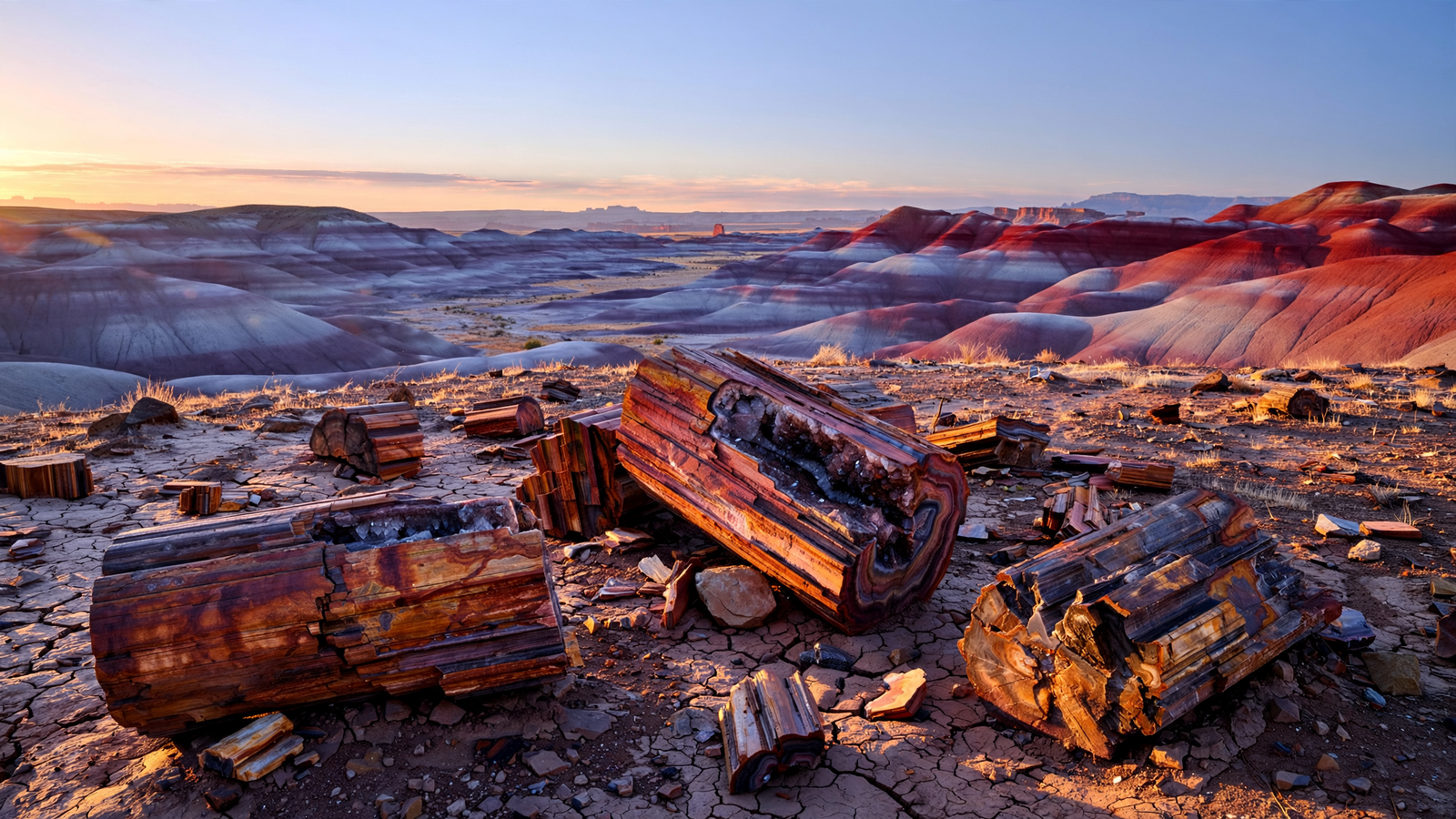
In eastern Arizona, the ground can look like it has been painted, polished, and arranged for display. Low hills shift through red, pink, gray, lavender, and cream. Bright fragments of fossilized wood catch the light. Beyond them, the Painted Desert stretches toward a horizon that seems almost too large for a single landscape.
This is Petrified Forest National Park, a place where geology, archaeology, ecology, and transportation history occupy the same public space. Its most famous objects are the enormous logs that became stone, but the park is more than a collection of spectacular fossils. It is a record of a vanished Triassic world, a homeland shaped by Indigenous communities, a living desert ecosystem, and a reminder that conservation can turn an exposed landscape into a shared American institution.
A forest that was never quite a forest as we imagine one
The name is memorable, but it can also be misleading. The trees preserved here did not stand in a modern woodland that slowly hardened in place. Many were carried by water into ancient floodplains, where they were buried by sediment over time.
The setting was very different from today’s dry Arizona. During the Late Triassic Period, roughly 225 million years ago, the region formed part of a broad, seasonally wet landscape near the western edge of the supercontinent Pangaea. Rivers moved through lowlands where conifers and other plants grew. Fallen trunks could be buried quickly enough to avoid complete decay.
Once buried, the wood was gradually altered by mineral-rich groundwater. Silica entered the cellular spaces and replaced much of the original organic material. Trace minerals helped create the familiar bands of red, yellow, purple, and brown. The result is stone that still preserves the grain, growth patterns, and sometimes the shape of the original tree.
That combination of age and detail gives petrified wood its particular power. It is not simply a rock that resembles a log. In many pieces, the structure of a once-living organism remains visible even though the material has been transformed. A visitor can see the outline of wood and understand that the object has crossed an almost unimaginable span of time. For related reading, see Petrified Forest: The Arizona Place Where Deep Time Meets an Open Road.
When erosion became a kind of curator
The fossilized logs were protected and revealed by the same long geological processes. Sediment buried the ancient landscape, then uplift and erosion began to remove the layers above it. Wind and water carved gullies, slopes, mesas, and badlands. Harder mineralized wood resisted erosion more effectively than the surrounding sediment, leaving sections of ancient trees scattered across the modern surface.
Many of the park’s most recognizable views come from this contrast. The Painted Desert’s softer sediments have been sculpted into rounded hills and sharply cut washes, while petrified logs lie across the ground like the remains of a giant construction project. The Blue Mesa area shows the effect especially clearly, with bands of blue-gray and purple clay forming a landscape that appears almost artificial from a distance.
The scenery is not static. Every storm, freeze, and gust of wind continues to change the park in small ways. New fragments may be exposed as slopes erode, while older ones are gradually broken down. The landscape feels ancient, but it is still in motion.
A public landscape with a long human history
People did not first encounter this region when scientists began studying its fossils. Indigenous communities have lived in and traveled through the broader landscape for centuries. Archaeological evidence in the park includes villages, room blocks, tools, pottery, and rock art associated with ancestral Puebloan communities.
Those traces change the way the park should be understood. Petrified Forest is not an empty wilderness interrupted by a few ruins. It is a cultural landscape in which water, stone, plants, travel routes, and places of shelter shaped human decisions over generations.
At Puerco Pueblo, visitors can see the remains of a substantial ancestral community and nearby petroglyphs. The site offers a more grounded view of the past than the park’s sweeping vistas alone can provide. People adapted to a difficult environment, built with local materials, cultivated crops where conditions allowed, and developed knowledge of a landscape whose resources were limited but meaningful.
Many objects found in the park are protected as archaeological resources. That protection matters because the meaning of a site depends on context. A pot fragment, tool, or stone arrangement is not merely an isolated artifact; it is part of a larger record of community life, movement, trade, and environmental change. For related reading, see Saguaro National Park: The Tucson Landscape That Lets the Desert Grow Tall.
From scientific curiosity to national protection
By the late nineteenth century, petrified wood from the region had become known to scientists, collectors, and tourists. Its unusual appearance also made it vulnerable. Pieces could be removed easily, and the very feature that made the area remarkable made it difficult to protect without public action.
President Theodore Roosevelt established Petrified Forest National Monument in 1906 under the Antiquities Act. That designation recognized the scientific and educational value of the fossilized wood and placed limits on private collecting. The protected area later expanded, and Congress redesignated it as Petrified Forest National Park in 1962.
The park now encompasses more than 90,000 acres. Its boundaries protect far more than the densest concentrations of petrified logs. They include grasslands, desert shrublands, badlands, archaeological sites, fossils, and the broad geological setting that gives the park its meaning.
That is one of the quiet achievements of the national park idea. Protection is not limited to saving a single famous object. It can preserve the relationships among objects: the log and the sediment that buried it, the village and the water source, the road and the communities it connected, the fossil record and the living species that occupy the landscape today.
A highway through deep time
Petrified Forest also contains a more recent layer of American history. Historic Route 66 once crossed the region, carrying families, freight, vacationers, and westbound travelers across the country. The highway was decommissioned in 1985, but parts of its alignment remain visible inside the park, along with remnants of the roadside infrastructure that accompanied it. For related reading, see Prescott National Forest: The Public Land That Makes a Mountain Town Possible.
Route 66 gives the park a useful change in scale. The petrified wood points backward hundreds of millions of years; the highway points to the twentieth century, when automobile travel reshaped the country. Both stories involve movement. Ancient trees were transported by rivers before becoming fossils, while modern travelers moved along a road built across the same broad landscape.
Seeing those histories together makes the park feel less like a display case and more like a layered archive. A person can stand near a fossilized log, walk past evidence of ancestral life, and follow the traces of a highway that carried travelers within the span of a few generations.
Why the forest still matters now
Petrified Forest National Park is often approached as a destination for spectacular photographs, and it deserves that attention. But its deeper value is educational. It makes several difficult ideas tangible at once: extinction, fossilization, erosion, Indigenous history, public land protection, and the long relationship between people and the landscapes they cross.
The park also shows why conservation is not the same as freezing a place in time. The fossil logs will continue to weather. Plants and animals will respond to drought, heat, fire, and changing seasons. Archaeological sites require careful stewardship. Visitors bring new questions to an old landscape, and scientific understanding continues to develop as researchers study the park’s rocks and fossils.
What remains constant is the invitation to look closely. A piece of petrified wood can reveal the architecture of a tree. A painted slope can show how sediment and minerals respond to erosion. A pueblo can place human history within the same view as deep geological time. An abandoned road can explain how quickly a national landscape can change.
That is the lasting wonder of Petrified Forest National Park. Arizona’s desert has not merely preserved the past. It has kept several pasts visible at once—and made them available to anyone willing to slow down long enough to read the ground.
Use: Park overview, landscapes, visitor resources, conservation context, and general historical background.
Use: Geological setting, Triassic fossils, petrification, erosion, and Painted Desert formations.
Use: Indigenous history, archaeological resources, historic preservation, and the park’s national-protection history.
Use: Historic Route 66’s relationship to the park and surviving features of the former highway.