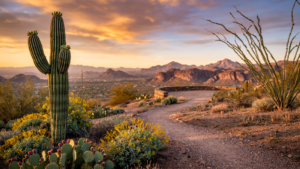
On the surface, Kartchner Caverns State Park can look like a quiet stretch of southeastern Arizona: desert grassland, scattered shrubs, distant mountains, and the broad light of the Sonoran Desert. The most remarkable landscape, however, is below the ground.
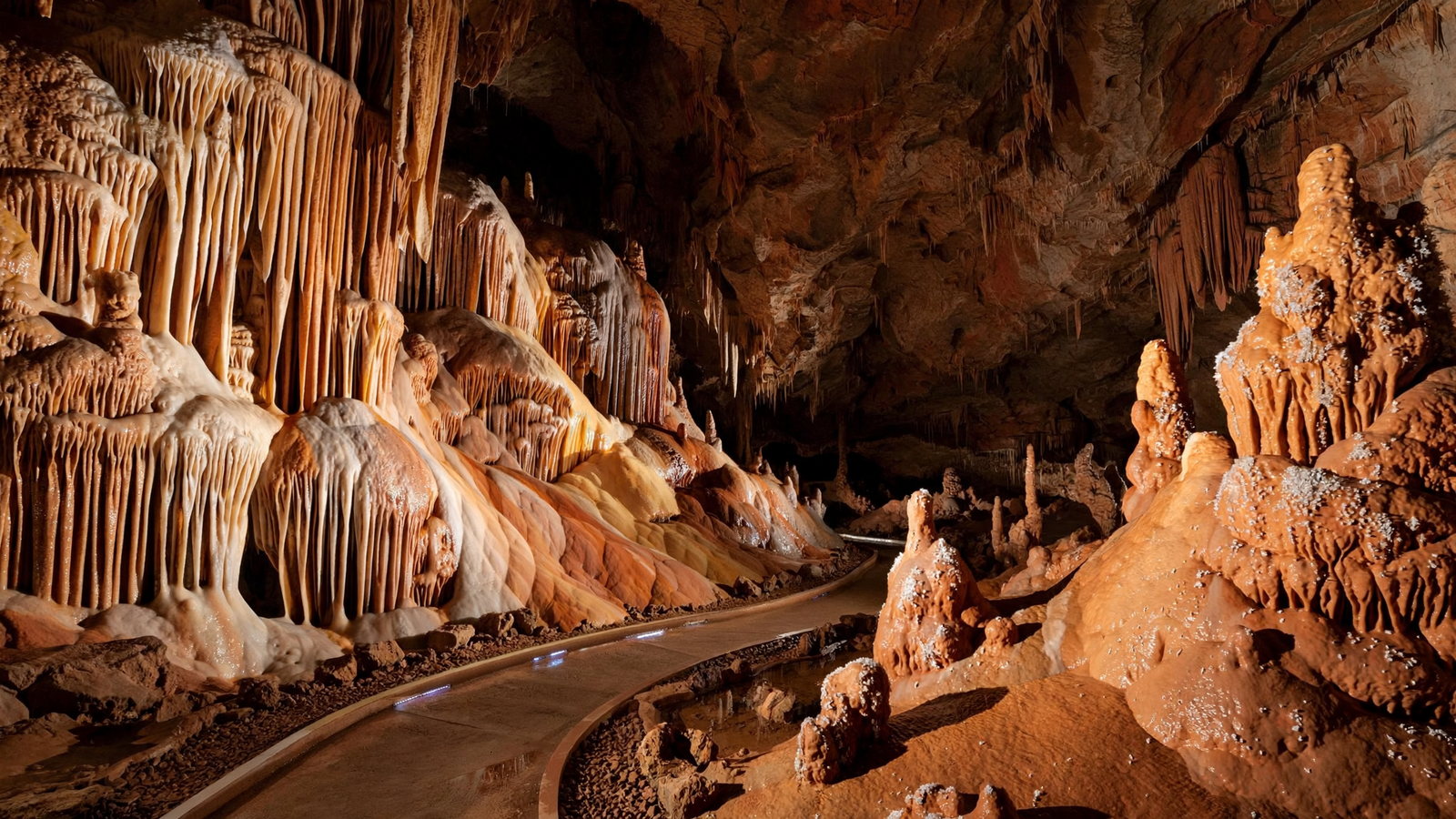
Inside the Whetstone Mountains, water has slowly shaped a limestone cave filled with columns, stalactites, stalagmites, flowstone, and delicate formations that continue to grow. The cave is dark, humid, and easily damaged. Its survival depends on controlling something that public attractions usually try to maximize: human access.
Kartchner Caverns became one of Arizona’s best-known underground destinations because the state found a way to let people see an extraordinary place without treating it like a conventional tourist attraction. The result is a rare kind of public landscape—one where the visitor experience is designed around restraint.
A discovery kept quiet
The story began in 1974, when University of Arizona geology students Gary Tenen and Randy Tufts were exploring the Whetstone Mountains. They noticed air moving from a small opening in the limestone. Following the opening led them into a cave that had remained largely hidden from the outside world.
The discovery could easily have become a rush of curious visitors. Instead, Tenen and Tufts understood that the cave’s formations were vulnerable. Mud, litter, broken rock, and even the oils on human hands can permanently alter a cave environment. They kept the location secret while considering how it might be protected.
The cave was on land owned by James and Lois Kartchner, whose name the cavern now carries. The family worked with the discoverers and Arizona officials to pursue public protection. That process took years. Arizona acquired the property in 1988, and Kartchner Caverns State Park opened to visitors in 1999.
The long delay was not a failure to develop the site. It was part of the preservation strategy. Before the public entered, engineers and conservation specialists had to figure out how to construct paths, lighting, doors, drainage systems, and visitor facilities without changing the cave’s underground climate. For related reading, see Kartchner Caverns: The Arizona Cave That Chose Conservation Over Discovery.
A cave that is still being made
Kartchner is often described as a “living cave.” The phrase refers to the fact that its formations are still developing. Rain and snowmelt that fall on the mountains can move slowly through soil and cracks in the limestone. Along the way, the water absorbs carbon dioxide and minerals. When it eventually enters the cave, changes in pressure and evaporation allow minerals to accumulate in new layers.
That process is extraordinarily slow by human standards, but it is not finished. A drip of water can leave behind a microscopic deposit. Repeated over thousands of years, those deposits become curtains, columns, stalactites, stalagmites, and other forms. The cave is therefore not simply an underground museum of ancient geology. It remains an active landscape.
Among Kartchner’s most recognizable formations are the massive Kubla Khan column and the long, fragile soda straws that hang from the ceiling. Soda straws begin as hollow mineral tubes. They can be so thin that a careless touch or a change in water flow may end their growth.
The formations also make time visible. A column that rises from floor to ceiling records a meeting between deposits growing upward and downward. Flowstone resembles frozen waterfalls, although it was created by thin sheets of mineral-rich water moving over rock. The variety is part of what makes a guided cave tour feel less like walking through a tunnel and more like entering a landscape with its own architecture.
Preservation begins with the air
Protecting a cave is not only a matter of keeping visitors from touching formations. It also means protecting the cave’s temperature, humidity, airflow, water chemistry, and biological communities.
Every person who enters brings warmer air, moisture, fibers, dust, and microorganisms from the surface. Doors that stand open too long can change air movement. Lighting can encourage the growth of algae near illuminated formations. Water introduced by construction or cleaning can alter the chemistry that formations depend on.
Kartchner’s visitor systems were designed with those concerns in mind. Tours use controlled entrances and exits, designated walkways, limited group sizes, and lighting that reveals the cave without turning it into a brightly illuminated room. Visitors are expected to remain on the path and avoid touching formations. Those instructions can feel strict, but they protect features that took tens of thousands of years to develop.
The park also monitors the cave over time. Temperature and humidity measurements help managers detect changes. Staff can watch for unwanted biological growth and assess whether structures or visitor patterns are affecting the underground environment. In a place where the most important changes may occur at a nearly invisible pace, monitoring is a form of patience made practical. For related reading, see Hotel St. Michael: The Prescott Landmark That Has Kept a Downtown Corner Alive.
Two rooms, two kinds of wonder
Kartchner’s public tours focus on two major sections of the cave: the Rotunda Room and the Big Room. Each has a distinct character.
The Rotunda Room is known for formations built by water moving through the limestone over long periods. The Big Room is larger and contains some of the cave’s most dramatic features. Together, the rooms show how different conditions—water flow, mineral availability, cracks in the rock, and the shape of the underground space—can produce different kinds of beauty only a short distance apart.
The Big Room is also important habitat for bats. Arizona State Parks temporarily closes that section during part of the year so Mexican free-tailed bats can use it as a maternity site. The seasonal closure is a reminder that Kartchner is not only a place for people to admire. It is also a functioning habitat whose wildlife needs take priority at particular times.
That balance changes the meaning of a cave tour. Visitors are not entering a sealed display case. They are entering a living system with seasonal rhythms and occupants. A closure is not an inconvenience imposed on nature; it is one of the ways the park makes room for nature.
What visitors see above ground
The park’s story does not end at the cave entrance. Above ground, Kartchner Caverns protects a section of the Whetstone Mountains and the surrounding desert environment. Trails, interpretive programs, and outdoor exhibits help place the cave in its larger setting.
This matters because caves are connected to the landscapes above them. Rainfall, vegetation, soil, rock fractures, and drainage patterns all influence what happens below. Protecting only the rooms where visitors walk would leave the system vulnerable to changes at the surface.
The above-ground park also offers a different pace from the guided cave experience. In daylight, visitors can look across desert grassland toward mountain slopes and consider how much of Arizona’s natural history is hidden from view. The cave is spectacular because it is unusual, but it is also a concentrated expression of processes happening throughout the region: erosion, mineral movement, drought, seasonal rain, and the slow reshaping of stone. For related reading, see The Elks Opera House: How Prescott Kept Its Historic Stage Alive.
Public access with limits
Kartchner Caverns demonstrates that preservation does not always require closing a remarkable place to everyone. It can also mean designing access carefully enough that people can learn from a landscape without consuming it.
That approach has practical consequences. Cave tours are scheduled rather than open-ended. Some areas remain closed. Photography rules and visitor instructions help reduce disruption. Conditions can change, and tour availability depends on the park’s operating policies, so visitors need to check Arizona State Parks before planning a trip.
The limits are part of the experience’s value. A cave does not become less democratic because it cannot accommodate unlimited traffic. Instead, the restrictions acknowledge that public ownership carries responsibilities. The goal is not to make the largest possible number of people pass through as quickly as possible. It is to make sure the cave remains healthy enough for future visitors to encounter something close to what earlier generations found.
A lesson in slow time
Modern life rewards speed: rapid construction, immediate access, constant visibility, and quick results. Kartchner Caverns offers a different measure of importance. Its formations grow drop by drop. Its protective systems were developed over decades. Its public story began with people choosing secrecy and patience over immediate attention.
That patience is now part of what Arizona shares with the public. The state did not simply open a hole in the ground and install lights. It created a carefully managed relationship among geology, wildlife, science, engineering, and visitors.
Standing beneath the Whetstone Mountains, a person can see evidence of time on several scales at once: a bat’s seasonal return, water moving through a crack, a mineral curtain built over centuries, and a public park shaped over generations. Kartchner Caverns is memorable for its beauty, but its deeper achievement is stewardship—the decision to let people enter a fragile world while asking them, first, to help it endure.
Use: Park history, location, visitor access, cave preservation, tours, and above-ground resources.
Use: Tour structure, cave rooms, visitor rules, and operational information.
Use: Discovery by Gary Tenen and Randy Tufts, the Kartchner family connection, state acquisition, and the park’s development.
Use: Cave conditions, seasonal considerations, bat protection, and visitor guidance.