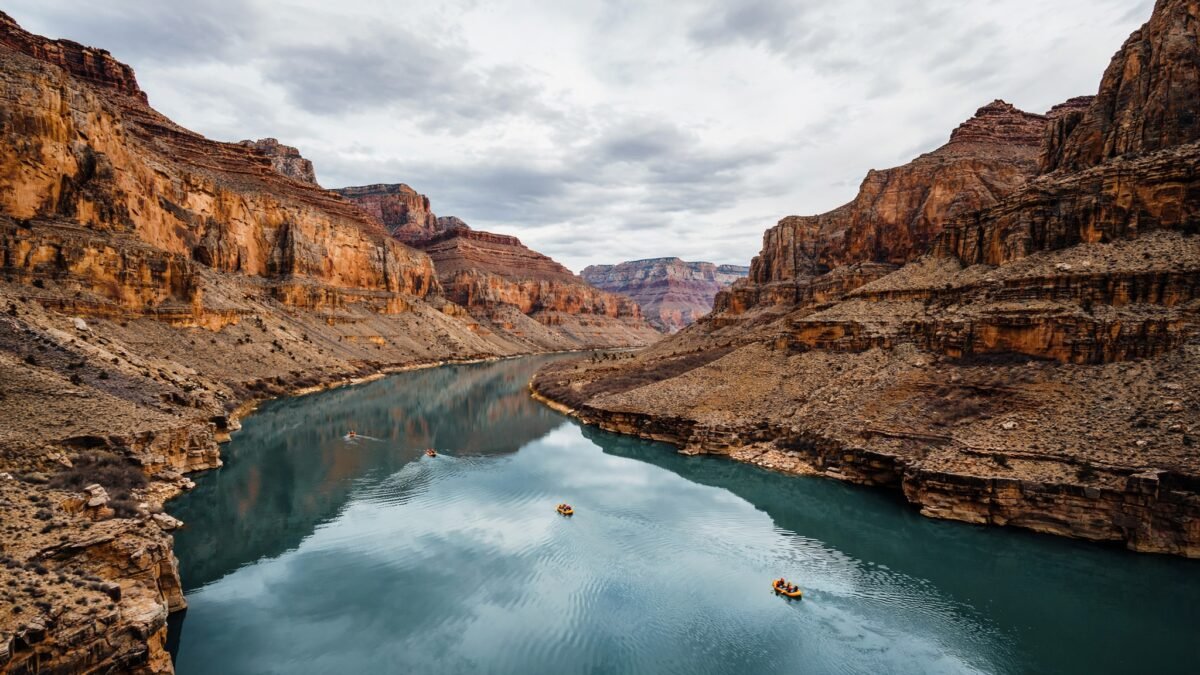
Prescott College alumni served as speakers, trip leaders and participating guides during the annual 2026 Grand Canyon River Guides Training Seminar held this past spring.
The seminar, sponsored by Grand Canyon River Guides, combined land-based presentations with practical instruction and discussions during a Colorado River trip through Grand Canyon. Topics included regional ecology, springs and tributaries, natural history, resource management, experiential education and whitewater rafting.
### Research on springs and tributaries
Joel Barnes, a 1981 Prescott College graduate, and Larry Stevens, a 1975 graduate, were topical experts for both parts of the seminar. During the Land Session, they presented recent field work and research examining the importance of springs within Grand Canyon and the ways those water sources connect with tributaries.
Several other Prescott College alumni attended the Land Session, including Justin Salamon, Gibbey Simeon, Peter Lefebvre, Brad Dimock and Paul Lauk.
Barnes and Stevens continued teaching during the River Session, addressing experiential education, regional ecology and issues related to managing natural resources. They also shared whitewater rafting techniques and knowledge developed through their experience on the river.
Nancy Brian, another Prescott College graduate and a former botanist for Grand Canyon National Park, joined the River Session as a speaker. Her presentations drew on her knowledge of plant ecology and the canyon’s natural history.
### Alumni aboard the river trip
Four Prescott College alumni were among the guides participating in the training trip: trip leader Liam O’Neill, Bec Kates, Angelica Cronin and Brennah Latchford. The trip was hosted by AzRA and began April 1 at Lee’s Ferry under cloudy and rainy conditions.
Guides represented several river organizations and companies, including AzRA, CANX, GCE, ARR/GCW, OARS, OU, Western and Wilderness. Additional speakers and experts joined different portions of the journey.
Kates later wrote about the seminar for Boatman’s Quarterly Review. Her account described a program that paired classroom-style learning with time at the oars, allowing less-experienced rowers to build skills while traveling downstream.
Early in the trip, Barnes led a discussion about the different layers that form the Grand Canyon landscape. The session connected geology, historic human travel and the canyon’s water system. Other presentations covered ties to the Little Colorado River, rapid formation, water-quality gauges and ways to access environmental data.
The group also studied the broader Colorado River system, including its headwaters and tributaries across four states and two countries. Cultural awareness, Wild and Scenic Rivers, beach conditions and the role of water levels in river travel were among the other subjects addressed during the seminar.
### Learning under low-water conditions
Low flows added a technical element to the training. Participants practiced routes through rapids and shared information before difficult runs. At Horn Creek Rapid, nine of 10 boats completed the planned route upright. One boat struck the right side and overturned, but the crew responded quickly, recovered everyone and reported no physical injuries.
Participants later reviewed the incident as part of the seminar’s emphasis on preparation, teamwork and learning from changing river conditions. The group continued through other rapids, including Bedrock and Deubendorf, while rotating rowers during long travel days.
Paul Dohm of the Adopt-A-Beach program accompanied part of the trip to establish a baseline record of camping beaches for the year. His observations documented beach loss in the Grand Canyon river corridor.
The seminar ended at Pearce Ferry after combining technical boating practice with instruction about the Colorado River and Grand Canyon. For the Prescott College alumni involved, the program provided an opportunity to apply academic research and field experience in the training of current river guides.