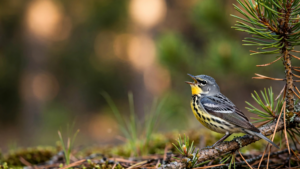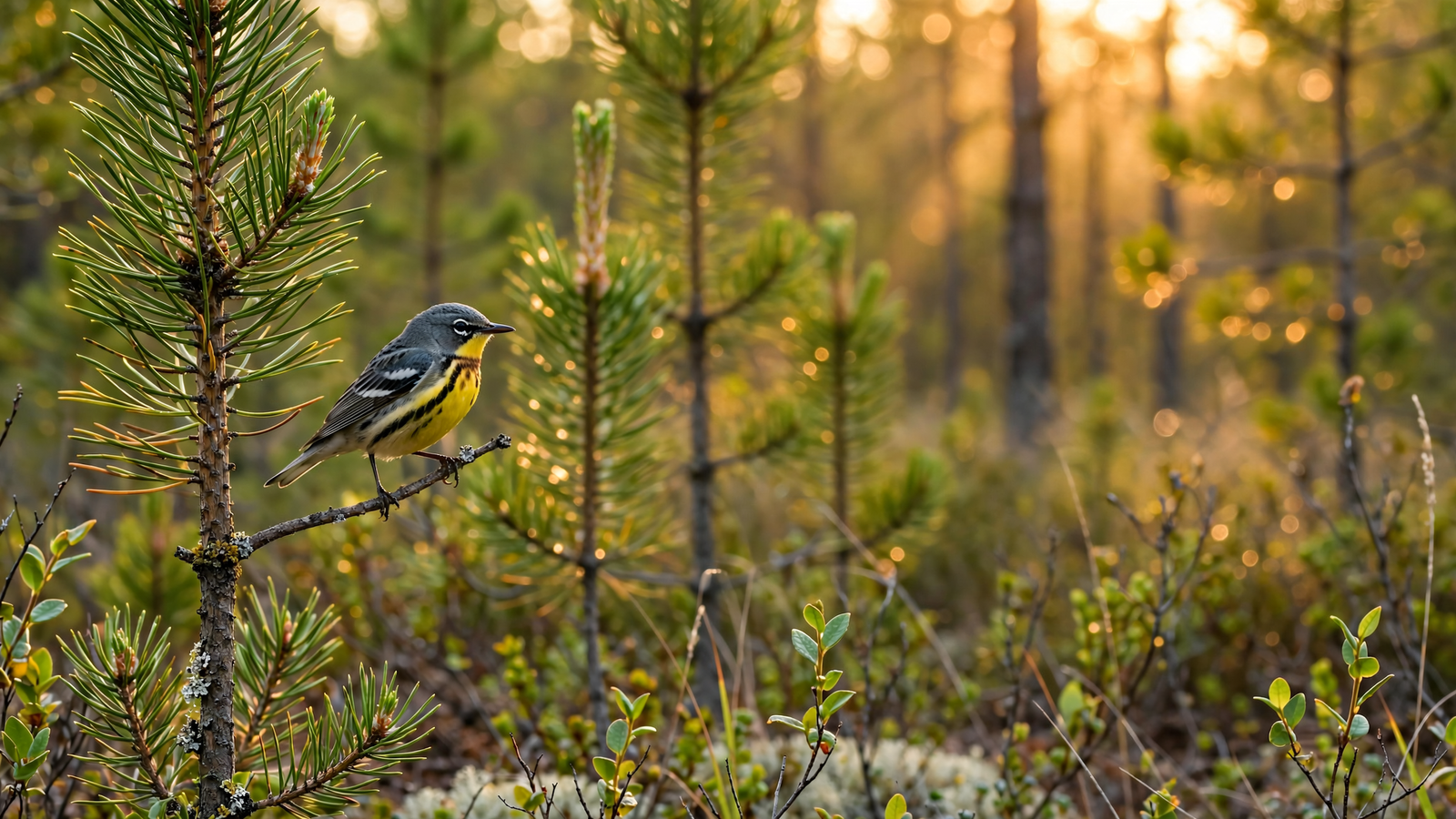
On a spring morning in Michigan’s northern Lower Peninsula, a small gray-and-yellow bird can disappear into a stand of young jack pine. The Kirtland’s warbler is not large, brightly dramatic, or easy to spot. But its presence tells a remarkable story: a species once limited to a narrow and declining habitat has expanded its breeding range and, after decades of conservation work, no longer needs federal protection under the Endangered Species Act.
The bird’s recovery was not the result of a single discovery or a quick rescue. It came from learning what kind of forest the warbler needed, restoring that forest at a large scale, and continuing the work after the population began to improve. The Kirtland’s warbler is now one of the clearest examples of how a threatened species can benefit when conservation is designed around the ecology of an entire landscape.
A bird built for a very particular forest
Kirtland’s warblers breed in young jack-pine forests, especially stands with trees close enough together to create cover but still low and open enough for the birds to move through. These forests are temporary by nature. As jack pines mature, their branches rise and the vegetation beneath them changes. The habitat gradually becomes less suitable for nesting.
Historically, wildfire helped renew this cycle. Fire opened the ground and released jack-pine seeds, allowing dense new stands to grow. In the decades when fires were suppressed and forests were managed differently, the young stands became less common. The warbler’s specialized habitat shrank along with them.
The species also faced pressure from brown-headed cowbirds, which lay their eggs in the nests of other birds. A warbler may raise a cowbird chick at the expense of its own young. For a population already restricted to a small number of breeding areas, that added pressure mattered. For related reading, see The European Bison: How Europe’s Largest Land Mammal Found Its Way Home.
By the middle of the 20th century, the Kirtland’s warbler had become closely associated with parts of Michigan’s jack-pine country. It was listed as endangered in 1967, when federal wildlife protection began to focus attention on the species’ rapidly diminishing habitat.
Conservation began with understanding the landscape
The first major lesson of the recovery effort was that protecting individual nests would not be enough. The warbler needed a continuing supply of young forest. That meant managing land on a rotating basis, creating new jack-pine stands as older ones grew out of the bird’s preferred condition.
Foresters and wildlife managers developed methods that could imitate some of the effects of natural disturbance. They planted jack pine, prepared soil, and used prescribed fire or mechanical treatments where appropriate. In some areas, managers also controlled brown-headed cowbirds during the breeding season.
These actions required cooperation across public and private land. The U.S. Forest Service, the U.S. Fish and Wildlife Service, Michigan wildlife agencies, conservation groups, timber interests, local communities, and landowners all had roles to play. The goal was not to preserve one frozen patch of forest. It was to maintain a moving mosaic of stands: some newly planted, some ideal for nesting, and others gradually aging toward the next cycle.
That approach changed the question from “Where are the birds today?” to “Where will suitable habitat exist several years from now?” It is a more demanding way to manage wildlife, but it is also more durable. A species depending on a changing habitat cannot be protected by treating the landscape as static.
A recovery that crossed state lines
As restoration expanded, Kirtland’s warblers began breeding beyond their traditional Michigan stronghold. Populations became established in Wisconsin, and the species also returned to parts of Ontario. Those new breeding locations mattered because they reduced the bird’s dependence on a single concentrated area. For related reading, see The Whooping Crane: How North America’s Tallest Bird Found a Way Back.
The expansion also showed that the warbler’s needs could be met in more than one place when managers recreated the right forest conditions. Habitat work in Wisconsin included planting and managing jack pine stands, while monitoring helped researchers understand how the birds used restored areas.
The warbler’s range is still unusual. It migrates each year to the Bahamas and nearby islands, meaning that its conservation story does not stop at the breeding grounds. Conditions in its wintering range, along with migration hazards and broader environmental changes, can affect the species as well. Even so, restoring breeding habitat in the Great Lakes region gave the bird a stronger foundation than it had a generation ago.
Why delisting was an important milestone
In 2019, the U.S. Fish and Wildlife Service removed the Kirtland’s warbler from the federal endangered species list. The decision followed decades of population surveys, habitat management, and recovery planning. It did not mean the bird had become common everywhere or that conservation could end. It meant the species had met the federal criteria for no longer being considered in danger of extinction or likely to become endangered within the foreseeable future.
Delisting is often misunderstood as the final page of a conservation story. In practice, it is a transition. The species remains protected by other laws, including the Migratory Bird Treaty Act, and wildlife agencies continue to monitor populations and habitat. The federal government also established a post-delisting monitoring period to watch for warning signs that could require renewed action.
That continued attention is especially important because the habitat itself has to be maintained. Young jack-pine forest does not remain young forever. If planting, fire management, or other restoration work stops, the supply of suitable nesting areas can eventually decline again. For related reading, see The Tool Library: How Borrowing a Drill Can Make Home Repair Feel Possible.
A practical model for species recovery
The Kirtland’s warbler offers a useful lesson beyond Michigan’s pine forests. Recovery did not depend on making the bird adapt to a radically altered world. Instead, people identified the conditions that allowed it to thrive and began rebuilding those conditions across a working landscape.
The strategy also demonstrates why conservation can take decades. A newly planted jack-pine stand does not become nesting habitat immediately. Forests must grow, birds must find them, and managers must learn which treatments work best. Population surveys then provide feedback, showing whether the habitat is producing more successful breeding pairs.
That patience produced something measurable. A bird once concentrated in a shrinking habitat now occupies breeding areas in multiple jurisdictions, and the federal government considers its population secure enough for delisting. The achievement rests on thousands of ordinary decisions: where to plant trees, when to burn, how to monitor nests, how to control invasive pressures, and how to keep agencies working toward the same long-term goal.
There is also a quieter reason for optimism. The Kirtland’s warbler’s recovery did not require a pristine wilderness untouched by human hands. It required people to understand that healthy forests change, and that responsible management can help those changes continue. In a landscape shaped by both natural processes and modern land use, conservation became an act of reconstruction.
When the warbler returns each spring, its song is more than a sign that one bird has survived another migration. It is evidence that a damaged ecological pattern can be repaired. The forest can be renewed, the birds can follow, and a species once edging toward disappearance can gain room to live in the future.
Use: Federal species history, habitat, conservation status, and recovery information.
Use: 2019 federal delisting milestone and continued conservation context.
Use: Michigan habitat, management practices, and species background.
Use: Bird identification, breeding range, habitat, and natural-history context.