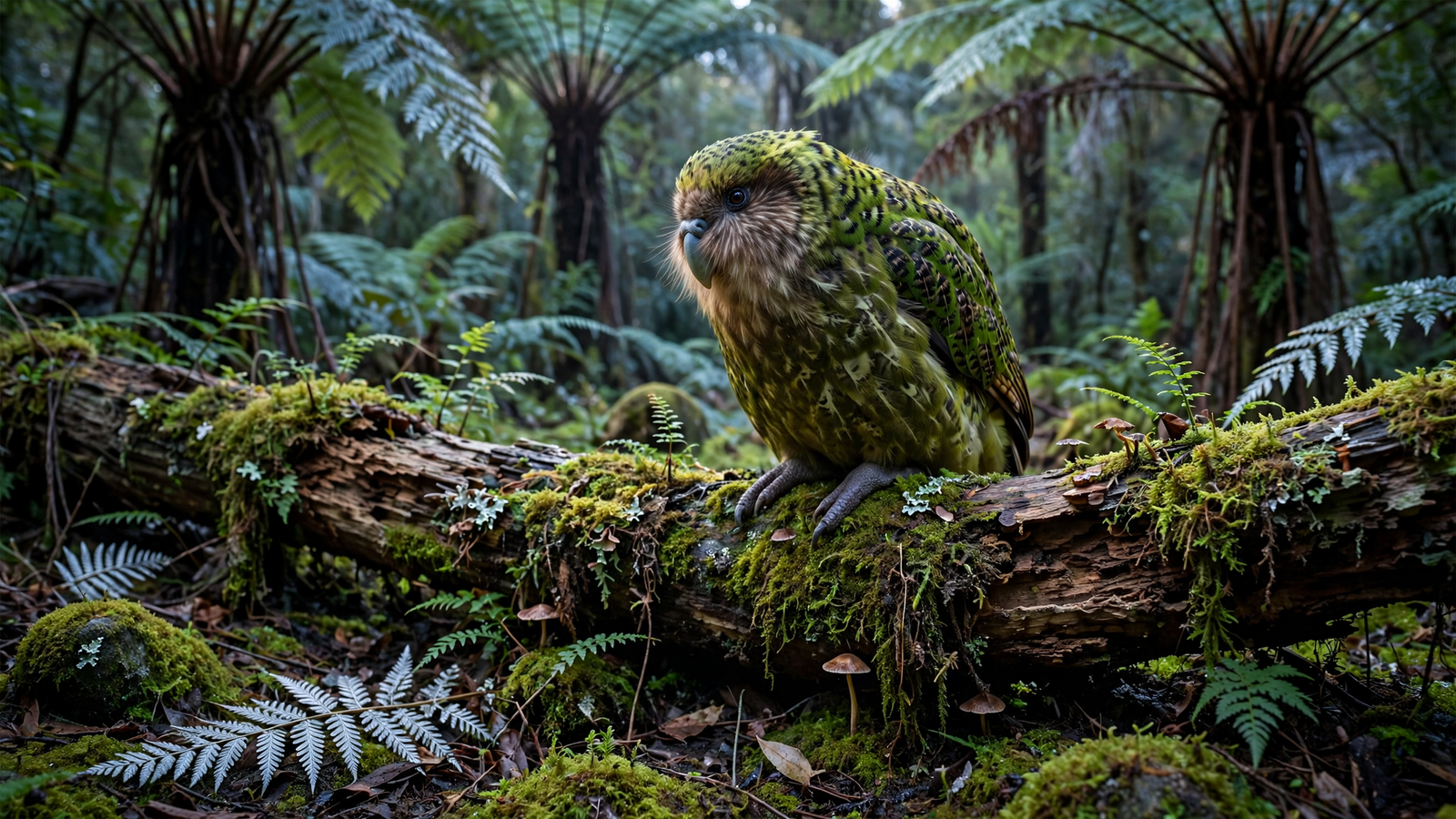
After sunset on a forested island off New Zealand, a heavy bird begins to move through the undergrowth. It cannot fly. It climbs with strong legs, uses its wings for balance, and gives off a musky scent that once made it easy for predators to find. Yet the kākāpō is not a relic kept alive only in captivity. It is a living conservation project, and one of the most closely watched recoveries in the world.
The kākāpō is a large, nocturnal, flightless parrot found only in New Zealand. Its moss-green feathers help it disappear into vegetation, while its rounded body and unusually expressive face have made it one of the country’s best-known native birds. The species is also critically endangered. Its survival now depends on a combination of predator-free habitat, careful breeding management, veterinary care, genetic research, and the knowledge of the Māori communities connected to its recovery.
That combination has achieved something that once seemed unlikely: the population has grown from a few dozen known birds in the 1990s to more than 200 today. The number remains small, and every adult matters. But the direction of travel has changed from disappearance to recovery.
A parrot shaped by an island without mammal predators
Kākāpō evolved in Aotearoa New Zealand, where native ecosystems developed without land-based mammalian predators. Before the arrival of humans, the country’s forests supported birds that filled roles occupied elsewhere by small mammals. Some birds hunted, some scavenged, and some, including the kākāpō, lived on the ground without needing to fly.
The kākāpō is the world’s heaviest parrot. It is also a vegetarian generalist, feeding on leaves, roots, bark, seeds, flowers, and fruit. It climbs trees and can glide down from branches, but it lacks the muscular flight adaptations of flying parrots. Its low-energy lifestyle worked in an environment where being flightless was not automatically dangerous.
Human settlement changed that balance. Polynesian settlers brought rats and dogs, while later European settlement added cats, stoats, and other animals. These predators could locate a slow-moving, ground-nesting bird that had evolved with little need to fear mammals. Habitat loss and changes to forest food supplies added further pressure. For related reading, see The Human Pangenome: How Scientists Are Building a More Complete Map of Our DNA.
By the late 20th century, conservationists feared the species was effectively lost. Birds were gathered from increasingly vulnerable mainland areas and moved to safer islands. In 1995, the known population stood at just 51 individuals. The emergency had become a managed recovery effort.
The first requirement was a place where kākāpō could live
The central idea behind the recovery program is simple but demanding: kākāpō need habitat without introduced mammalian predators. New Zealand conservation agencies and partners have therefore used islands as protected refuges, removing rats and other predators before transferring birds there.
Whenua Hou, also known as Codfish Island, became a major refuge for the species. Other predator-free islands, including Hauturu-o-Toi and Anchor Island, have also played important roles. These places are not untouched laboratories. They require continuing surveillance, quarantine procedures, pest-control work, and regular checks for any animal that could threaten the birds.
The island strategy illustrates a broader lesson in conservation. Protecting a rare species is not always a matter of placing more animals inside a fenced reserve. Sometimes it means restoring an entire ecological setting and then maintaining that restoration year after year.
A breeding system tied to the forest’s fruit supply
Kākāpō reproduction presents another challenge. The birds do not breed on a predictable annual schedule. Breeding is strongly linked to the availability of fruit from certain native trees, especially rimu. When those trees produce an unusually large crop, known as a mast, kākāpō are more likely to breed.
That pattern is an evolutionary adaptation to an unpredictable food landscape, but it makes recovery planning complicated. A conservation team may have to prepare for a major breeding season years in advance, then work around the realities of weather, food supply, nesting behavior, and individual health.
Female kākāpō raise the chicks alone. Nests are built on or near the ground, often in cavities or beneath vegetation, leaving eggs and young vulnerable if predators are present. During breeding seasons, conservation workers monitor nests, weigh chicks, treat illnesses, and intervene when a young bird needs help. The goal is not to replace the birds’ natural behavior, but to give that behavior a chance to succeed in a world that has been heavily altered. For related reading, see The Alaska Purchase: How a Remote Territory Became an American Future.
Technology has become part of that work. Many birds carry transmitters that allow researchers to follow their movements and detect unusual activity. The recovery team can use the data to locate nests, identify interactions between birds, and respond quickly when an animal becomes sick or injured. Each bird has an individual history, and that history informs decisions about breeding and care.
Genetics turns a small population into a long-term question
A population that passes through a severe bottleneck can face more than the danger of having too few individuals. It may also carry limited genetic diversity, increasing the risks of inbreeding and reducing the ability to adapt to disease or environmental change.
Kākāpō conservation therefore includes genetic analysis. Researchers use genetic information to understand relationships among birds and guide breeding choices. The aim is to avoid pairing closely related individuals when possible and preserve as much of the remaining diversity as the population expands.
In recent years, scientists have also used genome sequencing and other biological tools to investigate health, fertility, disease resistance, and inherited traits. Such work does not make recovery automatic. It gives conservationists better information when the population is small enough that a single breeding decision can matter.
Conservation is also a relationship with people
The kākāpō recovery program is not simply a technical exercise carried out by scientists. It is connected to Māori knowledge, language, history, and authority. The bird’s name comes from te reo Māori: kākāpō is commonly translated as “parrot” and “night,” reflecting its nocturnal life. For related reading, see The Goblin Shark: The Deep-Sea Predator With a Jaw That Shoots Forward.
Ngāi Tahu, the iwi whose traditional territory includes much of the South Island, has an important relationship with the species and with conservation work in the region. The recovery program’s partnership with Māori communities reflects a broader change in environmental practice: species protection is increasingly understood as involving cultural responsibility and decision-making, not only population counts.
That perspective also changes what success means. A recovered kākāpō population would not merely be a larger number of birds. It would be a species able to occupy functioning habitat, reproduce with less intensive intervention, and remain part of the living identity of Aotearoa.
Why the kākāpō story matters beyond New Zealand
The kākāpō is still critically endangered, and its future is not secure. A disease outbreak, an invasive predator, a poor breeding season, or a loss of genetic diversity could set the population back. Even on predator-free islands, climate change may alter the plants and fruit supplies that shape breeding.
But the recovery has already changed the conservation question. The issue is no longer whether the species can be found at all. It is how to move from emergency protection toward a self-sustaining population.
The answer so far has required patience rather than a single breakthrough. Islands had to be cleared of predators. Birds had to be located and monitored. Forest food supplies had to be understood. Genetic relationships had to be mapped. Māori knowledge and leadership had to be part of the work. Veterinary care and modern tracking tools had to support, rather than overwhelm, the birds’ natural lives.
That is what makes the kākāpō an important conservation story. Its recovery is not a tale of nature simply bouncing back once people step aside. It is an example of people taking responsibility for damage they helped cause, then building the conditions under which a remarkable species can do more of its own recovering.
Use: Species biology, conservation history, predator-free island management, breeding, and current recovery information.
Use: Official recovery-program information on monitoring, breeding, genetics, technology, and partnerships.
Use: Conservation status and authoritative species background.
Use: Historical, ecological, and cultural context for the species in Aotearoa New Zealand.