On a rise above the River Deben in Suffolk, England, a group of grass-covered mounds had long been part of the landscape. They looked ancient, but their story was almost entirely hidden. In 1939, that changed when excavation opened the largest mound and revealed the imprint of a ship buried in the earth.
There was no intact wooden vessel waiting underground. The timber had disappeared. But its shape remained in the soil, along with a chamber filled with objects of extraordinary craftsmanship: a decorated helmet, a shield, weapons, gold fittings, silver vessels and other treasures gathered from across the early medieval world.
The discovery became known as Sutton Hoo. It transformed the public image of Anglo-Saxon England, a period once reduced to legends, battles and a few surviving manuscripts. The burial suggested something more complex: a wealthy and internationally connected society with skilled metalworkers, long-distance trade, powerful rulers and elaborate ideas about memory, status and the afterlife.
A landscape of mounds
Sutton Hoo is the modern name for an archaeological site near Woodbridge, on the eastern side of England. The land contained numerous burial mounds, some of which had been robbed or damaged long before modern archaeology arrived. Local people knew the mounds were old, but their contents and purpose were uncertain.
The estate belonged to Edith Pretty, who lived at Sutton Hoo with her young son. In 1938, she asked Basil Brown, a local archaeological excavator, to investigate the largest mound. Brown was not a university professor or a museum celebrity. He was an experienced and resourceful researcher who had already worked on archaeological sites in Suffolk.
His early work revealed that the mound had been disturbed by looters. Yet the remains were not empty. Brown shifted his attention to another mound, later identified as Mound 1, and found traces that hinted at something much larger beneath the soil.
The outline of a ship
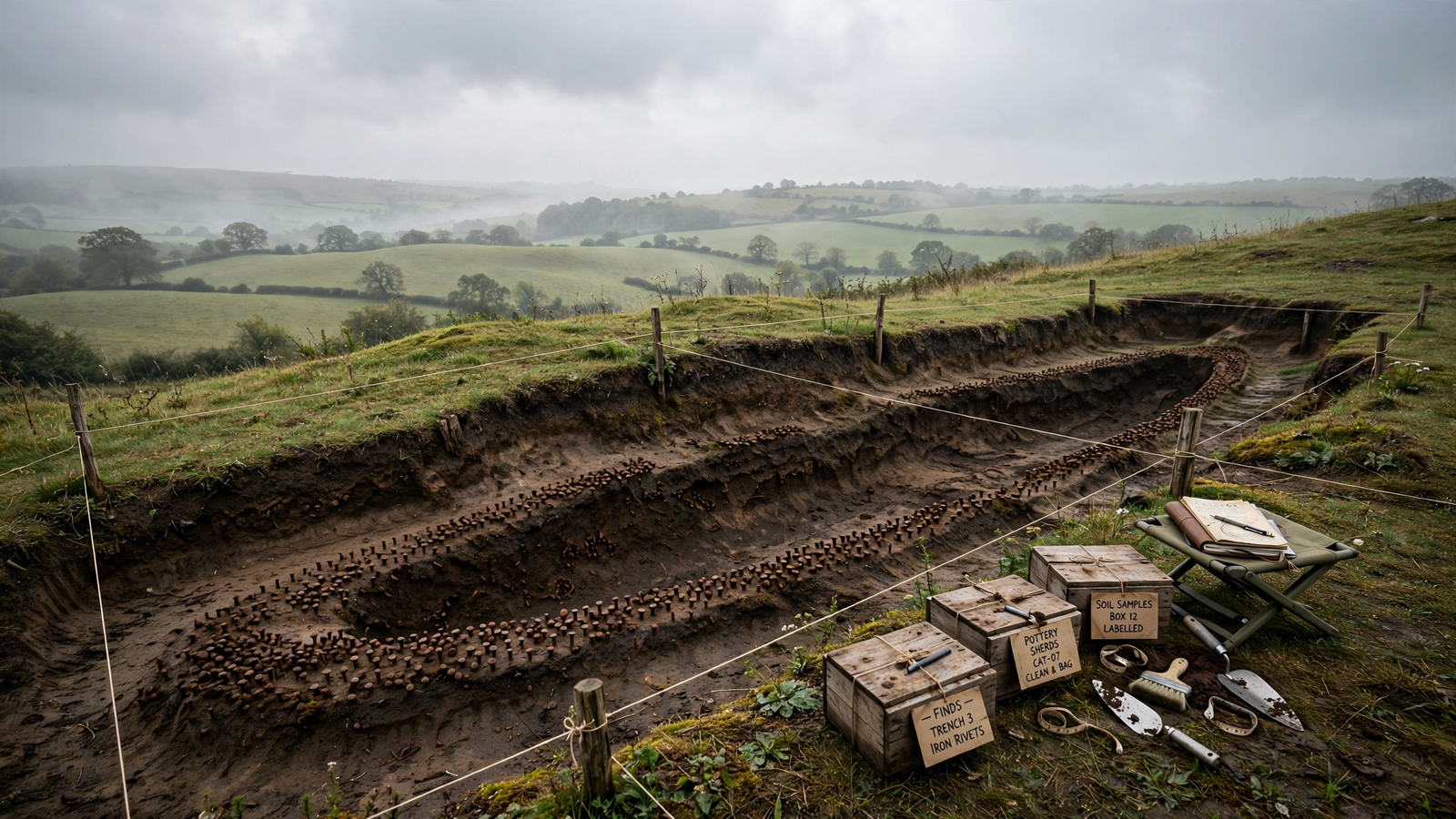
As the excavation progressed in 1939, the earth began to reveal a long, curved pattern. Iron rivets appeared in rows, marking the position of a vessel. The ship had been hauled inland and placed in a trench before the burial chamber was built at its center. For related reading, see The Antikythera Mechanism: How a Shipwreck Revealed the Ancient World’s Mechanical Cosmos.
The wood had decayed because of the local soil conditions, leaving a negative impression rather than a preserved hull. Archaeologists could nevertheless reconstruct the vessel’s size and design from the surviving rivets and soil stains. It was about 27 metres long, built for rowing and sailing, and large enough to represent a major investment of labor and materials.
At the center of the ship was a chamber containing objects that had been carefully arranged around the deceased. The body itself was missing. The soil was acidic, and later examination found chemical evidence consistent with the decay of human remains. Whether the burial originally contained a body that vanished or was created as a symbolic memorial remains an important part of the site’s mystery.
The absence of a body did not make the grave less informative. The objects formed a portrait of power. A sword, shield and spears conveyed the authority of a warrior. A purse held gold coins from the Frankish world. Buckles and shoulder clasps were made with intricate goldwork and garnets. Silver bowls and other vessels pointed to contacts reaching well beyond East Anglia.
A treasure chest of connections
The most famous object from Sutton Hoo is the helmet. Its iron surface had collapsed into hundreds of corroded fragments, but conservation specialists were able to reconstruct its form. The restored helmet has a human-like face, a sweeping nose and moustache, and a decorative animal motif that runs along the crown.
It is both protective equipment and sculpture. The helmet’s design belongs to a wider northern European tradition, but its quality and visual force are distinctive. Alongside the shield, sword and harness fittings, it suggests that the burial was intended to communicate authority as much as to provide equipment for another world.
Other objects widened the story. Some silverware appears to have originated in the eastern Mediterranean or the Byzantine sphere. The gold coins were produced in the Frankish kingdoms. The techniques used in the jewelry reflect artistic traditions moving around Europe, where craftsmen, objects and ideas traveled through diplomacy, trade, warfare and gift exchange.
Sutton Hoo was not an isolated village with a local treasure chest. It was part of a connected world. The burial’s contents show that early medieval Britain was linked to continental Europe and to the wider political and commercial networks of the time. For related reading, see The American Chestnut: How Science Is Giving a Lost Forest More Than One Way Back.
Who was buried there?
The identity of the person commemorated at Sutton Hoo has never been proved. The scale of the ship and the richness of the grave make a high-status individual likely, perhaps a ruler or a member of a ruling dynasty. The burial has often been associated with Rædwald, a powerful king of East Anglia who lived around the turn of the seventh century.
That identification remains a hypothesis rather than a settled fact. Written sources about the period were produced later and are difficult to match securely with the archaeological evidence. The site may represent a king, another elite figure or a commemorative burial connected to a royal household.
That uncertainty is part of what makes Sutton Hoo valuable. Archaeology does not always provide a single name or complete biography. Instead, it reveals patterns of life: who could command labor, who possessed imported goods, how status was displayed and how communities chose to remember the dead.
From a private estate to a national discovery
The excavation was still under way when Europe moved toward war. After the discovery became known, archaeologists from the British Museum and other institutions joined the work. The objects had to be documented, conserved and protected at a moment when Britain was preparing for conflict.
Edith Pretty donated the treasure to the nation. The decision meant that the finds would be preserved and made available for public study rather than treated as private property. The objects were eventually placed in the care of the British Museum, where the Sutton Hoo collection remains one of its most important groups of early medieval material.
The story of the excavation also changed how people thought about archaeological expertise. Basil Brown’s patient work was essential to recognizing the site’s importance, even though larger institutions later took over the excavation. The discovery became a reminder that major historical breakthroughs can begin with careful observation in an apparently ordinary place.
Why Sutton Hoo changed history
Before Sutton Hoo, popular images of Anglo-Saxon England were often shaped by sparse written records and later medieval storytelling. The burial supplied physical evidence for a society that was prosperous, technically skilled and culturally connected. For related reading, see The Oxford English Dictionary: How Millions of Words Became a History of Language.
It also showed that early medieval art was not crude or merely transitional. The helmet, jewelry, shield fittings and carved details demonstrate a sophisticated visual culture built around symmetry, animal forms, interlaced patterns and controlled use of precious materials. The objects were made to be seen, handled and remembered.
The ship itself expanded the picture further. It demonstrated that elite communities in England possessed the knowledge and resources to build and use substantial vessels. A ship burial was not only a statement about the person inside it. It connected that person to travel, seafaring, exploration and the movement of goods across the North Sea.
Modern research has continued to refine the site’s story. Conservation has revealed details that were invisible when the objects first emerged from the soil. Scientific analysis has helped researchers study materials, manufacturing techniques and the changing chemistry of the burial environment. Every new examination adds information without eliminating the central mystery.
A discovery that keeps unfolding
Sutton Hoo is often described as a treasure discovery, but its deeper importance lies in the questions it opened. What did power look like in seventh-century England? How did rulers build relationships across the sea? Which objects were made locally, and which arrived through exchange? Why was a ship chosen as the setting for remembrance?
The answers are still being assembled from metalwork, soil, landscape, written evidence and comparison with other burial sites. The excavation did not recover a complete story. It recovered enough evidence to make an almost forgotten world visible again.
Today, visitors can stand among the mounds and look toward the river that helped connect East Anglia to the North Sea. The landscape is quiet, but the discovery made it speak. Beneath one grassy rise, archaeologists found not only a remarkable grave but proof that early medieval England belonged to a wider, inventive and internationally connected world.
Use: Collection context, the ship burial, helmet, weapons, jewelry and international connections.
Use: Site history, Edith Pretty, Basil Brown, the 1939 excavation and the estate landscape.
Use: Historical overview of the burial mounds, excavation and significance of the site.