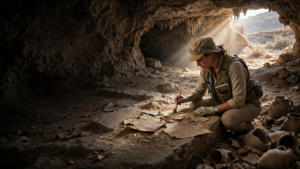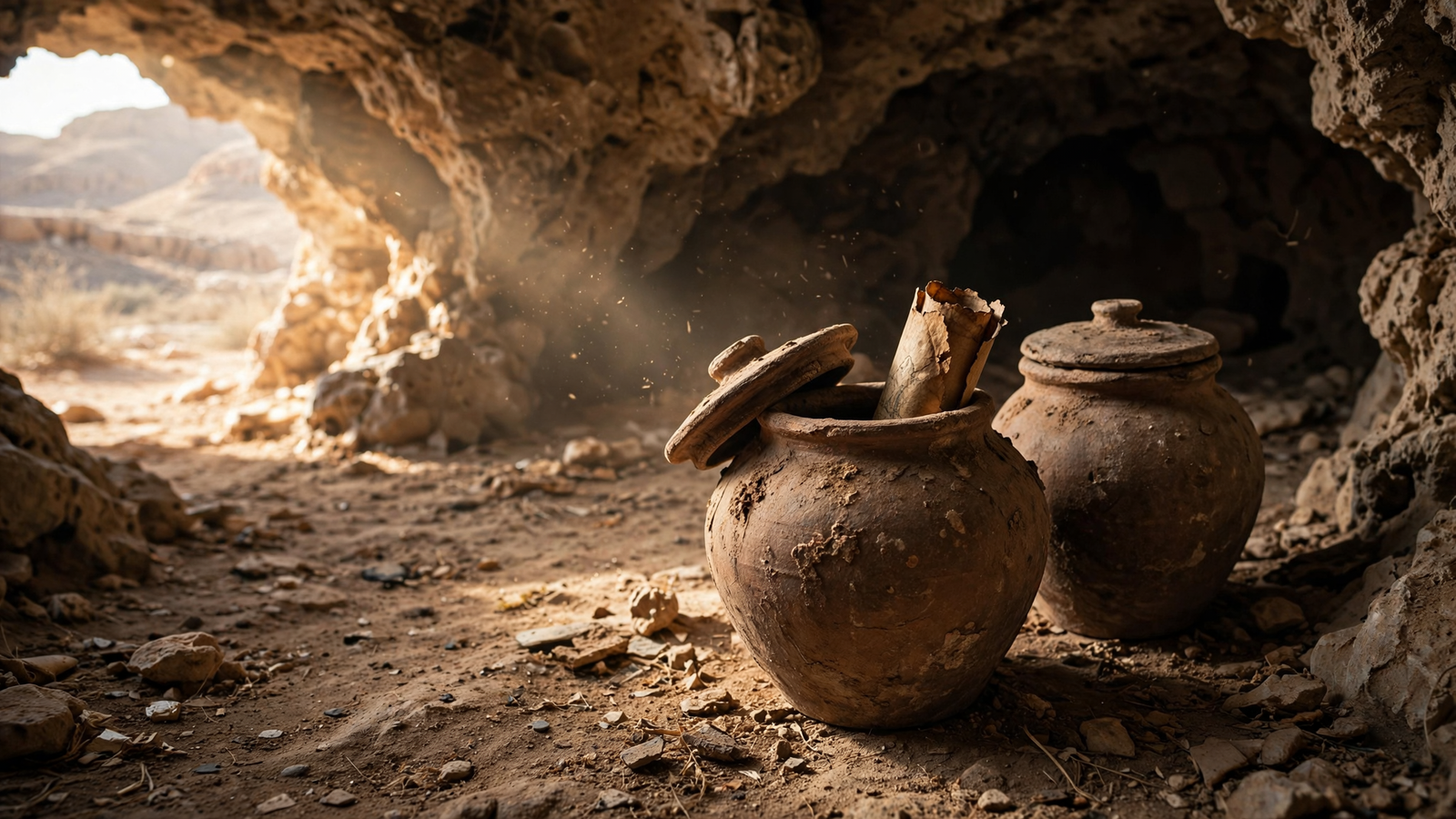
In the spring of 1947, a young Bedouin shepherd searching for a lost goat entered a cave near the northwestern shore of the Dead Sea. Inside, he found tall clay jars. Some held ancient scrolls wrapped in linen; others were empty or damaged. What first appeared to be an unusual collection of old manuscripts would become one of the most important archaeological discoveries of the 20th century.
The discovery took place near Khirbet Qumran, in the territory that was then part of Mandatory Palestine. Over the following decade, researchers and local explorers identified manuscripts in 11 caves along the cliffs. Together, the finds became known as the Dead Sea Scrolls: thousands of fragments and more than 900 separate manuscripts, copied roughly between the third century BCE and the first century CE.
The scrolls did not reveal a single lost book or solve every question about the ancient past. Their importance was greater than that. They preserved a library from a period when Jewish communities were living through political upheaval, religious debate, and the expansion of Hellenistic and Roman power. They also showed how varied ancient Jewish thought could be.
A discovery made by accident
The first cave is usually associated with three Bedouin shepherds who noticed the jars while looking for an animal. Accounts of the initial discovery differ in some details, but the broad outline is clear: manuscripts were removed from the cave, passed through antiquities dealers, and eventually recognized as ancient and unusually significant.
Several of the first scrolls came into the hands of scholars in Jerusalem. One of the best-preserved was a complete copy of the Book of Isaiah, written in Hebrew on leather. Other early finds included a collection of hymns, a rule text describing communal life, and a work later known as the War Scroll.
At first, the manuscripts attracted attention because of their age and condition. The Isaiah scroll, for example, was far older than the medieval Hebrew manuscripts that had formed the main basis for modern biblical scholarship. But the discovery soon raised a much larger question: who had created and stored this library in the desert? For related reading, see The Dead Sea Scrolls: How a Cave Discovery Opened a Window on the Ancient World.
What the caves contained
The scrolls were written in Hebrew, Aramaic, and Greek, the major languages of Jewish life and administration in the region. Their subjects were equally varied. Some texts are copies of books that later became part of the Hebrew Bible. Others are prayers, legal discussions, wisdom writings, apocalyptic visions, songs, calendars, and descriptions of community rules.
Copies of biblical books found at Qumran include Isaiah, Psalms, Deuteronomy, Genesis, Exodus, and many others. Nearly every book in the Hebrew Bible appears somewhere among the fragments, with the notable exception of Esther. The collection also includes texts that were not preserved in the later Jewish biblical canon, such as the Book of Jubilees and the writings often called the Enochic literature.
This mixture is one of the scrolls’ most important lessons. It shows that ancient readers engaged with a broad body of sacred and interpretive writing. The boundaries of authoritative scripture were not experienced in exactly the same way by every community or at every moment.
The manuscripts also preserve evidence of ordinary intellectual work. Scribes copied texts in different hands and formats. Some scrolls were carefully prepared, while others contain corrections, marginal notes, or signs of reuse. Together, they provide a record not only of ideas but of how people produced, handled, organized, and transmitted writing before the age of printing.
The people behind the library
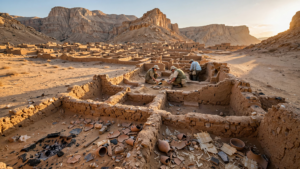
Archaeologists soon began comparing the manuscripts with the nearby ruins of Qumran. The site includes buildings, water installations, pottery, ritual baths, and evidence of occupation. Many scholars have connected the caves and settlement with a Jewish group often identified as the Essenes, a community described by the ancient historian Josephus and other writers.
That identification remains influential but is not universally accepted. Some researchers argue that the scrolls belonged to a particular sectarian community based at Qumran. Others believe the caves may have received manuscripts brought from Jerusalem or elsewhere, perhaps during the upheavals that preceded the Roman destruction of Jerusalem in 70 CE. Still others see the collection as more socially diverse than the traditional “Qumran community” explanation suggests.
The manuscripts themselves offer clues without providing a simple signature. Several texts describe a group separated from what its authors considered a corrupt religious establishment. They refer to strict rules, communal discipline, shared property, ritual purity, and a distinctive calendar. But other manuscripts are less sectarian and may have circulated more widely.
It is therefore safer to describe the scrolls as a library associated with the Qumran region than to claim that every manuscript was written by the same group. The continuing debate is part of the discovery’s value: the evidence is rich enough to support serious argument, but complex enough to resist an easy conclusion. For related reading, see Tutankhamun’s Tomb: How a Hidden Burial Reopened Ancient Egypt to the World.
A new window onto the Hebrew Bible
Before the scrolls were found, scholars relied heavily on much later medieval copies of the Hebrew Bible. The Dead Sea Scrolls pushed the manuscript record back by roughly a thousand years. They made it possible to compare earlier forms of biblical books with texts preserved in later Jewish tradition.
Those comparisons did not simply show that later versions were unreliable. In many places, the wording is remarkably stable. In others, the scrolls preserve differences in spelling, grammar, order, or individual passages. Some variations resemble the Hebrew tradition that later became standard; others are closer to the Greek translation known as the Septuagint or to the Samaritan Pentateuch.
The overall picture is one of both continuity and variety. Ancient scribes transmitted cherished texts with great care, but copying was not a mechanical process. Different textual forms could exist side by side, and communities could preserve their own versions of a shared tradition.
That insight changed biblical scholarship. Instead of imagining one perfectly uniform text moving unchanged through history, researchers gained evidence for a long period of transmission in which texts were copied, interpreted, revised, and sometimes combined.
The scroll that listed hidden treasure
Not every manuscript was literary in the usual sense. In 1952, explorers found a copper sheet in Cave 3. Once opened and read, it proved to be a list of buried treasures, naming locations and quantities of gold and silver.
The Copper Scroll remains one of the most mysterious finds from Qumran. Some scholars have viewed it as a genuine inventory, while others have questioned whether the listed treasure was real, symbolic, or intended for a particular audience. No confirmed trove matching its instructions has been recovered. Its unusual material and practical tone demonstrate how far the collection extends beyond familiar religious writing. For related reading, see The Antikythera Mechanism: How a Shipwreck Revealed the Ancient World’s Mechanical Cosmos.
From fragile fragments to a global archive
Preserving the scrolls has been a challenge from the beginning. The desert climate helped protect many manuscripts for centuries, but once fragments were removed from their containers, light, humidity, handling, and earlier restoration methods could threaten them. Conservators have had to stabilize leather and papyrus while documenting every fragment and keeping track of pieces that may once have belonged together.
Publication was also slow. The fragments were dispersed among institutions and research teams, and the work of identifying, joining, photographing, translating, and interpreting them took decades. Delays fueled public suspicion and scholarly frustration, although the manuscripts’ difficult condition and enormous number also made the project genuinely demanding.
Modern imaging has opened a new phase. High-resolution photography and multispectral techniques can reveal faded ink that is difficult to see with the naked eye. Digital databases allow scholars and the public to examine manuscript images without repeatedly handling the originals. The Israel Antiquities Authority and partner institutions have made many materials accessible online, expanding research beyond the museums and libraries that hold the physical fragments.
Why the discovery still matters
The Dead Sea Scrolls changed several fields at once. They reshaped the study of the Hebrew Bible, provided first-hand evidence for Jewish life during the Second Temple period, and offered new material for understanding the religious environment in which early Christianity emerged. They also gave historians a more detailed view of literacy, scribal practice, language, ritual, and community organization in the ancient eastern Mediterranean.
Yet their deepest contribution may be methodological. The scrolls remind us that the past rarely arrives as a complete story. It comes in fragments: a line of faded Hebrew, a broken jar, a disputed ruin, a manuscript copied by an unknown hand. Each piece can clarify the past, but each must also be read with restraint.
A chance discovery in a desert cave did not settle every question about ancient Judaism. It did something more useful. It widened the evidence, restored long-silent voices, and made the ancient world more varied, more human, and more difficult to simplify.
Use: Authoritative information on the discovery, caves, manuscripts, languages, digitization, and manuscript images.
Use: Background on the Dead Sea Scrolls, the Isaiah Scroll, the Qumran collection, and the museum’s preservation role.
Use: Historical overview of the discovery, major texts, their significance, and the relationship between the scrolls and biblical textual traditions.
Use: Cross-checking chronology, contents, archaeological context, and scholarly interpretations of the Qumran discoveries.