On November 4, 1922, workers clearing an ancient pathway in Egypt’s Valley of the Kings uncovered a stone step. Beneath it lay the beginning of a staircase, buried under centuries of dust and rubble.
The find was not immediately recognizable as one of archaeology’s greatest discoveries. The staircase led to a blocked doorway, and beyond that doorway was a small, crowded tomb belonging to a young pharaoh whose name had largely disappeared from popular memory: Tutankhamun.
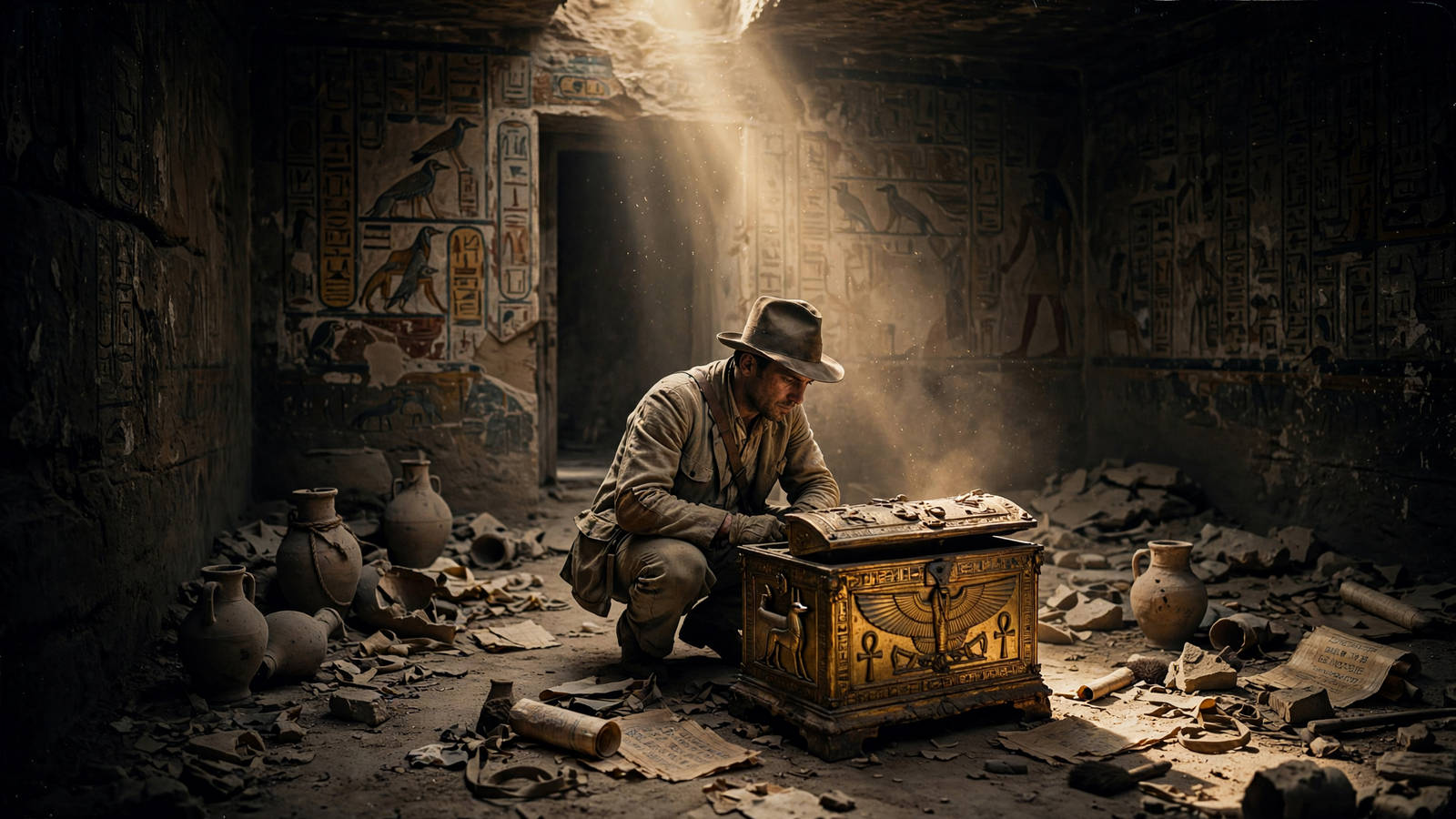
When British archaeologist Howard Carter entered the tomb several weeks later, he found objects piled so densely that the first chamber looked less like an orderly royal burial than a storehouse interrupted by time. Chariots, furniture, weapons, clothing, ritual objects, boxes, statues, and vessels filled the rooms. A sealed doorway led farther into the tomb.
The discovery of KV62, the tomb’s archaeological designation, did more than reveal the burial place of one Egyptian king. It transformed public ideas about ancient Egypt, demonstrated the value of patient excavation, and preserved an unusually detailed record of royal life during the New Kingdom.
A young king in a crowded dynasty
Tutankhamun ruled Egypt during the 18th Dynasty, a period that included some of the country’s most famous pharaohs. He came to the throne as a child, probably around the age of nine, and ruled for roughly a decade before dying as a teenager or young adult, around the late 14th century BCE.
His reign followed a period of religious upheaval. The earlier king Akhenaten had promoted the worship of the sun disk Aten and moved the royal court to a new capital at Amarna. After Akhenaten’s death, Egypt’s rulers gradually restored the older religious order. Tutankhamun’s original name, Tutankhaten, was changed to Tutankhamun, signaling a return to the worship of Amun and the traditional pantheon.
Because his reign was short and later rulers removed or obscured many traces of the Amarna period, Tutankhamun was not remembered in the same way as rulers who built enormous monuments or conquered foreign territories. His tomb survived partly because it was small, unfinished in places, and eventually covered by debris from later construction in the valley. For related reading, see The Rosetta Stone: How One Broken Monument Reopened Ancient Egypt.
The search in the Valley of the Kings
By the early 20th century, archaeologists had already excavated many royal tombs in the Valley of the Kings. Carter believed that Tutankhamun’s burial place might still be undiscovered, but locating it required years of work.
The excavation was supported by George Herbert, the fifth Earl of Carnarvon, who financed Carter’s investigations. Their partnership had continued through difficult seasons, even as much of the valley appeared to have been explored.
The small staircase found in November 1922 changed the search. Carter’s excavation team cleared twelve steps and reached a doorway bearing royal seals. He sent word to Carnarvon in England, who traveled to Egypt. On November 26, Carter made a small opening in the sealed entrance and looked inside with a candle or lamp.
What he saw became one of archaeology’s most famous moments. The first chamber contained a jumble of extraordinary objects, but the discovery was not a single dramatic unveiling. It was a long process of recording, conserving, photographing, and removing thousands of individual pieces without losing their relationships to one another.
Why the tomb was so important
Many royal tombs in Egypt had been robbed in antiquity. That meant archaeologists often found damaged chambers, scattered remains, or inscriptions without the objects that once accompanied them. Tutankhamun’s tomb had also been entered by thieves in ancient times, probably more than once, but the disturbance was limited. Much of the burial equipment remained in place.
The tomb was modest compared with the monumental burial complexes of more powerful pharaohs. It contained four main spaces: an entrance corridor, an antechamber, an annex, and a burial chamber with a treasury. The burial chamber held a series of nested shrines and coffins surrounding the king’s remains.
Its contents offered archaeologists an unusually broad picture of elite Egyptian material culture. There were ceremonial objects, but also items connected to movement, clothing, food, furniture, writing, warfare, and personal adornment. The collection included beds, stools, chests, walking sticks, bows, arrows, sandals, garments, vessels, and models.
These objects were not simply beautiful possessions. They carried information about technology, trade, artistic conventions, religious practice, and the organization of royal workshops. A carved box could reveal military imagery; a chair could show how furniture was joined and decorated; a piece of cloth could preserve evidence of ancient textile production.
The burial chamber and the golden mask
The innermost burial arrangements were designed to protect the king and sustain him in the afterlife. Several shrines enclosed the sarcophagus, while nested coffins surrounded the mummy. The famous gold mask covered the head and shoulders of the king’s innermost coffin. For related reading, see The Dead Sea Scrolls: How a Cave Discovery Opened a Window on the Ancient World.
The mask became the discovery’s most recognizable object, but it was only one part of a much larger funerary system. Its idealized face, striped nemes headdress, and protective symbols expressed royal identity and divine protection. The mask was made to transform the deceased king into an eternal ruler, not merely to serve as a portrait in the modern sense.
The burial also contained objects that complicate the image of a perfectly prepared royal ceremony. Some items appear to have been adapted from earlier pieces or made quickly for the young king. This is consistent with the short interval between Tutankhamun’s death and burial. The tomb provides evidence not only of Egyptian wealth and skill, but also of the practical pressures surrounding a royal funeral.
An excavation conducted as a record
One of Carter’s most important contributions was his attention to documentation. The excavation was photographed by Harry Burton, whose images recorded the arrangement of the chambers before objects were moved. Carter and his team catalogued the finds, described their positions, and arranged for conservation work before many pieces left the tomb.
The surviving records are now held and studied through the Griffith Institute at the University of Oxford. They include excavation notes, object cards, photographs, plans, and correspondence. Together, they allow researchers to reconstruct not only what was found, but how the excavation unfolded.
That record matters because an archaeological discovery is more than the recovery of objects. Once an object is removed from its original position without documentation, much of its meaning can be lost. Where a box stood, what it touched, and what was placed nearby may reveal how ancient people used it. Careful excavation turns a collection of things into historical evidence.
From archaeological site to global sensation
News of the discovery spread rapidly. The world’s newspapers followed the excavation, and public fascination helped make Egyptian imagery a defining influence on 1920s design. Jewelry, architecture, theater, advertising, and popular culture borrowed motifs associated with ancient Egypt.
The publicity also raised difficult questions about access and ownership. Carnarvon granted exclusive reporting rights to The Times of London, while other newspapers complained that they were being excluded. Egypt was still under British control, and Egyptian officials objected to the way foreign expeditions and museums had long removed antiquities from the country. For related reading, see Gladys West: How a Quiet Mathematician Helped Give the World GPS.
In the years that followed, the Egyptian government asserted greater control over the tomb and its contents. The objects are now associated primarily with the Egyptian Museum in Cairo and, more recently, with Egypt’s Grand Egyptian Museum. The discovery helped intensify a broader debate that remains central to archaeology: who has the right to excavate, interpret, display, and keep cultural heritage?
Beyond the “curse”
Newspaper stories soon promoted the idea of a pharaoh’s curse, especially after Carnarvon died in 1923. There is no archaeological evidence that the tomb caused a supernatural chain of deaths. The curse story was a media creation built around the public’s appetite for mystery.
The real story is more revealing. Tutankhamun’s tomb survived because of a combination of geography, chance, later building activity, and persistent investigation. It was found by people who understood that even an apparently empty patch of ground could contain evidence. Its significance comes not from a curse, but from the rare survival of a royal burial and the disciplined work required to understand it.
A discovery that keeps yielding questions
More than a century after the staircase appeared, Tutankhamun’s tomb remains valuable because it does not answer every question. Researchers continue to study the king’s health, family relationships, burial practices, materials, and the political changes surrounding his reign.
The discovery also changed how the wider public encountered the ancient past. Instead of seeing Egypt only through enormous monuments, people could look closely at a sandal, a painted chest, a child king’s throne, or a flower wreath placed near a burial. The tomb made ancient history feel detailed and personal.
KV62 was not the largest tomb in the Valley of the Kings, and Tutankhamun was not Egypt’s most powerful ruler. Yet the discovery showed how much history can survive in a vulnerable, imperfect place. A short reign, a hurried burial, and a hidden entrance combined to preserve a remarkable record of craftsmanship, belief, and human preparation for death.
What Howard Carter found in 1922 was therefore more than treasure. It was a time capsule assembled by ancient hands—and a reminder that archaeology’s greatest discoveries often begin with the patient removal of ordinary earth.
Use: Primary excavation records, photographs, notes, object documentation, and the chronology of the discovery.
Use: Authoritative historical context on Tutankhamun, the 18th Dynasty, the Amarna period, and the tomb’s significance.
Use: Cross-checking the king’s reign, historical setting, discovery, and burial.