In 1856, Eunice Foote placed gases inside glass cylinders and set them in sunlight. She was testing a question that now sits at the center of climate science: how does the composition of the atmosphere affect heat?
Foote was not working with satellites, computer models, or precision sensors. She had a pump, thermometers, glass vessels, sunlight, and a scientific instinct that was ahead of its time. Her short paper reported that air containing carbon dioxide—then commonly called carbonic acid gas—heated more strongly and retained heat longer than ordinary air.
The experiment did not explain the entire modern greenhouse effect, and Foote did not produce a forecast of future global temperatures. But it established an important piece of physical evidence: gases in the atmosphere do not all interact with heat in the same way.
For decades, almost no one treated her as part of the history of climate science. Her paper was rediscovered in the 21st century, bringing renewed attention to a woman who worked at a time when American scientific institutions rarely offered women equal access to laboratories, meetings, or professional recognition.
A scientist outside the usual institutions
Foote was born Eunice Newton in 1819 in Goshen, Connecticut, and grew up in a period when scientific education for women was limited. She attended the Troy Female Seminary in New York, an institution founded by educational reformer Emma Willard. The school encouraged students to study science through demonstrations and experiments rather than treating it as a subject reserved for men.
That education mattered. Foote became interested in the physical world, but she did not enter a university laboratory or build a conventional academic career. After marrying Elisha Foote, she lived in Seneca Falls, New York, where she was involved in reform and civic life as well as scientific investigation.
She and Elisha were among the signers of the 1848 Declaration of Sentiments associated with the Seneca Falls Woman’s Rights Convention. Eunice Foote also worked with her husband on inventions and technical experiments. The surviving record suggests a household where scientific curiosity was part of everyday life, even though the professional scientific world offered her few formal paths forward. For related reading, see The Gila Monster: How an Arizona Desert Lizard Helped Inspire a Diabetes Treatment.
That distinction is important. Foote was not invisible because she lacked ability or interest. She was largely absent from the institutions that decided which scientific work would be presented, published, remembered, and taught.
The sunlight experiment
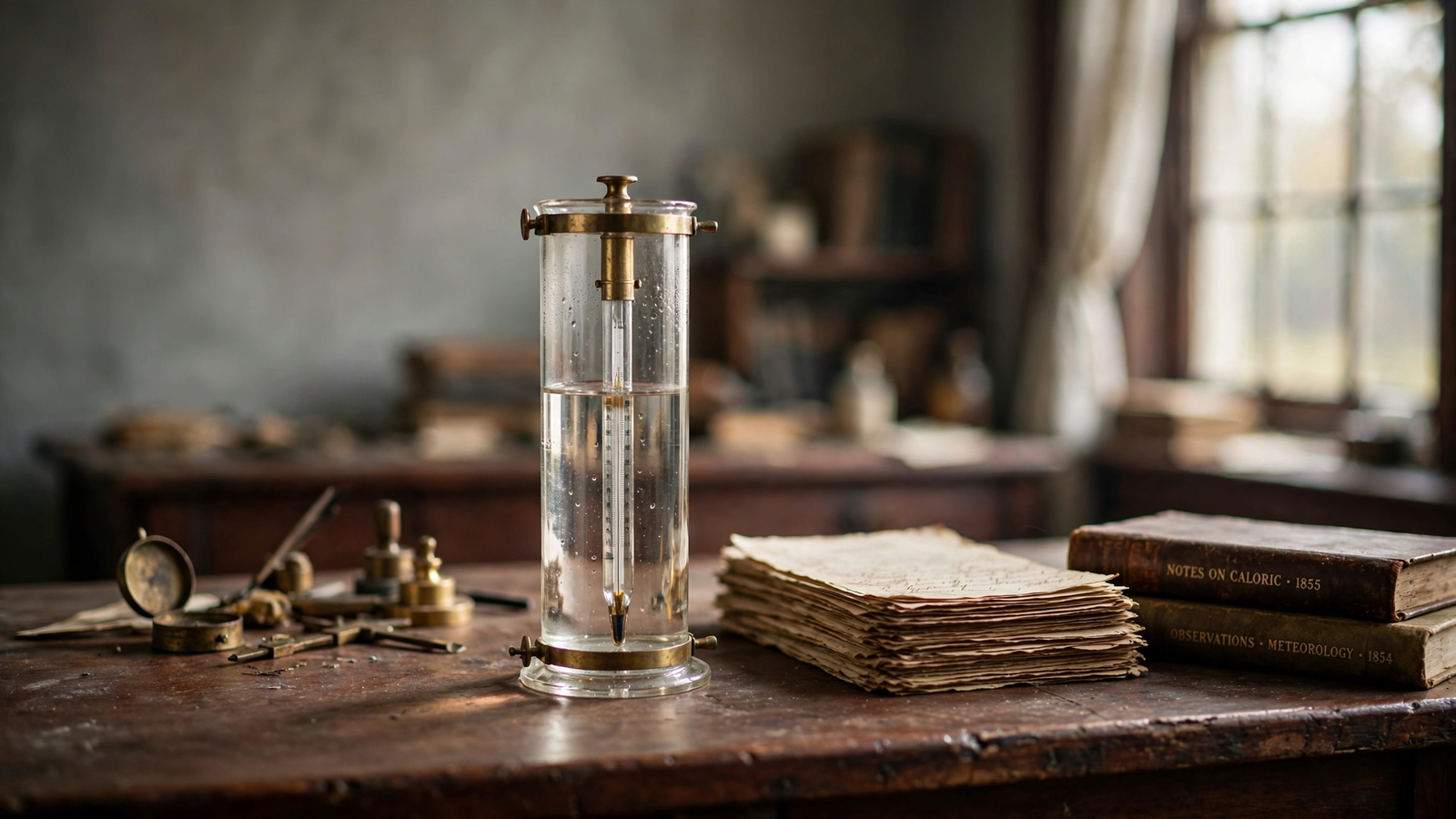
Foote’s best-known experiment was straightforward in design. She placed different gases in glass cylinders and compared their temperatures after exposure to sunlight. She examined ordinary air, hydrogen, and carbon dioxide, as well as differences between moist and dry conditions.
Her findings were qualitative rather than a modern controlled measurement series. Even so, the pattern she described was significant. The cylinder containing carbon dioxide became warmer than the cylinder containing ordinary air, and the gas also appeared to hold onto heat after the light source was removed.
Foote connected those observations to the atmosphere. If the amount of carbon dioxide changed, she reasoned, the atmosphere’s temperature could change as well. Her paper also considered the possibility that variations in atmospheric composition could have influenced the climates of Earth’s past.
Her work was published in the American Journal of Arts and Sciences in 1856 under the title “Circumstances Affecting the Heat of the Sun’s Rays.” It was only a few pages long, but it placed carbon dioxide and atmospheric temperature in the same scientific discussion.
Foote’s work should be described with care. She did not discover every part of the greenhouse effect, and she did not replace the more detailed laboratory research that followed. Her apparatus could not measure infrared radiation in the way later experiments would. What she did provide was an early experimental indication that carbon dioxide had heat-absorbing properties relevant to the atmosphere.
How her work reached the scientific record
In the 19th-century United States, women faced barriers to presenting research at scientific meetings. Foote’s paper was read at the 1856 meeting of the American Association for the Advancement of Science by Joseph Henry, the first secretary of the Smithsonian Institution. The paper was then published in the journal.
That route gave Foote’s experiment a place in print, but it did not give her the same public visibility as many male scientists of the era. Historical accounts have noted that a report of the meeting mentioned her experiment while emphasizing her husband’s scientific work. Foote’s paper subsequently disappeared from most standard accounts of the development of climate science. For related reading, see Landsat: How a Public View From Space Became an American Record of Earth.
Three years later, Irish physicist John Tyndall published influential experiments on the way gases absorb radiant heat. Tyndall’s work was more extensive and helped establish the physical basis of atmospheric heat absorption. It became a major part of the scientific story later told in textbooks.
The problem was not that Tyndall’s work lacked importance. It was that Foote’s earlier experiment had been left out of the story. Rediscovery does not mean the two bodies of work were identical; it means the historical record was incomplete.
A paper found again
Foote’s climate research returned to public attention after researcher Raymond Sorenson identified her paper while examining old scientific publications. His findings were reported in 2011, and later historians, scientists, and science writers investigated Foote’s life and work in greater detail.
The rediscovery changed more than a footnote. It showed how easily contributions can vanish when the scientist is working outside established institutions, when the experiment is published in a short paper, and when later histories focus on a better-known figure.
It also helped correct a common misconception about scientific progress: that major ideas always arrive through a single famous experiment or a single celebrated person. In reality, knowledge often develops through a chain of partial observations, repeated measurements, corrections, and connections made across different communities.
Foote’s experiment was one link in that chain. Scientists before her had studied the atmosphere and heat, and researchers after her made the measurements more precise. But her work deserves recognition because she tested the behavior of gases directly and drew a reasonable atmospheric conclusion from what she observed.
Science, access, and memory
Foote’s story is also about access. Women in the 1850s could participate in scientific culture, but usually under constraints that men did not face. They were often excluded from colleges, professional societies, laboratories, and the informal networks through which scientific reputations were built. For related reading, see The American Chestnut: How Science Is Giving a Lost Forest More Than One Way Back.
Those barriers affected the historical record as much as they affected careers. A scientist who cannot easily present her own work, build a laboratory, or correspond with influential colleagues is less likely to become part of the standard narrative—even when her observations are sound.
Foote’s life complicates the idea that a scientist must fit one recognizable model. She was an experimenter, inventor, reformer, wife, and mother. Her work did not come from a large research institution. It came from a period when women were finding ways to contribute to science despite being denied many of the structures that supported scientific careers.
That makes her recovery especially valuable today. The lesson is not that every overlooked experiment was secretly revolutionary. It is that the process of deciding what counts as important science can be shaped by social access as well as by evidence.
An early observation with a modern echo
Modern climate science rests on far more than Foote’s cylinders. Researchers now use laboratory spectroscopy, atmospheric monitoring, ice cores, ocean measurements, satellites, and climate models. The evidence for human-driven warming comes from many independent lines of research developed over more than a century.
Foote belongs near the beginning of that long history, not because she answered every question, but because she recognized that atmospheric gases could influence heat. Her paper gave that insight an experimental form at a moment when the science was still young.
More than 160 years later, her name is returning to classrooms, museums, and histories of science. That return is a small act of repair. It reminds us that discovery is not only about the people who became famous. It is also about recovering the careful work of people whose evidence was present all along, waiting to be read again.
Use: Background on Foote’s life, experiment, publication, and the later rediscovery of her work.
Use: Historical context for Foote’s 1856 paper and its relationship to later greenhouse-effect research.
Use: Primary source for Foote’s experimental method and reported observations.
Use: Context for the 1848 women’s rights movement and Foote’s civic-era setting.