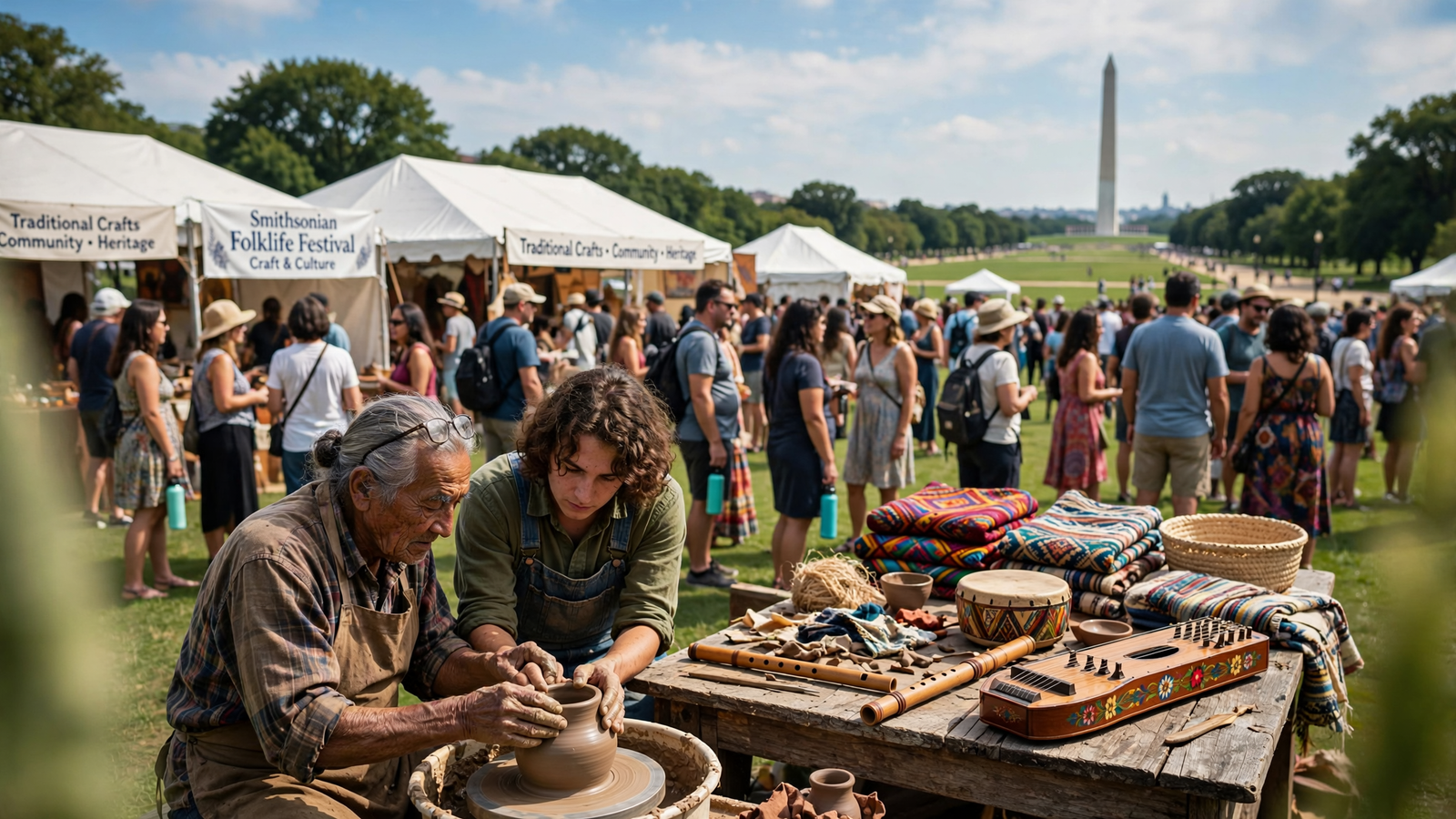
Every summer, the National Mall becomes something more than a park between the U.S. Capitol and the Washington Monument. For a few weeks, it can become a kitchen, a workshop, a stage, a farmyard, a dance floor, and a gathering place for traditions that might otherwise remain invisible to most of the country. For related reading, see “Books Build Us”: The Library of Congress Brings the National Book Festival Back to Washington.
That transformation is the work of the Smithsonian Folklife Festival, an annual celebration of cultural knowledge presented by the Smithsonian’s Center for Folklife and Cultural Heritage. Since its beginning in 1967, the festival has brought practitioners of living traditions into public view—not as anonymous examples of “heritage,” but as musicians, artists, cooks, builders, farmers, storytellers, and teachers with their own expertise and authority.
The result is one of the most hopeful ideas in American cultural life: a national institution can make room for people to explain their own traditions, and the public can encounter those traditions through conversation and participation.
A festival built around people, not objects
Museums are often associated with things that have been preserved: paintings, tools, clothing, instruments, manuscripts, and buildings. Those objects matter, but the Smithsonian Folklife Festival began with a different question. What if cultural heritage were presented through the people who practice it?
The festival’s approach treats culture as active knowledge. A song is not only an artifact; it is something learned, adapted, and performed. A recipe is not simply a list of ingredients; it can carry family memory, regional identity, agricultural knowledge, and judgment developed over years. A craft is not merely a finished object; it includes the gestures, materials, stories, and decisions that make the object possible.
This emphasis on living practice gives the festival an unusual atmosphere. Visitors may watch a demonstration, but they can also ask questions. They may hear a performance, but they can also learn what the music means to the people who play it. The central experience is not simply looking at culture. It is meeting people who make, teach, preserve, and change it.
From a national stage to a shared space
The first Festival of American Folklife took place on the National Mall in 1967. It was created during a period when scholars, museums, and public institutions were rethinking what belonged in the national cultural record. Instead of focusing only on elite art or officially recognized history, folklife programs gave greater attention to everyday knowledge and community traditions.
The Smithsonian was well positioned to make that idea visible. The National Mall offered a setting associated with national memory, but the festival filled it with forms of expression that did not always receive space in formal cultural institutions. Performers and craftspeople could represent their communities on their own terms, while visitors from across the country could encounter a wider definition of American creativity.
Over time, the event expanded beyond the United States. International programs brought artists and tradition-bearers from other parts of the world to Washington, placing American traditions in conversation with global ones. The festival was renamed the Smithsonian Folklife Festival in 1988, a change that reflected its broader scope and its understanding of folklife as a field that crosses borders.
The festival has never been a single style of music, one regional cuisine, or one definition of tradition. Its subjects have included communities, countries, occupations, landscapes, belief systems, foodways, artistic practices, and forms of work. That variety is part of the point. Culture does not live in only one place, and no single institution can speak for all of it.
Artists as teachers and experts
One of the festival’s most important contributions is the way it frames artists. Participants are not invited merely to entertain an audience. They are often asked to explain processes, demonstrate techniques, discuss their communities, and show how knowledge is passed from one generation to another.
A musician may be both performer and historian. A basket maker may also be an environmental observer, because the quality of the work depends on understanding plants and seasons. A cook may carry knowledge of migration, trade, religion, and family life in a single dish. A farmer may be preserving a set of ecological practices as well as producing food.
That broader view helps audiences see creativity as part of daily life. The artist is not separated from the community that gives the work meaning. Nor is tradition presented as frozen in the past. Practitioners can honor inherited forms while introducing new materials, new subjects, new collaborations, and new audiences.
This is especially important for traditions that have often been ignored by official cultural histories. The festival’s format creates room for African American, Indigenous, immigrant, rural, working-class, and regional communities to be represented through their own voices and skills. It also makes clear that the United States has never had just one cultural story.
The value of a free public encounter
The festival’s location gives its work unusual reach. The National Mall is not a specialist venue. People arrive for museums, monuments, work, school trips, tourism, or a walk through the city. They may not have planned to attend a cultural program at all. A visitor can come across a performance or demonstration simply by moving through the public landscape.
That accessibility matters. Many cultural experiences require a ticket, a trip, or prior knowledge. The Folklife Festival places artists and audiences in a setting that is open and highly visible. The encounter can be brief or sustained. Someone may stop for a song, return for a cooking demonstration, or spend an afternoon learning about a community whose history was previously unfamiliar.
The festival also changes the meaning of the National Mall. The Mall is often used as a symbol of government, protest, ceremony, and national power. During the festival, it becomes a place where national identity is explored through ordinary acts of making and remembering. A country’s culture is shown not only in monuments and official speeches, but in the hands of people repairing, carving, singing, weaving, cooking, and teaching.
Tradition is not the opposite of change
The word “traditional” can sometimes suggest something unchanging. The Smithsonian’s folklife work offers a more useful definition. A tradition survives because people continue to use it, interpret it, and find meaning in it. That means change is not necessarily a threat to tradition. It can be evidence that a tradition remains alive.
Festival participants may adapt old forms to new circumstances. Younger artists may learn from elders while developing styles of their own. Communities may use familiar music, food, craft, or storytelling to discuss contemporary concerns. A tradition can remain recognizable without remaining identical.
This understanding also avoids treating communities as museum pieces. The people represented at the festival are not symbols of a vanished past. They are participants in the present. Their practices can be connected to work, family, faith, migration, technology, climate, education, and political life. The festival gives audiences a chance to encounter culture as an ongoing process rather than a finished exhibit.
A national institution that makes room
The Smithsonian Folklife Festival does not solve every problem faced by artists or traditional practitioners. A few weeks on the Mall cannot replace long-term support, fair compensation, community control, or access to venues and education. But the festival demonstrates what a public cultural institution can do well: create a platform, provide resources, invite serious attention, and allow knowledge to travel.
Its strongest achievement may be simple. It tells visitors that expertise is widely distributed. Knowledge does not belong only to universities, conservatories, galleries, or government offices. It is also held by people who learned from parents, grandparents, neighbors, apprenticeships, landscapes, workplaces, congregations, and years of practice.
That message is good news because it expands the circle of people whose creativity counts. It invites audiences to be curious without requiring them to be experts. And it gives artists a public setting in which their work can be understood as more than performance or decoration—as a form of memory, instruction, identity, and community life.
For more than fifty years, the festival has made the nation’s symbolic front yard into a place of cultural exchange. Its temporary stages and workspaces disappear after each season, but the larger idea remains: a country becomes richer when its people are given room to show one another how they make meaning.
Use: Background on the Smithsonian Folklife Festival, its purpose, public programming, and history.
Use: Institutional reporting and context on folklife, cultural practitioners, and the festival’s programs.
Use: Authoritative information about the Smithsonian center’s mission and folklife research.
Use: Additional authoritative context on folklife as community-based cultural knowledge and practice.
Smithsonian Center for Folklife and Cultural Heritage — About the Festival — https://festival.si.edu/about — Background on the Smithsonian Folklife Festival, its purpose, public programming, and history.
Smithsonian Center for Folklife and Cultural Heritage — Folklife Magazine — https://folklife.si.edu/magazine — Institutional reporting and context on folklife, cultural practitioners, and the festival’s programs.
Smithsonian Institution — Center for Folklife and Cultural Heritage — https://www.si.edu/folklife — Authoritative information about the Smithsonian center’s mission and folklife research.
Library of Congress — American Folklife Center — https://www.loc.gov/folklife/ — Additional authoritative context on folklife as community-based cultural knowledge and practice.