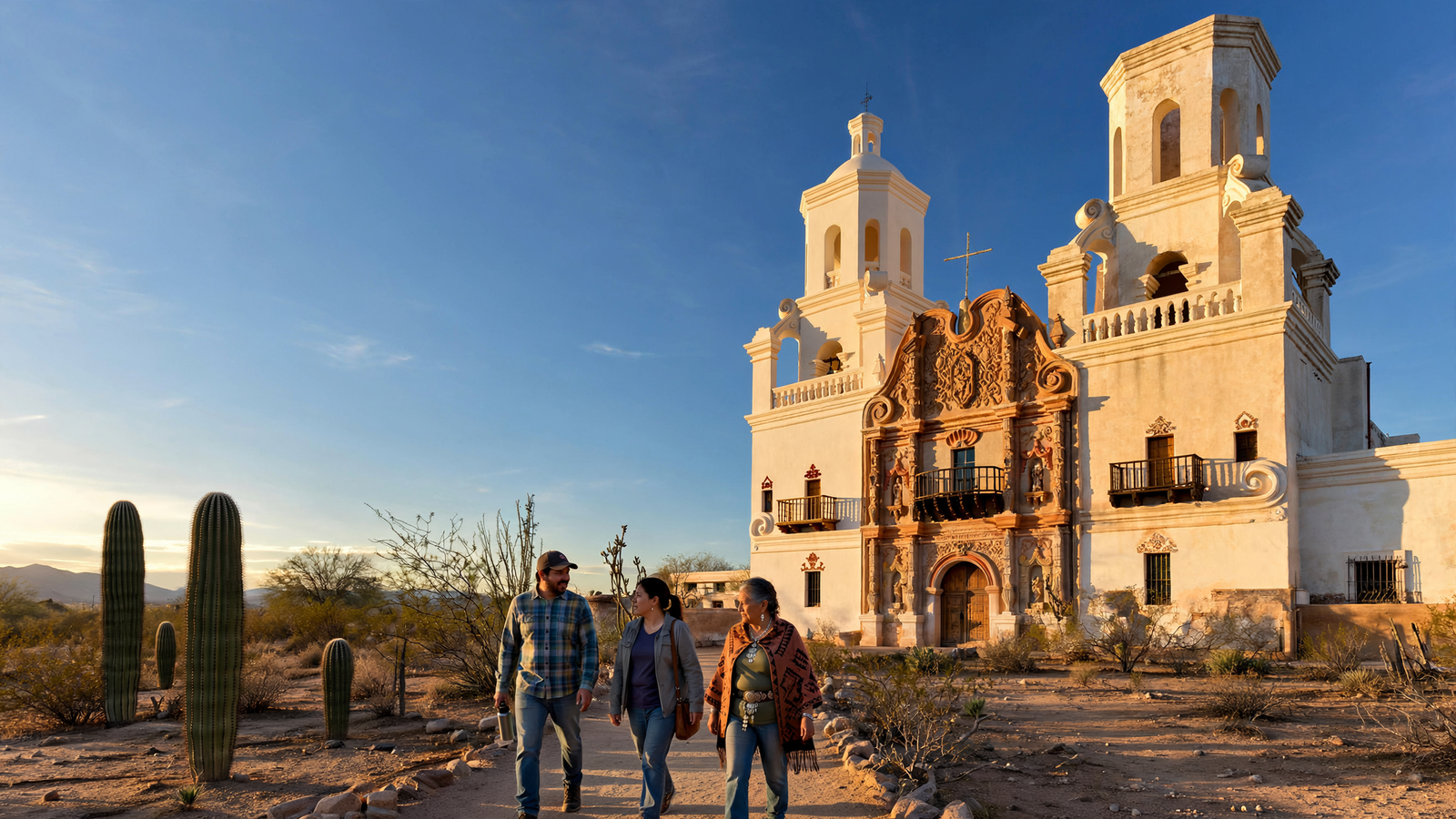
South of Tucson, where the Santa Cruz River crosses the Sonoran Desert, a white church rises above the surrounding landscape with an almost improbable richness. Its towers are shaped with scrolls, saints and carved ornament. Its interior glows with painted figures and gilded details. Against the desert’s muted browns and greens, San Xavier del Bac seems at first like a European building placed far from its original world. For related reading, see Tuzigoot National Monument: How a Verde Valley Hilltop Keeps an Ancient Community in View.
But the mission’s story is not simply the story of a church carried into Arizona. San Xavier del Bac stands on the land of the Wa:k community, part of the Tohono O’odham Nation. It remains an active Catholic parish and a place where O’odham life, Spanish colonial history, Mexican history and the history of the United States continue to meet. For related reading, see Prescott’s Historic Neighborhoods: How an Arizona Town Keeps Everyday Places Alive.
That continuity is what makes San Xavier one of Arizona’s most important historic places. Its architecture draws visitors, but its living community gives the site its deeper meaning.
A place with a history older than the mission
San Xavier del Bac was established in a landscape already shaped by generations of O’odham life. The Santa Cruz River valley offered water, fertile ground and a natural corridor through the desert. O’odham communities farmed in the region, cultivating crops such as corn, beans and squash and maintaining social and cultural connections across what is now southern Arizona and northern Sonora.
The mission’s name reflects the period when Spanish Catholic missionaries entered that landscape. Jesuit missionary Eusebio Francisco Kino visited Bac in the late seventeenth century, and a mission presence developed there around the beginning of the eighteenth century. The mission was dedicated to Saint Francis Xavier, the sixteenth-century Jesuit missionary whose name became attached to many Catholic institutions around the world.
Missionization was not a simple exchange of beliefs or customs. It brought new religious institutions and colonial authority into an established Indigenous world. O’odham people adopted, adapted and sometimes resisted elements of the mission system, while continuing to live in their own communities and maintain their own identity.
That layered history is easy to lose when visitors focus only on the church’s beauty. San Xavier is best understood not as an isolated Spanish monument, but as a place where a long O’odham presence continues through and beyond the colonial structure.
The church that visitors see today
The present church was built in the late eighteenth century, during the period when the Franciscan order took over many missions after the expulsion of the Jesuits from Spanish territories. Construction began in 1783 and was completed in 1797, according to the National Park Service.
The building is made primarily of adobe, a practical material for the desert and one that has required continuing care. Its exterior combines a straightforward mission plan with a highly elaborate decorative vocabulary. Domes, towers and carved details give the church a distinctive silhouette, while the interior contains sculpture and paintings associated with the artistic traditions of northern New Spain.
Much of the church’s visual power comes from contrast. Its exterior is pale and sculptural, with ornament concentrated around entrances and towers. Inside, the walls and altars are crowded with color. Religious figures, floral patterns and architectural details create an enclosed world that feels more theatrical than the surrounding desert.
The result is often described as one of the finest examples of Spanish Colonial architecture in the United States. That description is useful, but incomplete. The church was created in a specific borderlands setting, using local labor and materials and serving a community whose history did not begin with Spanish arrival.
From Spanish frontier to American territory
San Xavier survived several changes in political power. When Mexico became independent from Spain in 1821, the mission entered a new national system. After the United States acquired much of present-day southern Arizona through the Gadsden Purchase in 1853, San Xavier became part of an American territory.
Those political transitions changed the institutions surrounding the mission, but they did not erase the community that sustained it. The church remained a place of worship, ceremony and gathering. Its history is therefore different from that of a ruined settlement or a museum building preserved after its original use ended.
San Xavier is often called the “White Dove of the Desert,” a nickname inspired by its pale exterior. The phrase captures the building’s visual presence, but the mission’s survival depended on less poetic forms of work: repairing adobe, protecting painted surfaces, maintaining the roof and caring for a structure exposed to intense sun, seasonal rain and long-term material decay.
Preservation as a continuing responsibility
By the twentieth century, the church required serious conservation. Earlier repairs had sometimes used materials that did not behave well with historic adobe. Modern preservation efforts have increasingly emphasized careful research, compatible materials and attention to the building’s original construction methods.
The nonprofit Patronato San Xavier has played a central role in raising money and supporting conservation. Its work has helped fund specialized restoration of the church’s exterior and interior, including the delicate surfaces that make San Xavier so remarkable. The project is not a single restoration with a final completion date. Historic adobe buildings require regular inspection and repeated intervention.
This approach changes the way visitors might think about authenticity. The goal is not to freeze San Xavier in one imagined moment from the eighteenth century. It is to keep the building safe, legible and useful while respecting the materials, craftsmanship and religious purpose that have carried it across centuries.
Preservation also involves choices about what to show. Layers of paint, repairs and alterations can each tell part of the story. Conservators must decide when to stabilize an existing surface, when to remove damaging material and when to leave evidence of age visible. At San Xavier, the work is especially demanding because the church is both a historic landmark and an active sacred space.
A living mission rather than a finished monument
San Xavier’s continuing religious life distinguishes it from many historic sites. Masses, feast days and community traditions remain part of the place. Visitors may enter as travelers, worshippers, students or neighbors, but the church is not simply a backdrop for tourism.
The surrounding community also keeps the mission connected to O’odham identity. The church’s Catholic tradition and O’odham cultural life are not best understood as mutually exclusive categories. Over generations, the community has made the mission part of its own lived history, even as that history includes the unequal power relationships of colonialism.
That complexity is important. San Xavier can be admired for its artistry without turning colonial history into a romantic story. It can be recognized as a Catholic church without overlooking the Indigenous people whose homeland surrounds it. And it can be protected as an architectural masterpiece without treating it as detached from everyday community life.
Why the place still matters
Arizona has no shortage of spectacular historic landscapes. Some preserve ancient settlements; others interpret mining, ranching or territorial government. San Xavier offers something different: a place where the past has not been separated from the present.
The church’s survival shows what can happen when preservation is connected to use. The building remains meaningful because people continue to worship there, care for it and interpret it through their own experience. Its adobe walls are historic, but they are not silent. They still enclose music, prayer, ceremonies, maintenance work and the daily decisions required to keep an old place alive.
For visitors, the most rewarding approach is to look beyond the famous facade. Notice the church’s setting in the Santa Cruz valley. Consider the O’odham history that predates the mission. Pay attention to the evidence of craftsmanship and repair. Remember that the building is not an abandoned relic but part of a community with its own present-day life.
San Xavier del Bac endures because several histories remain visible in one place. The mission is an architectural treasure, a record of colonial borderlands and a living O’odham community. Its greatest lesson may be that historic preservation is not only about saving buildings from the past. It is also about making room for the people and traditions that give those buildings meaning now.
Use: Construction history, architectural context and the mission’s historical development.
Use: Authoritative background on the mission corridor, Indigenous history and Spanish colonial sites in southern Arizona.
Use: Current mission identity, religious activity, visitor information and community context.
Use: Conservation history and ongoing preservation work at the church.
National Park Service — Tumacácori National Historical Park, San Xavier del Bac — https://www.nps.gov/tuma/learn/historyculture/san-xavier-del-bac.htm — Construction history, architectural context and the mission’s historical development.
National Park Service — Tumacácori National Historical Park — https://www.nps.gov/tuma/index.htm — Authoritative background on the mission corridor, Indigenous history and Spanish colonial sites in southern Arizona.
San Xavier del Bac Mission — https://sanxaviermission.org/ — Current mission identity, religious activity, visitor information and community context.
Patronato San Xavier — https://patronatosanxavier.org/ — Conservation history and ongoing preservation work at the church.