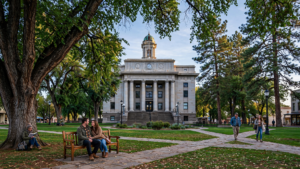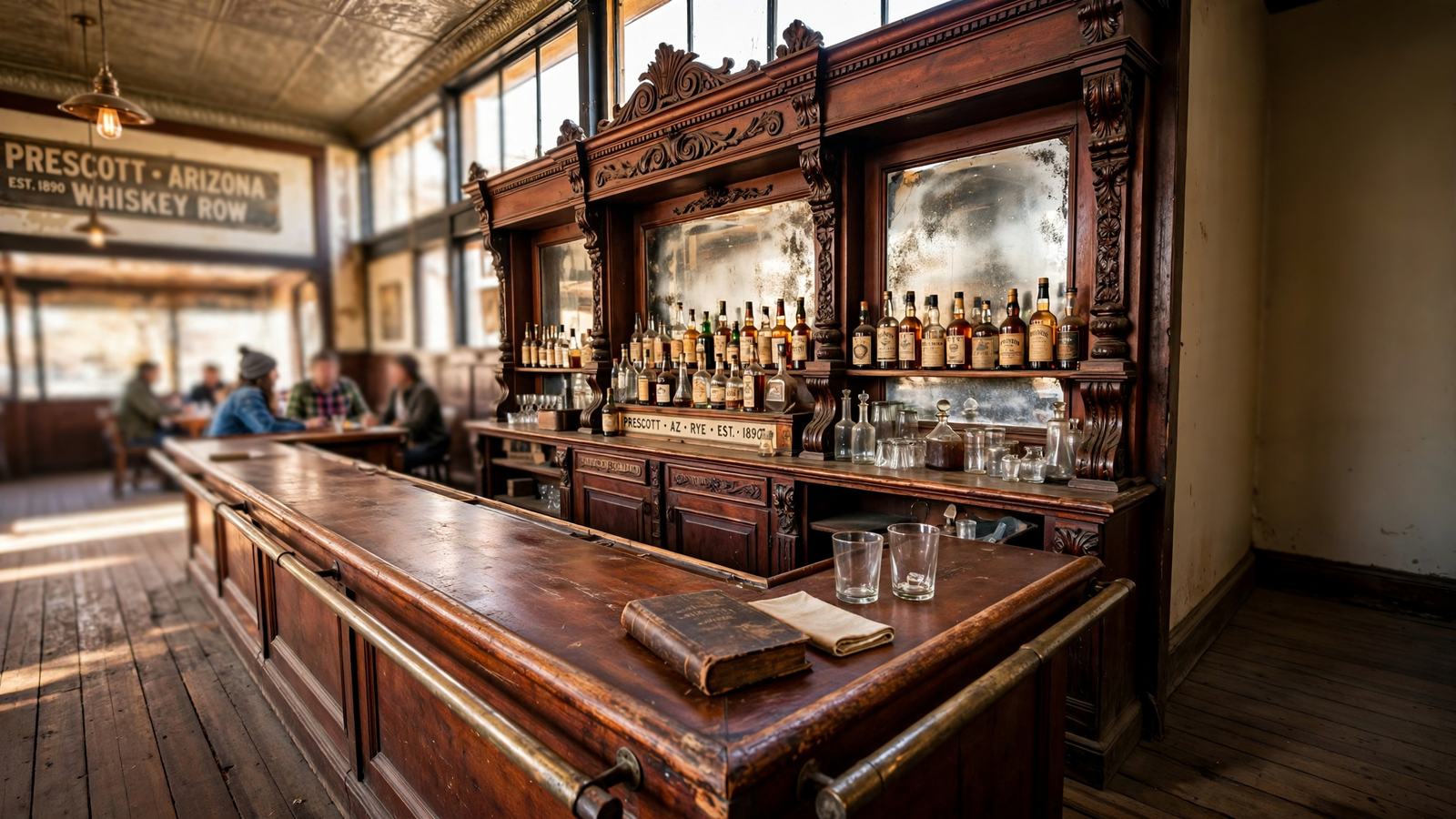
In Prescott, history is often easiest to find at street level. It is in the courthouse lawn, the brick sidewalks, the storefronts along Montezuma Street—and in the dark wood of a bar that has watched the town change around it.
The Palace Restaurant and Saloon has stood on Whiskey Row since the late nineteenth century. Today, it is a restaurant, bar, and gathering place. Its continued life offers a different way to understand historic preservation: not as the act of sealing a building away from the present, but as the work of allowing an old place to keep serving people.
That distinction matters in Prescott. The city’s historic identity is not confined to museums or plaques. It is woven into businesses that still open their doors, serve meals, welcome visitors, and give residents a reason to return. The Palace is one of the clearest examples.
A saloon on a frontier town’s main street
The Palace traces its history to 1877, when Prescott was still a young Arizona community and the territory’s population was growing around mining, military activity, commerce, and government. The town had already served as the territorial capital, and its central streets were becoming the place where different parts of frontier life met.
A saloon in that setting was more than a place to order a drink. It could be a restaurant, meeting point, news exchange, and informal waiting room. People came downtown to conduct business, visit the courthouse, shop, find lodging, or meet friends. Establishments along Montezuma Street benefited from that constant movement.
The Palace became part of this commercial strip, later known as Whiskey Row. The nickname helped turn a group of businesses into a recognizable civic landscape, but the street’s importance was broader than its reputation. It was one of Prescott’s public rooms—a compact downtown where local business and social life overlapped. For related reading, see Watson Woods: How a Prescott Creek Became a Living Room for Wildlife and Neighbors.
That role helps explain why the building’s story has remained important. The Palace is not significant only because it is old. It is significant because it has continued to occupy the same kind of social position: a place where a visitor can encounter the town through an ordinary activity such as sitting down for lunch or meeting someone at the bar.
The fire that reshaped downtown
Prescott’s history includes a dramatic reminder of how fragile a western town could be. In July 1900, a major fire swept through downtown, destroying much of the business district. The disaster changed Prescott’s streetscape and led to rebuilding in more durable materials, including brick and stone.
The Palace is closely associated with the fire because of the effort to save its substantial wooden bar. According to the establishment’s own historical account and local descriptions of Whiskey Row, the bar was carried out of the building during the emergency and later returned. The story has become one of the best-known pieces of Prescott folklore—not because it erases the destruction, but because it shows how strongly people valued a familiar public place.
After the fire, Prescott rebuilt its commercial center. The new buildings helped create the architectural character visitors recognize today: substantial façades, closely spaced storefronts, and a downtown designed for walking. The Palace remained part of that renewed streetscape.
There is a useful lesson in that sequence. Historic places are rarely preserved by avoiding change. They survive because communities repair them, adapt them, and decide that they still belong in everyday life. The Palace’s story follows that pattern. A business associated with an earlier era endured by becoming part of the next one.
Beyond the mythology of Whiskey Row
Whiskey Row is an appealing name, but it can also reduce a complicated place to a simple western image. The history of downtown Prescott includes saloons and miners, certainly, but it also includes merchants, workers, families, government employees, travelers, Indigenous communities, and people whose lives did not fit the popular frontier script.
The Palace is most interesting when viewed in that wider setting. Its value is not that it recreates an imaginary Old West. Its value is that it connects a contemporary downtown to the many ordinary uses that have always made central streets matter. For related reading, see The Oxford English Dictionary: How Millions of Words Became a History of Language.
A restaurant is a particularly effective form of preservation because it asks a historic building to remain social. Visitors do not need specialized knowledge to enter. They can come for a meal, notice the old bar, look at the photographs and woodwork, and begin asking questions. The building becomes an introduction rather than an endpoint.
That accessibility also keeps the past from becoming purely decorative. The Palace’s history is visible, but it is not separated from the present. A person sitting at the bar is participating in the building’s continuing use, not simply observing an artifact behind glass.
A place that still works as a place
Historic downtowns often face a difficult balance. They must attract visitors without becoming stage sets, and they must support local businesses without losing the features that make them distinctive. The Palace illustrates one way that balance can work.
Its historic identity is part of the experience, but the building remains a functioning business. It has to accommodate meals, conversations, staff, deliveries, maintenance, changing expectations, and the practical demands of a modern town. That daily work is easy to overlook, yet it is what keeps preservation from becoming merely visual.
The same principle can be seen across Prescott’s central district. A historic storefront matters more when it is occupied. A sidewalk matters more when people use it. A courthouse square becomes meaningful when it continues to host meetings, celebrations, music, and informal encounters. Places gain staying power when their history supports present-day activity. For related reading, see The World’s Oldest Pants: How 3,000-Year-Old Trousers Rewrote the History of Clothing.
The Palace adds an intimate scale to that larger civic picture. The courthouse plaza is public in an obvious way; a restaurant is public through invitation and habit. People gather there in smaller groups, often for reasons that have nothing to do with history. Yet those ordinary visits are precisely what allow history to remain part of the town’s rhythm.
Why the story still belongs to Prescott
Prescott has changed repeatedly since the Palace opened. Transportation has changed, the economy has shifted, and the city’s relationship with tourism has grown. The downtown is no longer the same commercial world that existed in 1877. That is not a failure of authenticity. It is the condition that makes the Palace’s survival meaningful.
A place can remain recognizable without remaining unchanged. The Palace does not need to pretend that Prescott is still a territorial capital or a mining frontier. It can acknowledge those origins while operating in the present, where residents and visitors share the same tables and streets for different reasons.
That continuity is the real discovery on Whiskey Row. The most valuable historic places are not always the grandest buildings or the most carefully interpreted museums. Sometimes they are the ones that continue to perform a familiar civic function: giving people somewhere to meet.
At The Palace, a nineteenth-century saloon became a twentieth-century survivor and remains a twenty-first-century gathering place. Its old bar carries the drama of the 1900 fire, but its deeper story is quieter. Prescott kept making room for the building, and the building kept making room for Prescott.
That is how a historic place stays alive—not by standing apart from the city, but by continuing to belong to it.
Use: Used for the establishment’s 1877 origins, continuing operation, and account of its historic bar and relationship to the 1900 fire.
Use: Used for local context about Whiskey Row, downtown Prescott, and the street’s role as a historic visitor and community destination.
Use: Used as authoritative background for understanding Prescott’s downtown historic character and the preservation context surrounding its commercial district.
The Palace Restaurant and Saloon — official history and visitor information — https://www.thepalaceprescott.com/ — Used for the establishment’s 1877 origins, continuing operation, and account of its historic bar and relationship to the 1900 fire.
City of Prescott — Whiskey Row — https://www.prescott-az.gov/visitors/attractions/whiskey-row/ — Used for local context about Whiskey Row, downtown Prescott, and the street’s role as a historic visitor and community destination.
Prescott National Historic District — National Park Service, National Register of Historic Places — https://www.nps.gov/subjects/nationalregister/index.htm — Used as authoritative background for understanding Prescott’s downtown historic character and the preservation context surrounding its commercial district.