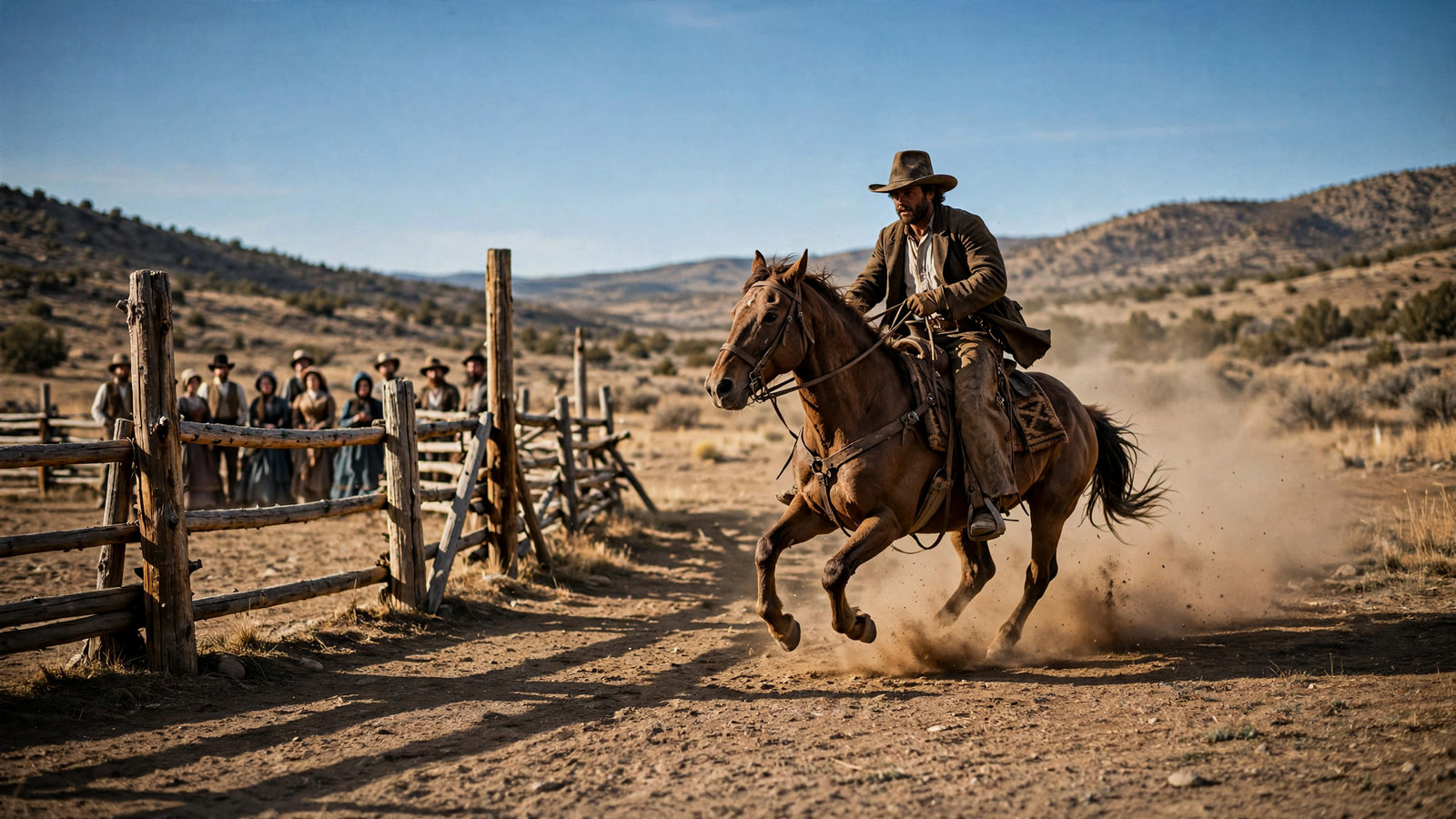
On July 4, 1888, Prescott hosted a contest that would become the starting point of one of its best-known traditions. Prescott Frontier Days dates its first rodeo to that Independence Day gathering. More than a century later, the event still puts Prescott’s frontier-era past in view—not as a museum display, but as a public spectacle shaped by changing ideas of sport, skill and western identity.
The rodeo’s familiar arena events can make it seem as if the sport arrived fully formed. Its beginnings were less tidy. Rodeo grew out of the practical work of handling cattle and horses, and from contests in which ranch workers tested skills they used on the job. Prescott’s 1888 event belongs to that transition: work associated with ranch life was becoming something people could gather to watch.
From working skills to a public contest
In the late 19th century, ranching was part of life across the American West. Managing livestock required horsemanship, control and quick decisions. Communities also held celebrations and gatherings where people could compete, watch demonstrations and spend time together. Over time, contests rooted in these skills developed into rodeos, with rules, scheduled performances and paying audiences.
That history matters because “the first rodeo” is difficult to define. Informal contests and demonstrations took place in different communities, and the events did not all use the same name or format. Prescott Frontier Days identifies its 1888 gathering as the beginning of its own rodeo. The more careful historical claim is that Prescott has a notably early record for an organized rodeo tradition—not that no cowboy contest happened anywhere before it.
Prescott was then a young Arizona Territory community, and public celebrations offered a way to bring people together. A Fourth of July date gave the contest an obvious place in the civic calendar. What began as a local event acquired a lasting identity: a celebration tied both to national Independence Day and to the regional culture of ranching and horsemanship.
Why Prescott’s claim lasts
Prescott Frontier Days promotes the event as the “World’s Oldest Rodeo.” The title rests on the longevity of its organized rodeo tradition, rather than on a claim that rodeo-like contests began nowhere else. That distinction is useful. The history of rodeo developed in many western communities, while Prescott’s particular story is about an event that has continued to connect generations of residents and visitors with the region’s past.
Continuity does not mean the event has remained unchanged. Rodeo developed into a regulated sport, with defined events and professional competitors. Modern programs include contests such as bronc riding, roping and barrel racing. Their arena presentation is different from everyday ranch work, even as the events draw on skills and traditions associated with it.
That shift—from practical skill to organized competition—is part of the broader story of rodeo. A contest can preserve a recognizable connection to working life while also becoming entertainment. The arena turns individual abilities into a public test, with rules and a crowd. It also gives a community a recurring occasion to tell stories about its own history.
A tradition that keeps changing
Rodeo history is sometimes told as a simple celebration of the Old West. A fuller account leaves room for change. The sport’s formats and audiences have evolved, and the meaning of western heritage is not fixed. Prescott’s rodeo can be both a historical tradition and a modern event—one that invites people to consider which parts of the past are being remembered and how.
The annual gathering also makes history tangible. Visitors do not need to picture an abstract frontier; they can see skilled riders and ropers compete in a contemporary arena. That is not the same as recreating ranch life in 1888. Rather, it shows how a community has carried forward a set of skills and an event identity while adapting them for a new era.
Prescott’s claim to rodeo longevity is compelling precisely when stated carefully. The town’s rodeo traces its organized beginnings to July 4, 1888, while the wider sport grew from practices and contests across the West. Together, those histories explain how a local celebration became a durable tradition—and why the rodeo remains one of the most visible ways Prescott connects its present-day community to its territorial past.